DE
DE  EN
EN Runtime and uptime visibility
See when endpoints are powered on, where runtime accumulates and which time windows create the biggest optimization potential.

Platform reporting
Auto Shutdown Manager by EnviProt turns endpoint runtime, shutdown and wake data into practical reports for IT operations, energy management and business-case validation.
From policy to proof
Power management only becomes credible when IT can show runtime, cost, energy and environmental impact with data. ASDM reporting connects endpoint telemetry with the shutdown and wake decisions that created the result.
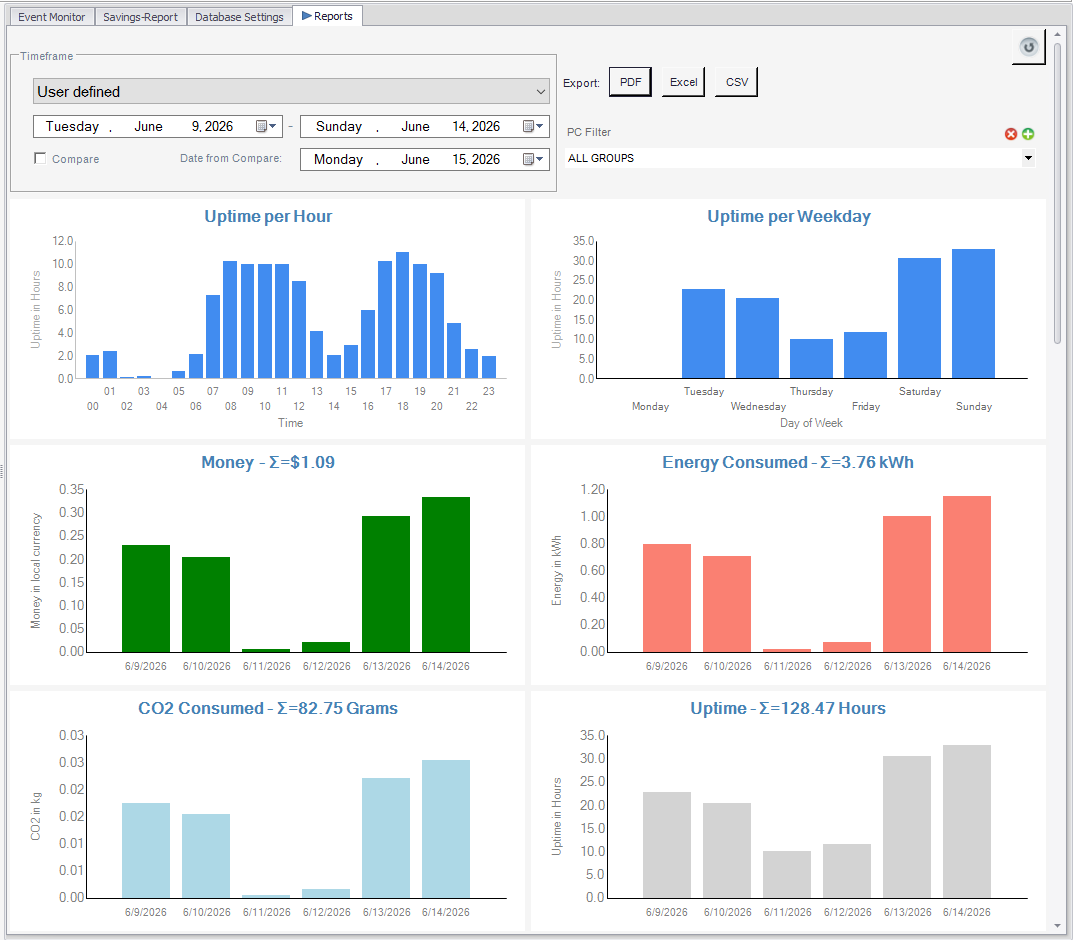
See when endpoints are powered on, where runtime accumulates and which time windows create the biggest optimization potential.
Translate runtime into electricity cost, energy consumption and estimated CO₂ output based on configured values and available telemetry.
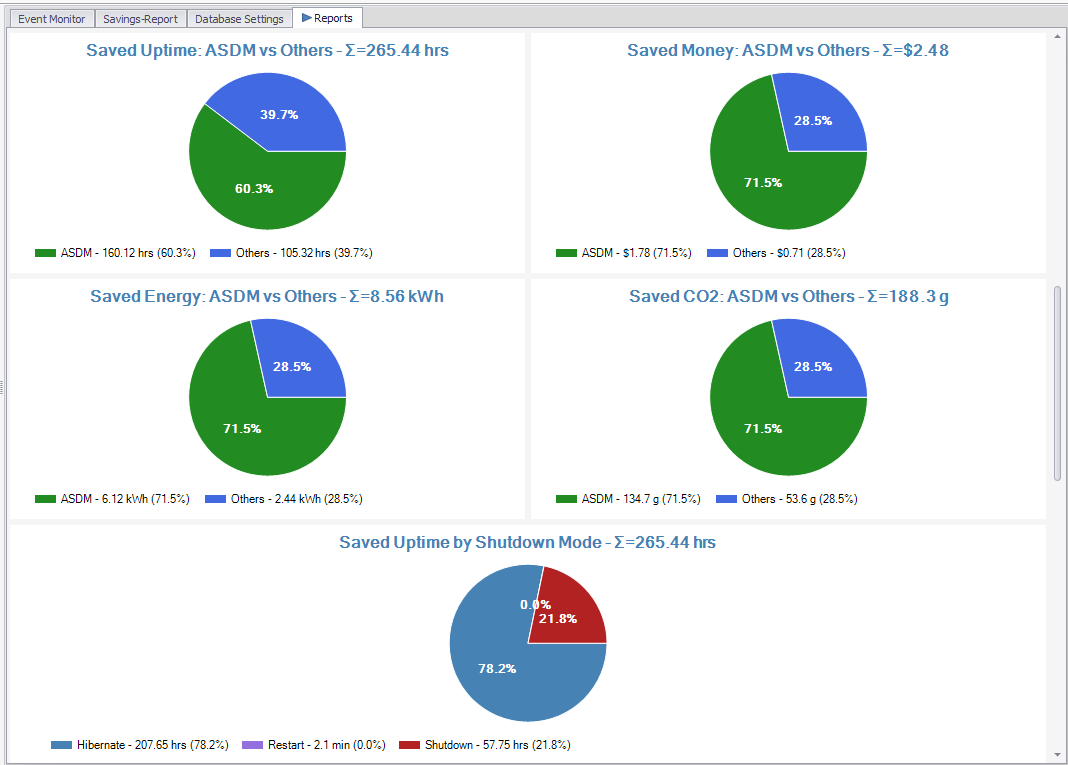
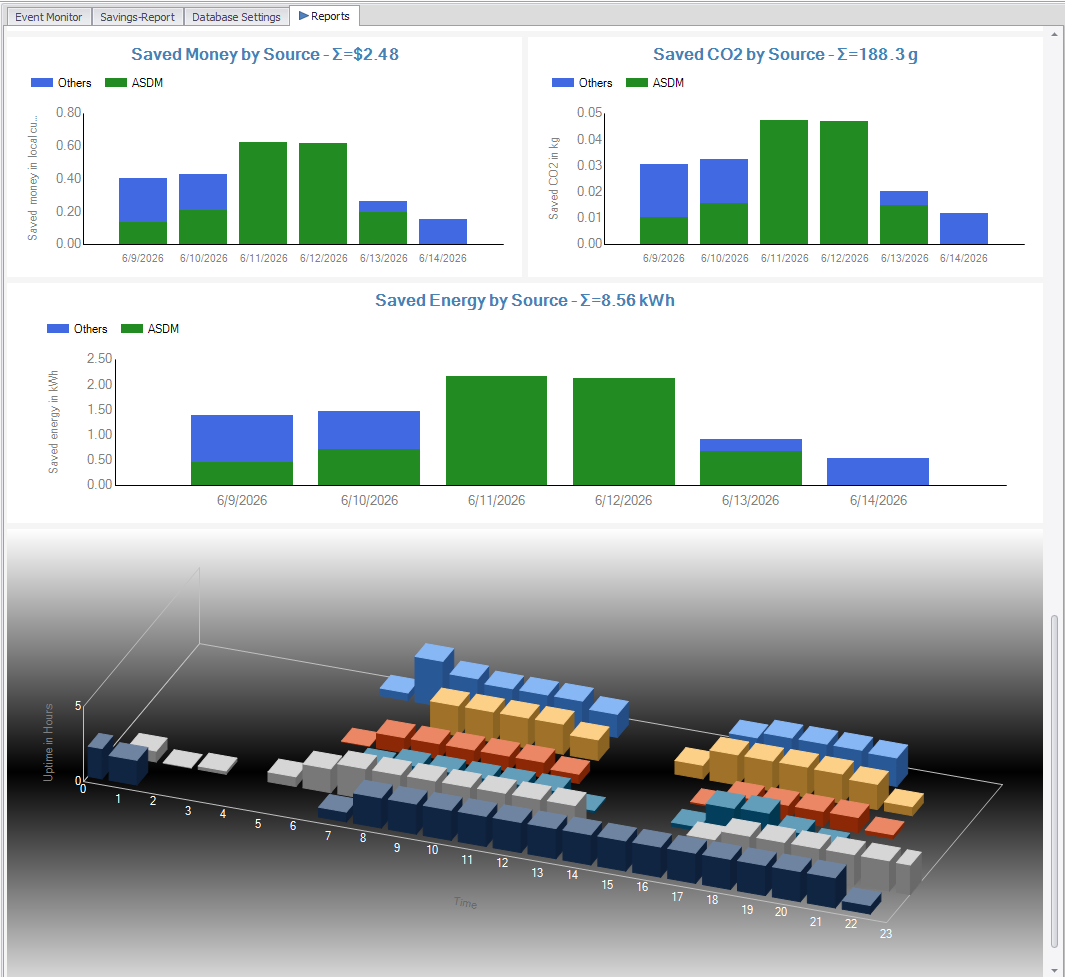
Break down savings by shutdown source, including ASDM-triggered actions and other shutdown sources, so the result can be explained.
Product proof
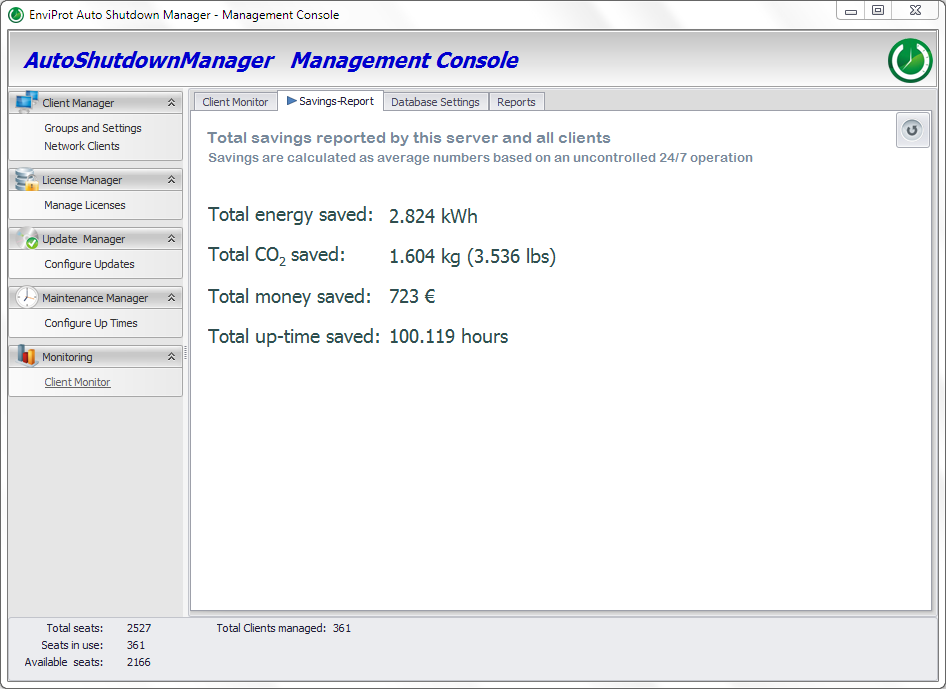
The reporting tab can visualize uptime by hour and weekday, money, energy, CO₂ and saved uptime. Exports are available for PDF, Excel and CSV where reporting is configured.


Why dedicated reporting matters
ASDM reporting is designed to support IT troubleshooting and business communication without turning the power-management project into a spreadsheet exercise.
Use cases
The same data can answer different questions depending on who is looking at the power-management project.
Find runtime patterns, validate policies and identify groups that still run longer than expected.
Track progress of rollout, policy tuning and endpoint availability across larger environments.
Review estimated cost impact and compare documented savings against license and rollout decisions.
Use kWh and estimated CO₂ data as supporting evidence for Green IT, ESG-related reporting inputs and energy-management initiatives.
Claim-safe reporting
ASDM does not promise the same savings for every organization. Results depend on device population, configured policies, user behaviour, energy prices, calculation assumptions and the reporting period. The right promise is simple: measure, tune, validate and document.
FAQ
No. Savings must be measured in the actual environment. ASDM helps document runtime, energy and estimated CO₂ impact so the project can be validated with real data.
Yes, reports can be used with group and PC filters where reporting data is available, helping IT compare pilots, departments, sites or policy groups.
The reporting UI supports export options such as PDF, Excel and CSV, making it easier to share data with IT leadership, finance or sustainability teams.
CO₂ values are estimates based on configured emission factors and measured or calculated energy consumption. They should be treated as reporting support, not as a universal certification value.
ASDM is not a CSRD compliance system. It can provide supporting endpoint runtime, energy and estimated CO₂ data that may help internal Green IT, ESG or CSRD-related reporting workflows, depending on your reporting scope and calculation assumptions.
Prove the savings
Start with a controlled pilot, review uptime and energy data, then use reporting to decide which policies are ready to scale.
Platform · Modern Standby / S0 Handling
Modern Standby (S0) changes how Windows devices sleep, wake and behave with external displays. Our Auto Shutdown Manager helps IT teams manage this reality with hibernation logic, scheduled wake support and monitor DDC/CI handling for supported external displays.
Why Modern Standby is different
With Modern Standby, many Windows 10/11 laptops and compact PCs no longer use classic S3 sleep in the way IT teams expect. A device may appear idle or asleep while parts of the system remain active. In real operations, this can mean battery drain, heat in a closed laptop bag, missed scheduled maintenance or external monitors left running during unattended runtime.
S0 devices can continue consuming power after the screen turns off, especially on mobile devices running on battery.
If a laptop remains active in a closed bag, heat and battery drain become an operational support issue.
Scheduled wake events may not behave like classic wake timers on every Modern Standby system.
External monitors can become part of the power-management problem when PCs run unattended.
ASDM approach
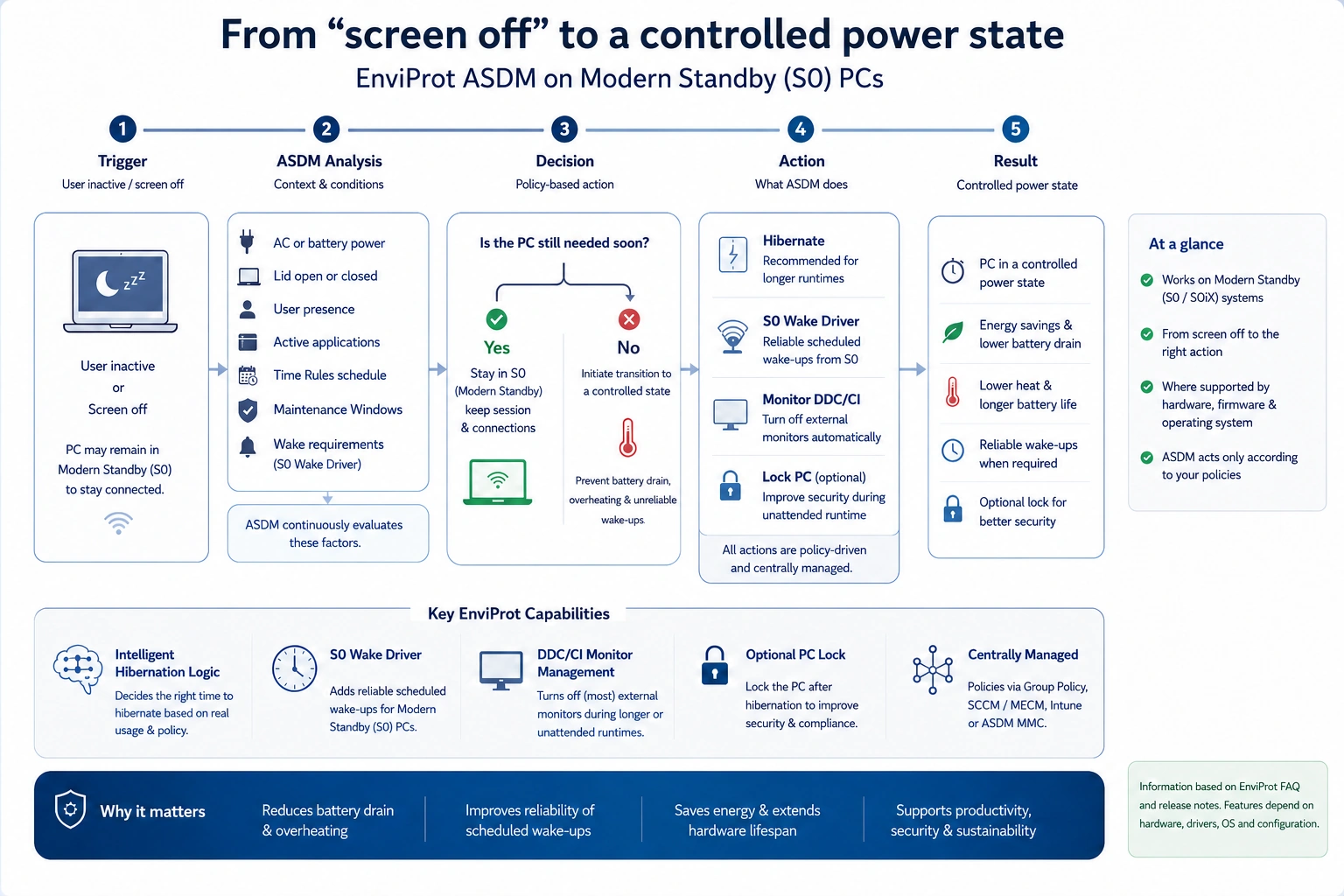
Modern Standby is not solved by a single checkbox. ASDM combines endpoint power policy, the S0 Wake Driver add-on and newer external monitor DDC/CI handling so IT can control what happens before, during and after unattended runtime.
For S0-capable systems, ASDM can use configured timers and policies to move from Modern Standby into hibernation where appropriate, helping reduce battery drain and heat risk.
The optional add-on helps scheduled wake events created by ASDM run more reliably on many Modern Standby systems where classic wake behavior is limited.
For S0-based PCs with supported external monitors, ASDM can use DDC/CI to turn external monitors off and on, and optionally lock the PC for improved energy savings and security.
Operational process
Modern Standby can leave a PC technically connected while still consuming power, producing heat and behaving differently from classic sleep. ASDM checks policy, user presence, work context, time rules and wake requirements before moving the endpoint into the intended state.
Guardrail
ASDM can help control S0 runtime, hibernation, scheduled wake and external monitor handling where the Windows device, monitor and driver environment support the required actions. Validate the behavior on the target hardware before broad rollout.
S0 Wake Driver
Classic wake timers do not behave consistently across every S0-based device. The EnviProt S0 Wake Driver is an add-on for Auto Shutdown Manager environments where scheduled wake from Modern Standby or hibernation needs to be made more dependable.
The optional EnviProt S0 Wake Driver supports scheduled wake events on suitable Modern Standby/S0 devices. Availability and the current package are listed centrally in the downloads area.
After installation, administrators can configure ASDM Time Rules and wake planning as usual, then validate the behavior on their target hardware.
Important condition
The S0 Wake Driver can help with scheduled wake reliability, but every device model should be tested. BIOS/UEFI settings, Windows power policy, device firmware and driver behaviour can all affect the final result.
Newer capability: external monitors
Recent ASDM releases add monitor DDC/CI management for S0-based PCs and Modern Standby PCs with external monitors. Where the monitor and graphics path support DDC/CI, ASDM can turn most external monitors off automatically during longer or unattended runtime, turn them on again, and optionally lock the PC.
Reduce external-display runtime during unattended periods where DDC/CI is available and supported.
Bring supported external displays back when the endpoint needs to be available again.
For unattended runtime, the PC can optionally be locked to support energy savings and security-oriented operating routines.
Terminology note: The correct standard name is DDC/CI — Display Data Channel Command Interface. The feature depends on monitor, graphics adapter, cable and driver support.
Why standard power settings are not enough
Windows power settings are still relevant, but they do not cover the full enterprise process: user work, time rules, hibernation fallback, wake reliability, external monitors and proof of runtime reduction.
FAQ
Modern Standby, also called S0 low-power idle, is a Windows power model where the system can appear asleep while parts of the device remain active. This differs from classic S3 sleep and can create new operational challenges for IT.
If the device does not fully power down, it can continue consuming power. On mobile devices, this can drain the battery or create heat when a laptop is closed and stored in a bag.
It is an add-on for ASDM environments where scheduled wake events need to work more reliably on Modern Standby systems. Behaviour still depends on the device model, firmware, drivers and Windows power policy.
Not universally. Modern Standby behaviour is highly dependent on hardware and firmware. The S0 Wake Driver can help, but each device model should be validated before broad rollout.
DDC/CI means Display Data Channel Command Interface. Where the monitor, graphics adapter, cable and drivers support it, ASDM can turn external monitors off and on during longer or unattended runtime.
Yes, recent ASDM releases describe an optional PC lock when using DDC/CI monitor management for S0-based PCs with external monitors.
CONTROL S0 INSTEAD OF HOPING IT BEHAVES
Start with a representative pilot group of S0 devices, external monitors and common laptop models. Validate hibernation timing, scheduled wake behaviour, monitor DDC/CI support and user impact before rolling out broadly.
Platform · MECM / SCCM Integration
Microsoft Configuration Manager manages deployments, updates and endpoint operations. Our Auto Shutdown Manager complements it by helping PCs be awake when maintenance or deployments need them — and by returning endpoints to a controlled power state afterwards where configured.
The operational gap
MECM / SCCM can deploy software and updates, but it does not by itself solve the complete endpoint power-management process around those deployments. IT needs endpoints awake before the job starts, protected from avoidable interruption, and returned to the intended power state afterwards.
A deployment window is only useful if the target PCs are actually reachable when the job starts.
Keeping PCs powered on just to be safe increases avoidable runtime, costs and operational exposure.
Wake, shutdown and restart scripts can become fragile when they are not part of a managed power process.
Maintenance actions should avoid interrupting active users, open work or still-running business jobs.
How the integration fits
The ASDM MECM (SCCM) integration is about timing and control: synchronize wake planning with deployment schedules, support on-demand wake and shutdown from the Microsoft Configuration Manager console, and keep the endpoint power state aligned with real IT operations.
Software updates, deployments or maintenance work are planned in Microsoft Configuration Manager.
ASDM can synchronize wake planning with MECM deployment timing for the affected PCs.
Wake-on-LAN, WOL Proxies and ASDM policies help make endpoints available for the work.
After the work is complete, endpoints can return to a configured shutdown, standby or runtime policy.
Process overview
Admins keep using MECM / SCCM for deployment timing and Device Collections. ASDM synchronizes the relevant schedule, creates a wake plan, uses the configured WOL infrastructure and helps target PCs be awake before updates, maintenance or software rollout begin.
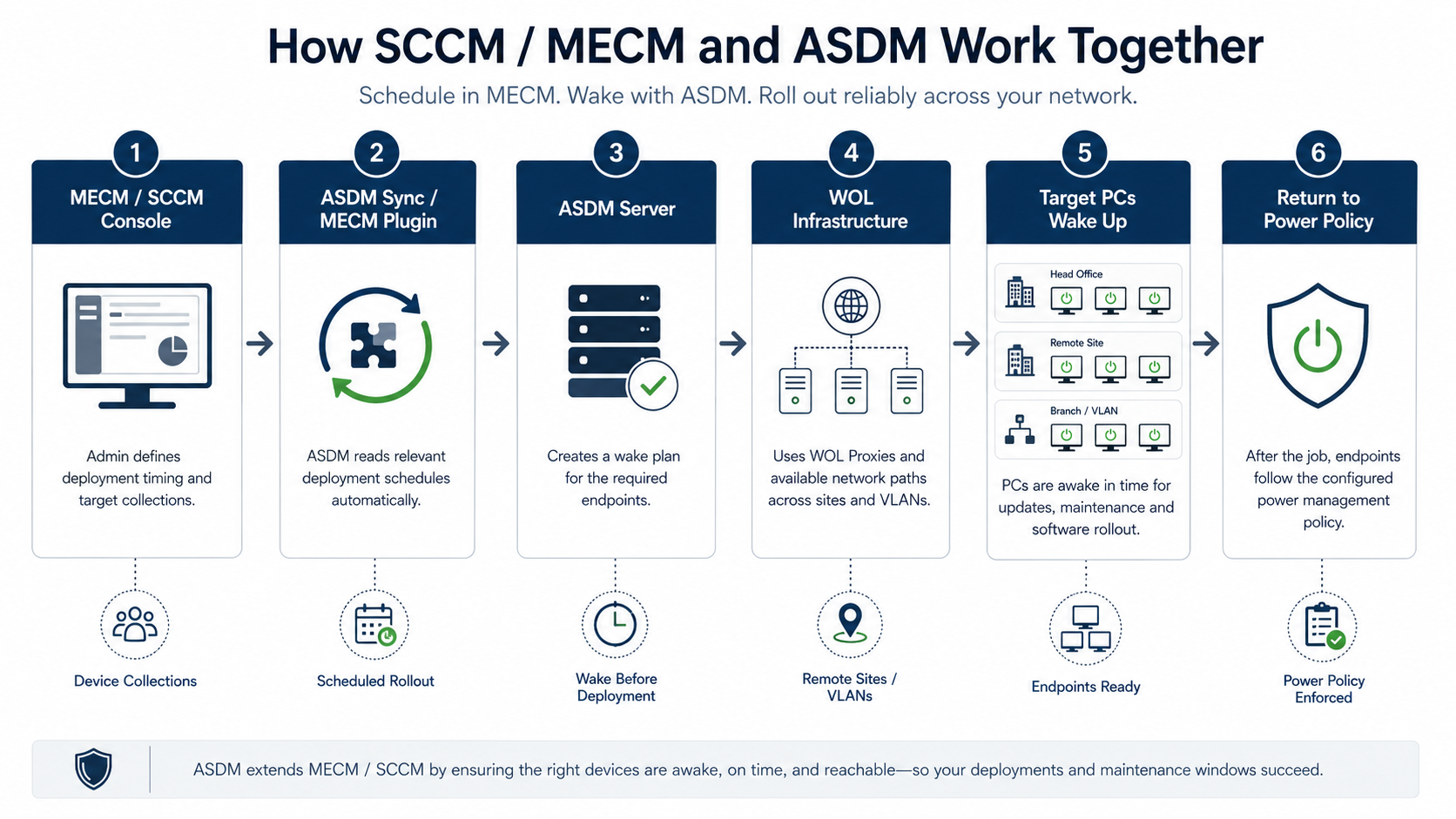
Deployment timing and Device Collections remain in the Microsoft Configuration Manager workflow.
ASDM builds the wake plan and uses configured WOL infrastructure, including WOL Proxies where required.
After the job, endpoints can follow the configured ASDM power policy instead of staying online by habit.
Operational guardrail: Wake reliability still depends on client state, firmware, adapter settings, WOL Proxy placement, routing and firewall rules. Validate the wake path in your own network before relying on broad rollout.
Our MECM (SCCM) integration
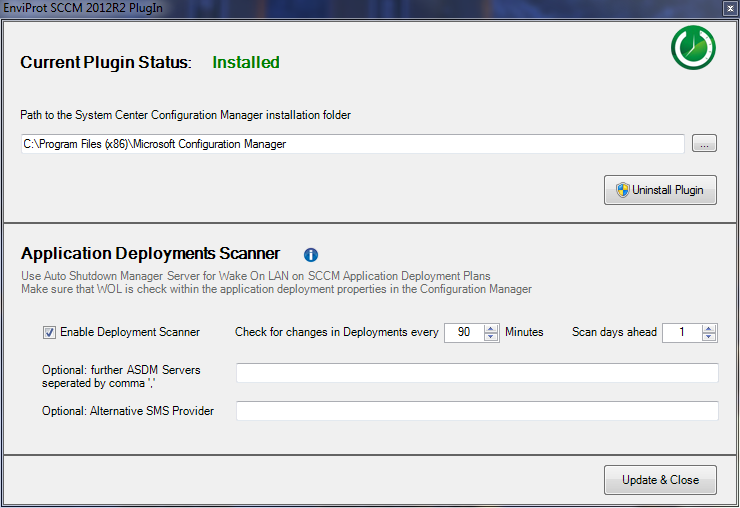
Our MECM (SCCM) plugin supports Microsoft System Center Configuration Manager and Microsoft Endpoint Configuration Manager environments. It synchronizes deployment timing for WOL, provides on-demand wake and shutdown actions in the MECM console, and handles deployments based on Device Collections.
Our MECM (SCCM) plugin supports Configuration Manager environments, including SCCM 2012 R2 and newer.
ASDM can synchronize WOL timing with MECM deployment timing so PCs can be prepared before the maintenance work starts.
ASDM handles deployments based on Device Collections, so it fits into existing Configuration Manager workflows.
Console actions
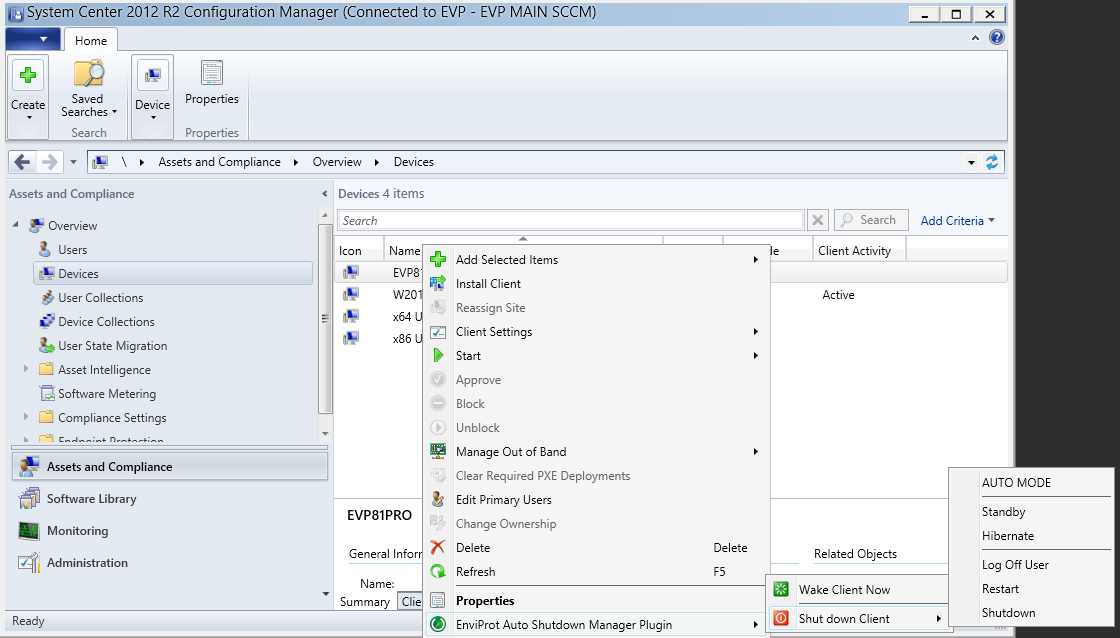
For administrators, the value is not another isolated tool. The integration can expose on-demand wake and shutdown actions in the MECM console context, while ASDM handles the endpoint power logic behind those actions.
Wake selected endpoints when an administrator needs availability for deployment, support or operational work.
Trigger controlled shutdown actions after work is complete, without turning endpoint power management into ad-hoc scripts.
Important positioning
Microsoft Configuration Manager, Intune and Group Policy remain responsible for endpoint management, deployment and policy areas. ASDM focuses on the power and wake process around those tools: when PCs should be awake, when they can shut down, and how endpoint availability can be made operationally reliable.
Where ASDM adds value
This distinction matters. The goal is not to replace Microsoft Configuration Manager, but to remove the power-state friction that can cause deployments, updates and remote work to miss their window.
Product proof
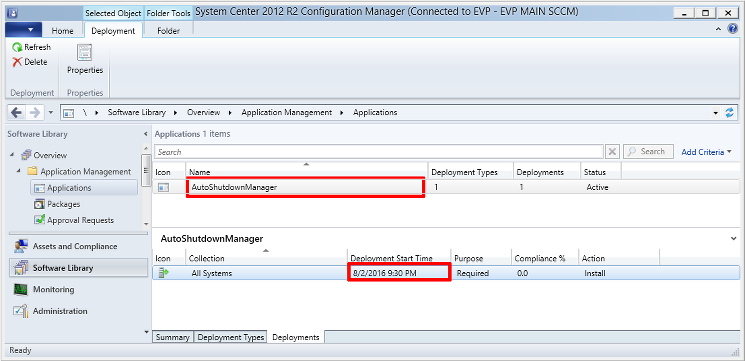
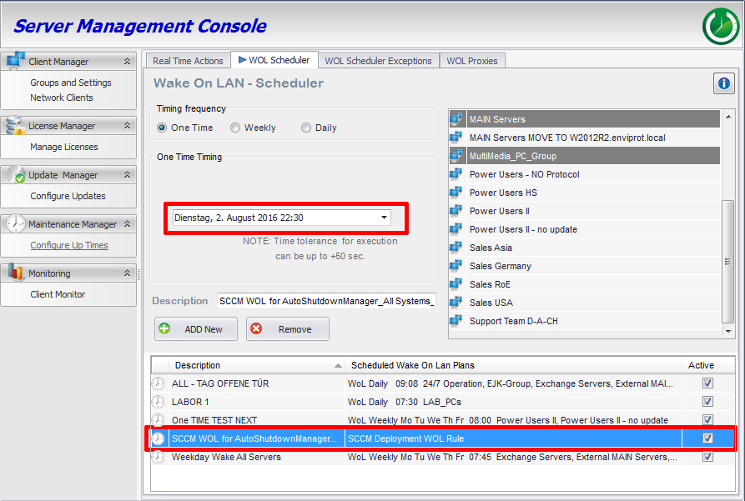
The screenshots below show our MECM (SCCM) plugin in practice: plugin configuration, Configuration Manager console actions, an MCM deployment schedule and the corresponding ASDM WOL Scheduler entry. Together, they show how ASDM works alongside Microsoft Configuration Manager without replacing it.
Terminology
Many IT teams still say SCCM. Microsoft has used names such as System Center Configuration Manager and Microsoft Endpoint Configuration Manager, and today the product is commonly referred to as Microsoft Configuration Manager. This page uses MECM (SCCM) for clarity and also mentions Microsoft Configuration Manager for current terminology.
FAQ
No. ASDM complements Microsoft endpoint-management tools. MECM, Intune and GPO remain responsible for deployment, configuration and policy areas. ASDM focuses on endpoint power state, wake readiness, controlled shutdown and reporting around those tools.
Yes, ASDM can synchronize WOL timing with MECM (SCCM) deployment timing so endpoints can be prepared before software deployments or updates run, where WOL and network conditions support it.
Yes. Our MECM (SCCM) plugin supports on-demand WOL and shutdown actions directly from the Configuration Manager console.
ASDM handles deployments based on Device Collections. Device-based targeting fits the endpoint power-management use case because wake and shutdown actions apply to physical or virtual endpoint devices.
In our current ASDM manual, we document support for Microsoft System Center Configuration Manager / MECM (SCCM) 2012 R2 and newer. Please also validate the exact integration requirements for your MECM environment.
That depends on the configured ASDM policies. Endpoints can remain available, shut down, restart or return to another configured power state where appropriate.
MAKE DEPLOYMENTS POWER-AWARE
Start with a pilot around maintenance windows, deployment timing or wake reliability. Validate how ASDM can keep endpoints available for MECM work while reducing unnecessary runtime outside those windows.
Solutions · Sustainable IT Savings
Auto Shutdown Manager by EnviProt helps organizations reduce avoidable PC runtime while keeping endpoints available for users, remote work, patching, scans and maintenance. The business case is not only the power bill: it also includes less manual IT effort, fewer user interruptions and a more reliable maintenance routine.
The operational savings gap
Many organizations know that PCs remain powered longer than needed. The difficult part is not the idea of shutting them down. The difficult part is doing it without interrupting users, missing maintenance windows, breaking remote access or creating a new pile of scripts and exceptions.
Idle PCs can remain on overnight, over weekends or after shared-device use, even when no operational work is planned.
A power policy that ignores real users, open work, presentations or exceptions can quickly create support tickets and distrust.
Patch windows, scans, backups and administrative work need the right endpoints awake at the right time.
Management and procurement need estimates, reports and a pilot path, not vague claims about “green IT”.
Proof, benchmarks and realistic claims
Energy savings are usually the easiest part of the business case to calculate. Public benchmarks and ASDM case-study material show that the potential can be material, but the final number depends on device count, runtime, electricity cost, hardware, network wake behavior and policy scope.
ENERGY STAR case-study material reports that, for a monitored desktop population, UC Berkeley saved about 80% of what would otherwise have been spent for that group with Auto Shutdown Manager.
EnviProt’s ASDM material describes Mesquite Independent School District managing power and updates across 8,500 PCs on 47 campuses, including scheduled wake for updates.
ASDM case-study material for Osnabrück University describes a deployment for more than 120 PCs and a short payback period in that specific environment.
ASDM case-study material for Kliniken Essen-Mitte describes a hospital setting with around 800 PCs and the need to reduce consumption without disrupting clinical workflows.
How to read “up to 80%”
“Up to 80%” is a useful proof point when tied to documented scenarios. It should not be presented as a guaranteed result for every customer. The responsible message is: estimate, pilot, measure and validate in your own environment.
External benchmark context
External energy-efficiency material gives useful context, but it is not a substitute for a local pilot. Use these figures as benchmark orientation and then validate the actual savings in your organization.
ENERGY STAR states that enabling power management on a certified desktop computer can save an office or home office about $15 per year.
EPA office power-management material has described potential savings of $25–$75 per computer annually from using standby and hibernate features.
Lower endpoint runtime can also reduce heat output and cooling load in some environments. Treat this as a supporting benefit unless you measure it locally.
Beyond the power bill
Electricity costs are measurable. IT time and employee interruptions are harder to convert into a clean number, but they are part of the business case. Central power control helps IT avoid manual workarounds while keeping maintenance and user productivity in view.
IT can wake, shut down, restart or return selected endpoints to policy without asking someone on-site to press a power button or check a machine.
Updates, scans and scheduled maintenance can run outside working hours where wake, network and policy conditions are validated.
When heavy scans and patching run at better times, employees are less likely to be slowed down by background maintenance during productive work.
Visual summary
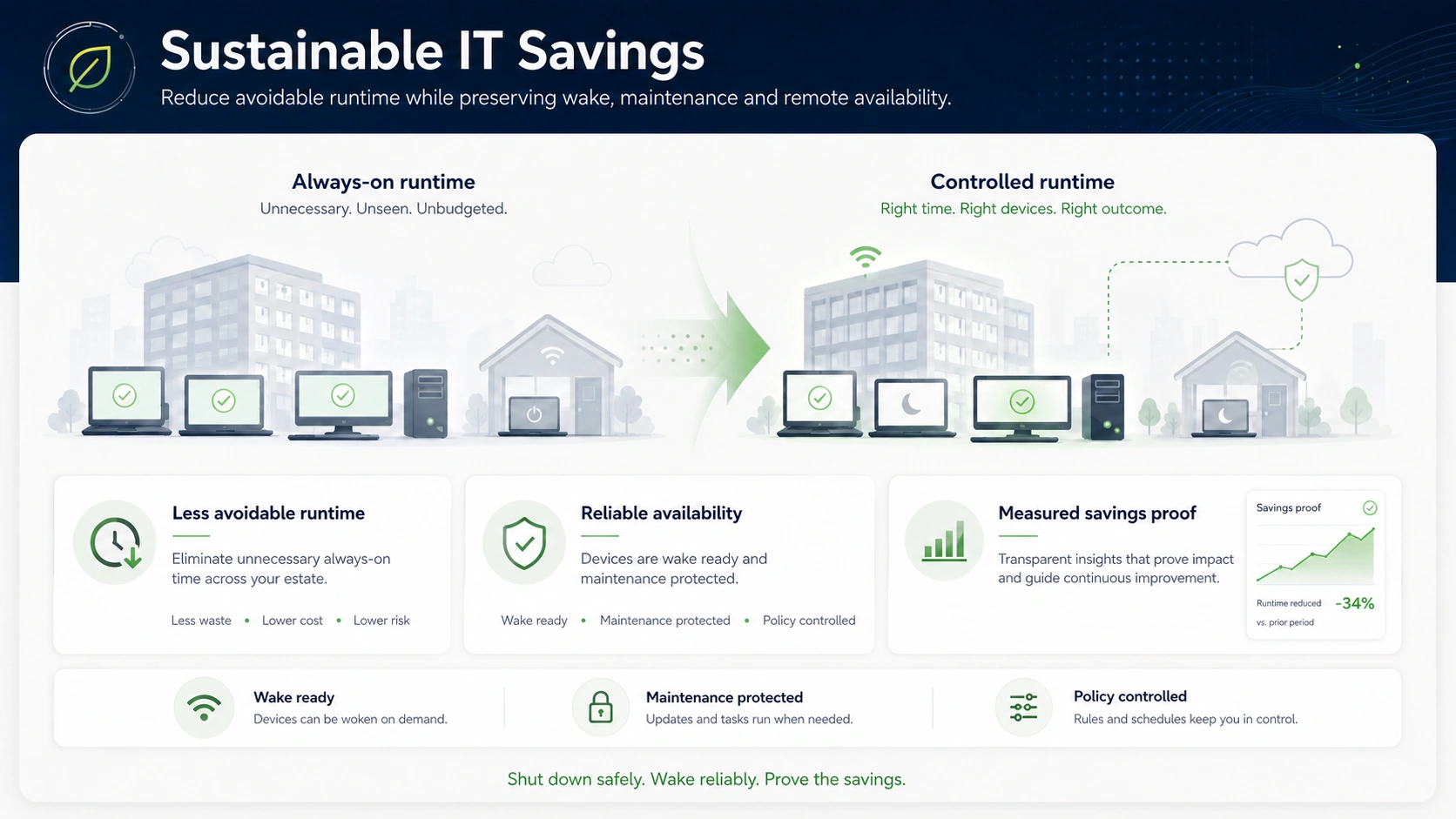
This conceptual graphic summarizes the core idea behind Sustainable IT Savings: reduce unnecessary always-on runtime while preserving wake readiness, maintenance protection, policy control and measurable proof.
Why standard tools are not enough
Windows, GPO, SCCM/MECM, Intune and scripts can help with parts of endpoint power management. ASDM complements them by connecting safe shutdown, reliable wake, maintenance protection and reporting into one operational process.
PCs should not run all night or weekend unless there is a real operational reason.
Standard policies can set sleep or shutdown behavior, but they often lack the full operational context around users, exceptions, wake, maintenance and reporting.
ASDM applies controlled idle shutdown policies with warnings, cancellation behavior and configured exceptions so runtime can be reduced without blind enforcement.
Energy savings must not interrupt active users, presentations or important tasks.
A script may shut down correctly in the lab but fail in daily operations when exceptions, logged-on users or local work patterns differ.
ASDM is designed for controlled power management with configured conditions, user warnings and policies that can be piloted before broader rollout.
Patching, scans, backups and admin work need endpoints awake and protected at the right time.
If PCs are simply turned off, updates and maintenance can be missed. If they stay on, savings disappear.
ASDM connects scheduled wake, policy exceptions and maintenance workflows so endpoints can be available for planned work and return to policy afterwards.
Remote access and support must not require keeping every PC online 24/7.
When wake is unreliable, organizations often leave PCs running so users and IT can reach them later.
ASDM combines endpoint power policies with enterprise wake scenarios and WOL Portals where hardware, firmware and network conditions support them.
IT and management need evidence before scaling a power-management rollout.
A power plan or script does not automatically produce a credible estimate, pilot result or management-ready savings story.
ASDM supports the business case with reporting and an ROI path so organizations can estimate savings, validate them in their own environment and scale responsibly.
Safe adoption path
Endpoint energy savings should be validated in your own environment. Hardware, firmware, user behavior, network wake conditions and maintenance routines all influence the result.
Identify where endpoints stay powered without a clear operational reason.
Apply controlled idle rules to a limited group with warnings and exceptions.
Test wake, remote access and maintenance behavior before wider rollout.
Use evidence from the pilot to refine rules and build a management-ready case.
Runtime reduction, not security replacement
ASDM does not replace endpoint protection, patching, hardening or incident response. It can support operational exposure reduction by helping avoid unnecessary endpoint runtime while preserving wake-up, maintenance and remote-access availability.
FAQ
Both can matter, but the operational side must come first. If shutdown breaks patching, remote access or users' work, the savings program will fail. ASDM is positioned as controlled endpoint power management, not generic sustainability marketing.
No. Savings depend on device count, current runtime, electricity prices, user behavior, policies, hardware and network conditions. The responsible path is to estimate, pilot, measure and scale.
It should be read as a documented scenario-specific proof point, not a universal promise. Strong savings examples are useful, but every organization should validate runtime, wake behavior, maintenance windows and electricity assumptions in its own environment.
Yes, but carefully. The power bill is easier to measure. Reduced manual effort, fewer local-hands requests and fewer user interruptions are operational value factors that should be described honestly and validated during a pilot where possible.
Yes, where configured policies and environment conditions support the schedule. The goal is to keep endpoints available for planned work and avoid leaving them powered unnecessarily afterwards.
They can where wake, network and portal scenarios are configured and validated. ASDM is designed to combine runtime reduction with reliable wake availability instead of forcing every PC to stay online.
No. ASDM complements Microsoft endpoint management. It adds controlled shutdown, wake, exception handling and reporting around tools that already manage policies, deployments and devices.
Shut down safely. Wake reliably. Prove the savings.
Start with a controlled pilot, validate wake and maintenance behavior, then use the ROI Calculator and reporting path to decide where rollout makes sense.
Platform · WOL Proxy & Wake-on-WAN
Wake-on-LAN becomes an enterprise problem as soon as endpoints live behind routers, VLANs, branch offices and security policies. Auto Shutdown Manager by EnviProt can use WOL Proxies to wake PCs inside remote network segments without turning every router into a directed-broadcast exception.
Conceptual overview
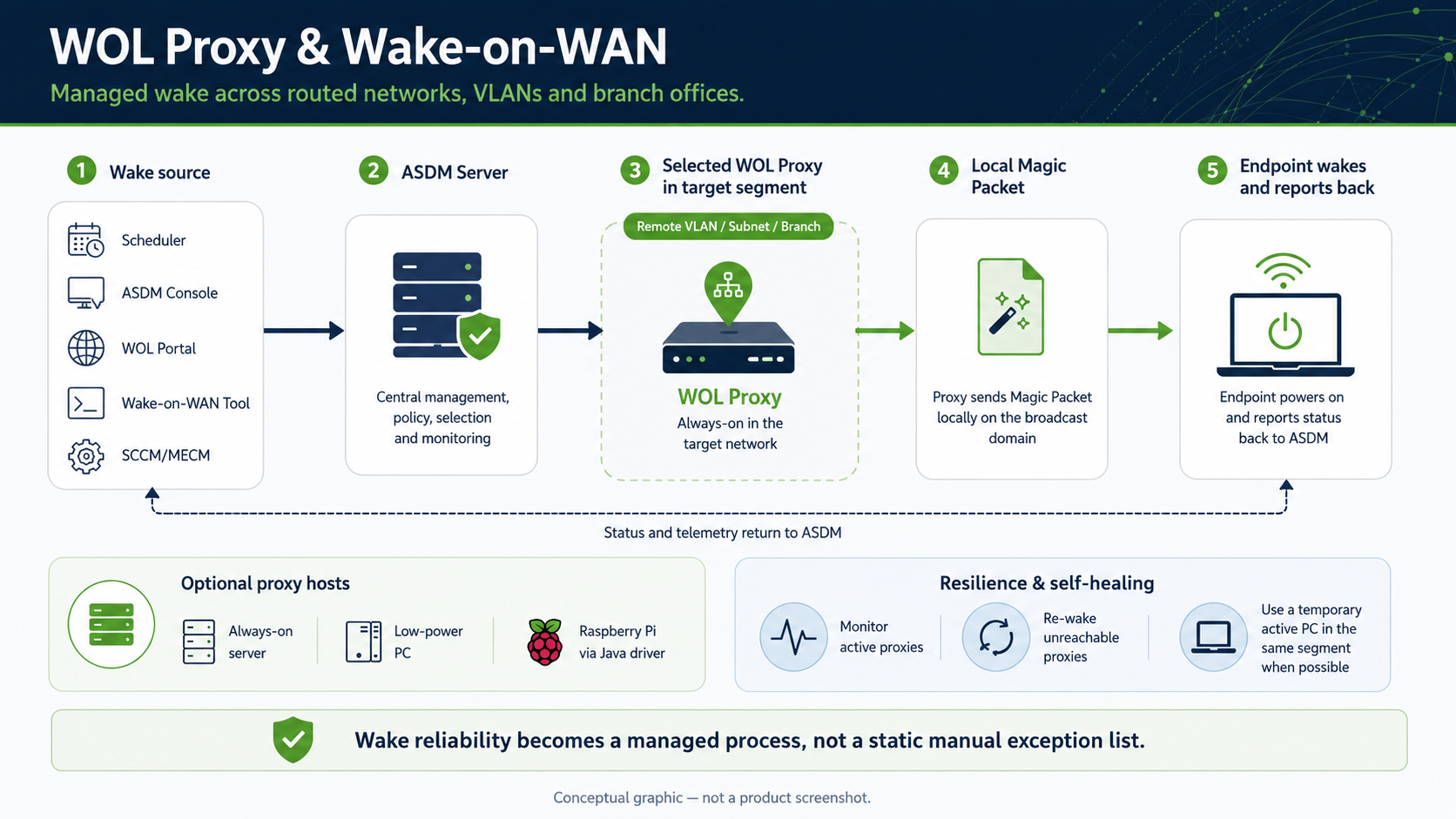
This is the complete idea in one view: wake requests can come from schedules, admins, portals or management tools; ASDM selects the right WOL Proxy in the target network; the proxy sends the Magic Packet locally; the endpoint wakes and reports back. Proxy hosts can be servers, low-power PCs or Raspberry Pi-class devices, while monitoring and temporary proxy handling improve resilience.
Why basic Wake-on-LAN stops at network boundaries
Wake-on-LAN is simple inside one subnet. It becomes harder when the target PC is in another VLAN, behind a router, in a branch office or in a network where directed broadcasts are restricted by policy. That is where WOL Proxies are useful: they move the final wake action into the target segment.
Wake traffic that works locally may not cross routers or VLAN boundaries without a planned WOL approach.
Directed broadcasts may be unavailable, blocked or unwanted in many enterprise environments.
Branch offices and remote segments need local wake capability without requiring an administrator on site.
Networks change. Proxy candidates retire, move groups or become unavailable. Manual proxy lists age quickly.
How the proxy model works
The ASDM Server does not need to broadcast directly into every remote segment. It can ask a selected WOL Proxy in the target network to create the Magic Packet locally. The target PC wakes in its own segment and reports back to the ASDM Server when it comes online.
Sends the wake request to the selected proxy for the destination segment.
Runs inside the target segment and creates the local Magic Packet.
The packet reaches the sleeping PC on the local network where Wake-on-LAN can work.
The PC starts and changes status back to available in ASDM.
Automatic WOL Proxy generation
In large environments, manually choosing and maintaining WOL Proxies can become its own administration task. The WOL Proxy Auto Generator is designed to analyse the network, propose suitable proxy clients, reduce redundant proxy coverage and keep the topology useful as networks and devices change.
ASDM can identify suitable proxy candidates based on network structure and endpoint availability, instead of forcing admins to build every entry by hand.
Administrators can exclude notebooks, unwanted segments or groups, prefer selected groups and keep manually selected proxies at the highest priority.
The generator can reduce redundant subnet coverage and prefer clients that can serve multiple segments where this fits the network design.
A generated proxy list can be exported as an Excel-compatible CSV preview before changes are applied.
Selected proxy clients can be moved into a suitable WOL Proxy policy group so idle timers and time rules do not shut them down accidentally.
Generation and optimization can be run daily, on a scheduler or manually, helping replace inactive, retired or defective proxy candidates.
Resilient wake infrastructure
A proxy that is unreachable cannot wake the segment it protects. ASDM can monitor active WOL Proxies, try to wake them again and, where possible, temporarily use another active PC in the same target segment to preserve wake capability while the intended proxy is unavailable.
ASDM can watch configured WOL Proxies and detect when one becomes unreachable.
The server can attempt to reactivate the intended proxy so the designed topology comes back.
If another active PC exists in the same segment, ASDM can use it temporarily to trigger the local wake process.
Scheduled generation and maintenance can replace inactive or unsuitable proxies as the network changes.
Important wording
Wake reliability still depends on endpoint hardware, firmware, network policy and local segment conditions. The value of ASDM is that the wake topology can be monitored, repaired and operated centrally instead of being a static list of manual exceptions.
Low-power proxy options
Ideally, a WOL Proxy can be a server that already runs 24/7. Where that is not practical, low-power devices such as Raspberry Pi or other small PCs can be used with the EnviProt Java WOL Proxy driver. These devices can be a practical fit for branch offices, remote VLANs or small segments where a full server would be excessive.
Use an already-on server where available, or a low-power proxy device where that is the better operational choice.
Small sites often need local wake capability without adding a full infrastructure server.
Raspberry Pi support is an option for suitable environments. It is not required for every WOL Proxy design.
Special topic: VLANs
In large environments, administrators often ask whether every VLAN needs its own physical WOL Proxy PC. Not necessarily. In a virtualized network, one VM running the normal ASDM Client can serve multiple VLANs when the VM has a separate virtual NIC in each target VLAN and each vNIC has a valid IP address in that subnet.
The ASDM Server sends the wake request to the proxy VM. The proxy VM then sends the Magic Packet as a local Layer-2 broadcast through the vNIC that belongs to the target VLAN. Because the broadcast is created inside the correct broadcast domain, there is no routed broadcast between the server and the sleeping endpoint.
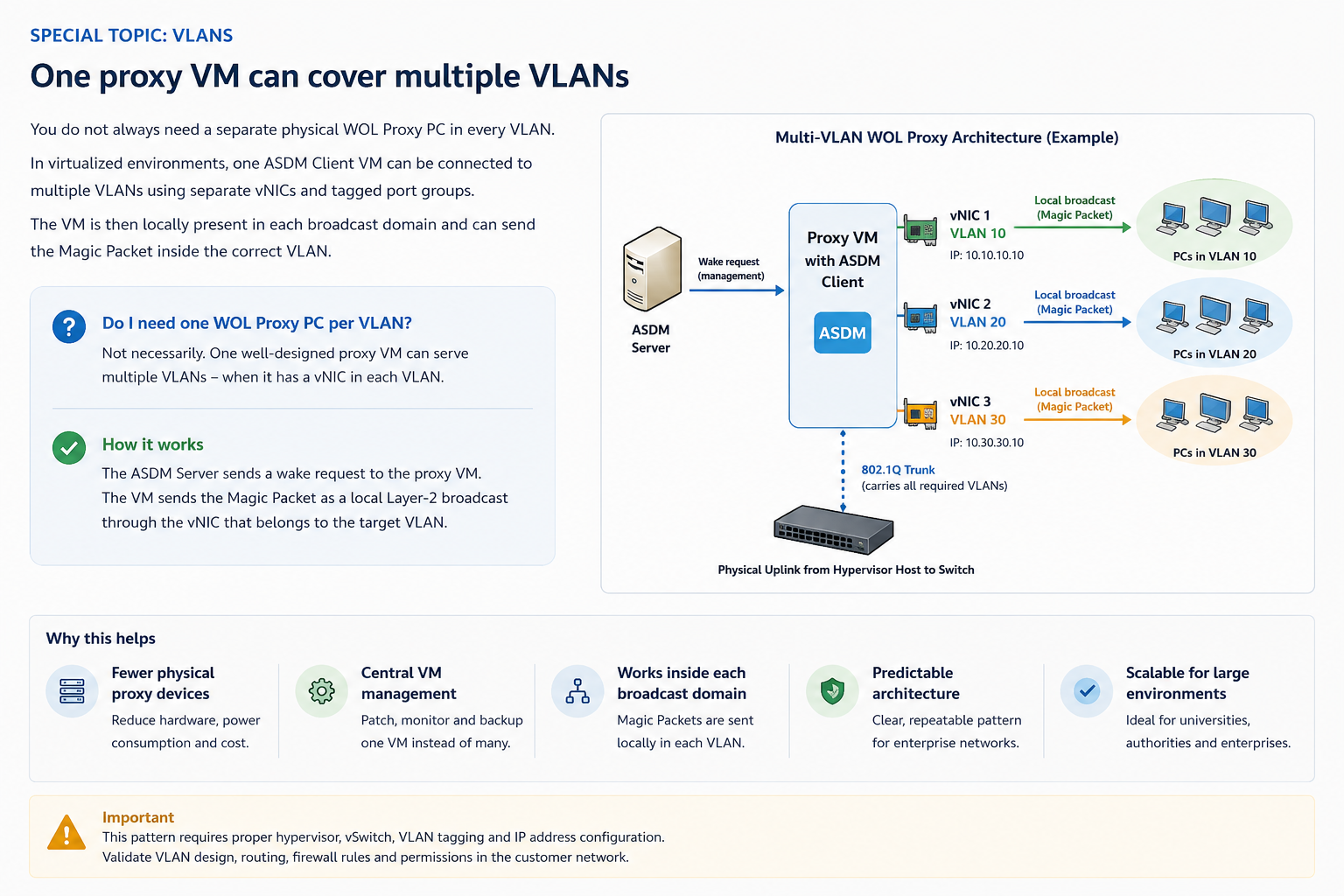
Instead of placing a separate always-on proxy PC in every VLAN, a well-designed proxy VM can be attached to several VLANs.
Each vNIC makes the proxy locally present in that broadcast domain, so the Magic Packet is sent inside the correct target VLAN.
This pattern can simplify WOL Proxy planning for enterprises, universities, public-sector networks and large segmented environments.
Architecture guardrail
The VM must really be connected to the required VLANs with the correct vSwitch, tagged port groups, 802.1Q trunking, IP addressing, routing, firewall rules and permissions. Validate the VLAN design in the customer network before relying on it for production wake operations.
Why this matters
Basic wake tooling often fails because the network changes faster than the manually maintained wake configuration. ASDM turns WOL Proxy handling into a managed topology with monitoring, candidate selection and policy integration.
Product proof
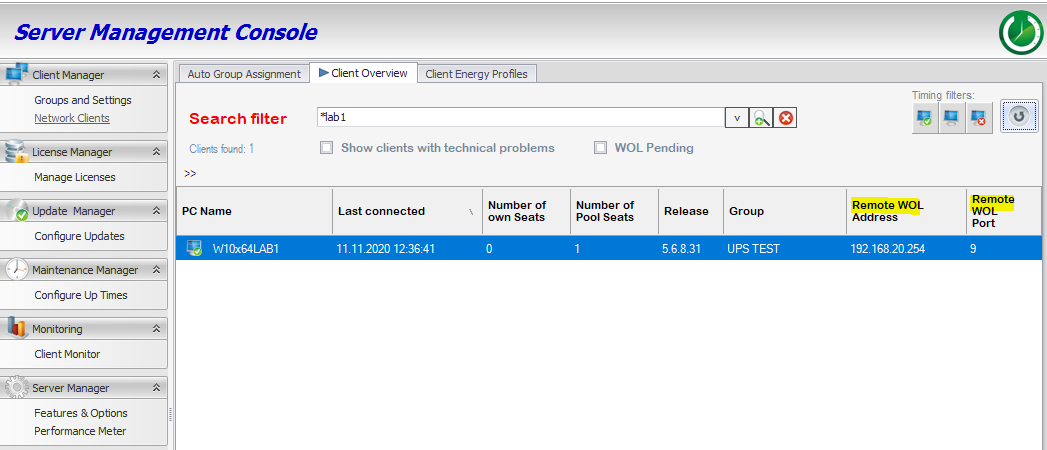
The two product screenshots show real ASDM configuration areas for WOL Proxies. They confirm that WOL Proxy handling is integrated into the ASDM workflow.

Alternative routing method
If the network and security policy permit routed broadcast forwarding, ASDM can reach remote subnets by directed broadcast without a WOL Proxy.
FAQ
You need a WOL Proxy when the target PC is in a network segment where simple local Wake-on-LAN traffic cannot reach it and directed broadcasts are not available, not allowed or not desirable.
No. In an enterprise ASDM context, the important part is controlled wake across remote or routed network locations. A proxy in the target segment can create the local Magic Packet where the endpoint can actually receive it.
No. An always-on server can be the best WOL Proxy if it already exists in the segment. Raspberry Pi or similar low-power devices are useful options where a full server is unnecessary.
No. Hardware, firmware, network and policy conditions still matter. ASDM can improve resilience by monitoring proxies, attempting wake-up and using temporary proxy options where possible, but every environment should be validated.
Not always. In virtualized environments, one ASDM Client VM can cover multiple VLANs when it has a separate vNIC and valid local IP configuration for each target VLAN. The VM then sends the Magic Packet locally through the matching VLAN interface. This requires proper hypervisor, vSwitch, trunking, routing and firewall design and must be validated in the customer network.
No. ASDM complements endpoint management tools by handling the power and wake process around maintenance, remote availability and endpoint runtime control.
WAKE RELIABLY ACROSS REAL NETWORKS
Start with the networks where wake-up is unreliable today: routed VLANs, branch offices, remote sites or places where directed broadcasts are not acceptable. ASDM gives IT a controlled way to design, monitor and maintain WOL Proxy capability.
Solutions · Remote PC Power Control
Auto Shutdown Manager by EnviProt helps IT teams reach, wake, restart and shut down managed PCs across offices, buildings, branches and remote sites. It centralizes power control for support, maintenance, inventory and urgent response workflows.
The operational gap
Helpdesk, RDP, VPN, inventory and deployment tools all depend on one simple condition: the endpoint must be powered, reachable and in the expected state. In real operations, the needed PC may be off, asleep, in another building, behind a routed network, at a branch site or simply unavailable when IT needs it.
Admins should not have to call someone on-site just to press a power button, restart a PC or confirm that a device is online.
Enterprise PCs may sit in offices, departments, classrooms, labs, branches or remote sites across different network segments and time zones.
Remote support, patching, scans, inventory and scripted actions need endpoints to be available at the right time, not running all day and night.
In operational or security-related situations, IT may need to move selected devices into a controlled power state without waiting for local staff.
IT operations view
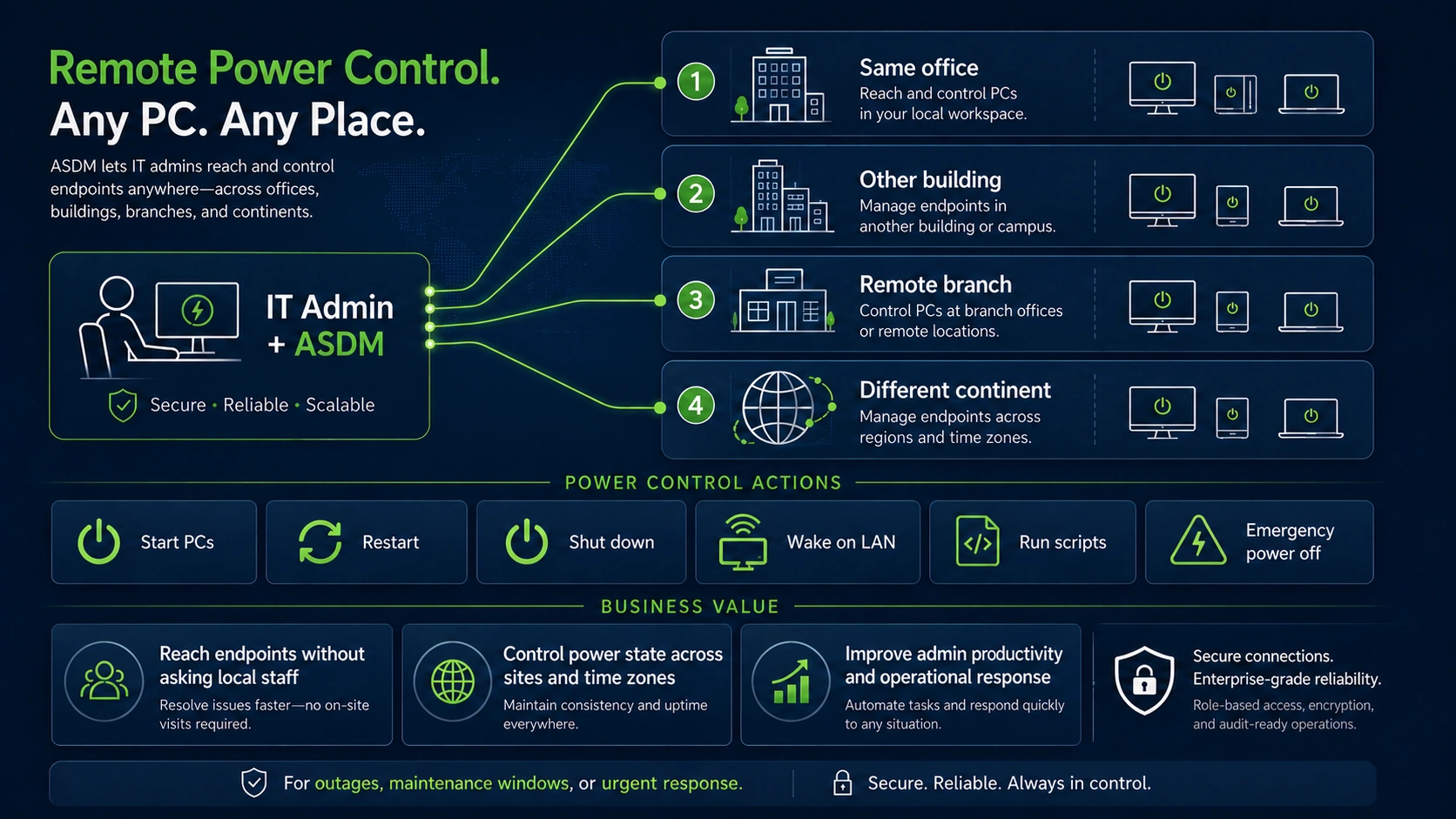
The graphic below is a conceptual operations view, not a product screenshot. It shows the intended workflow: IT selects the target devices or groups, applies the required action, and receives a controlled result instead of relying on manual site intervention.
Why standard tools are not enough
ASDM does not replace remote-access, deployment or endpoint-management platforms. It complements them by solving the power-state and runtime-control problem around those tools.
IT needs the endpoint available even when nobody is near the device.
RDP, VPN, remote-support tools and inventory systems cannot manage a PC that is powered off, asleep or unreachable.
ASDM lets IT wake selected PCs or groups and then apply configured restart, shutdown, standby, hibernate or logoff actions where policy and device conditions allow.
Power control must work beyond the same room or same switch.
Basic magic packets often fail across VLANs, routed networks, branch sites or remote segments unless the network path is designed for wake traffic.
ASDM supports enterprise wake scenarios such as Wake-on-LAN, Wake-on-WAN and WOL Proxy approaches where hardware, network routing and configuration support them.
After support, patching or diagnostics, PCs should return to the intended power policy.
When wake and shutdown are unreliable, organizations often leave PCs running to avoid availability problems, wasting energy and extending unnecessary runtime.
ASDM can return devices to configured shutdown, standby, hibernate or runtime policies after maintenance or support work, depending on rules, workload and endpoint conditions.
Sometimes IT needs to take selected endpoints offline quickly and centrally.
Calling a colleague, waiting for physical access or relying on ad-hoc scripts creates delay and inconsistent handling.
Power management is not a security product. But central power control can help IT move selected devices into a controlled offline or shutdown state faster when an operational or security-related situation requires it.
Helpdesk and operations should not depend on one-off scripts or personal workarounds.
Manual scripts and local procedures may solve individual cases, but they are difficult to audit, repeat and scale across departments or locations.
ASDM centralizes power actions, schedules, groups and reporting so IT can apply consistent controls instead of relying on local improvisation.
Admin workflow
The value is not only the power action itself. The value is the repeatable operational workflow around it.
Choose a PC, group, department, site or maintenance target instead of treating all endpoints the same way.
Wake, restart, shut down, log off, standby, hibernate or run configured actions according to policy.
Once the PC is reachable, your remote support, deployment, inventory, antivirus or maintenance tools can do their job.
After work is complete, the endpoint can return to the intended power state and the result can be logged or reported.
Product proof
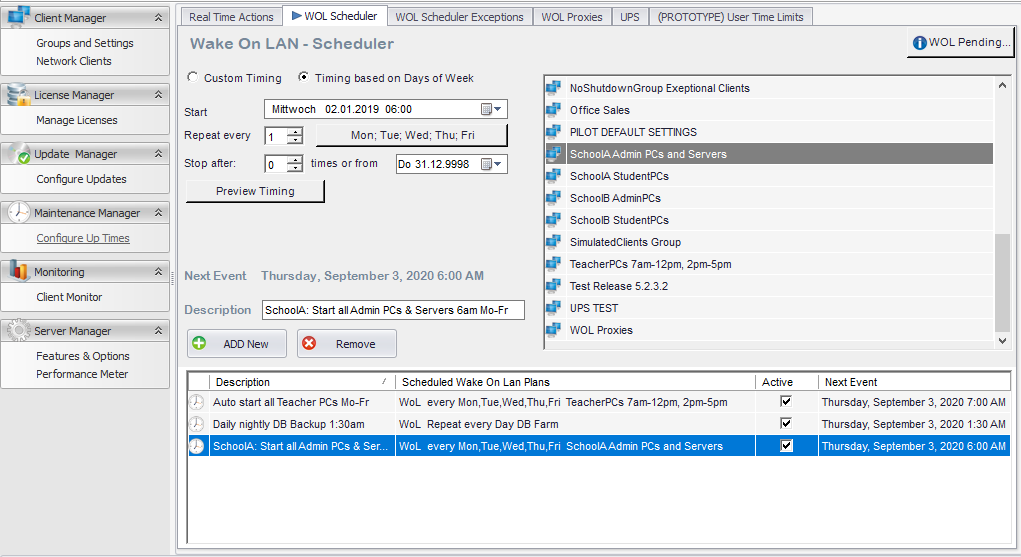
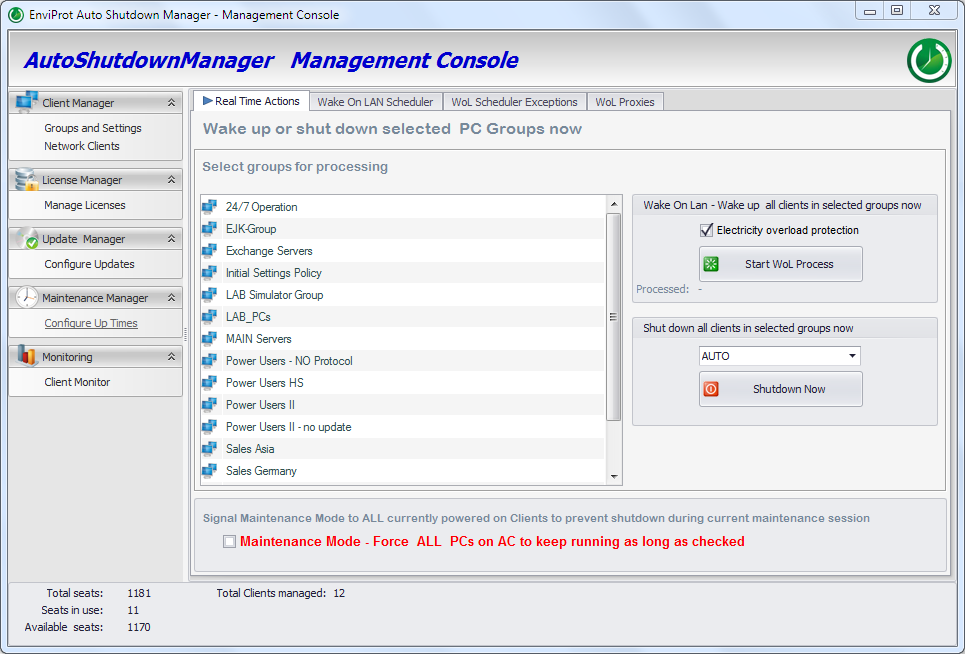
ASDM exposes the practical pieces IT needs: real-time actions, Wake-on-LAN support, group management, scheduling and reporting. Validate the exact behavior in your own hardware and network environment.
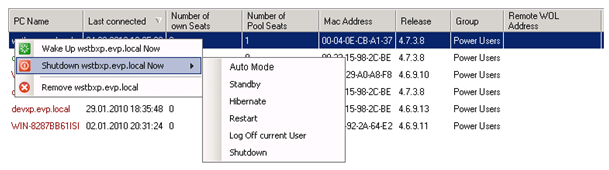
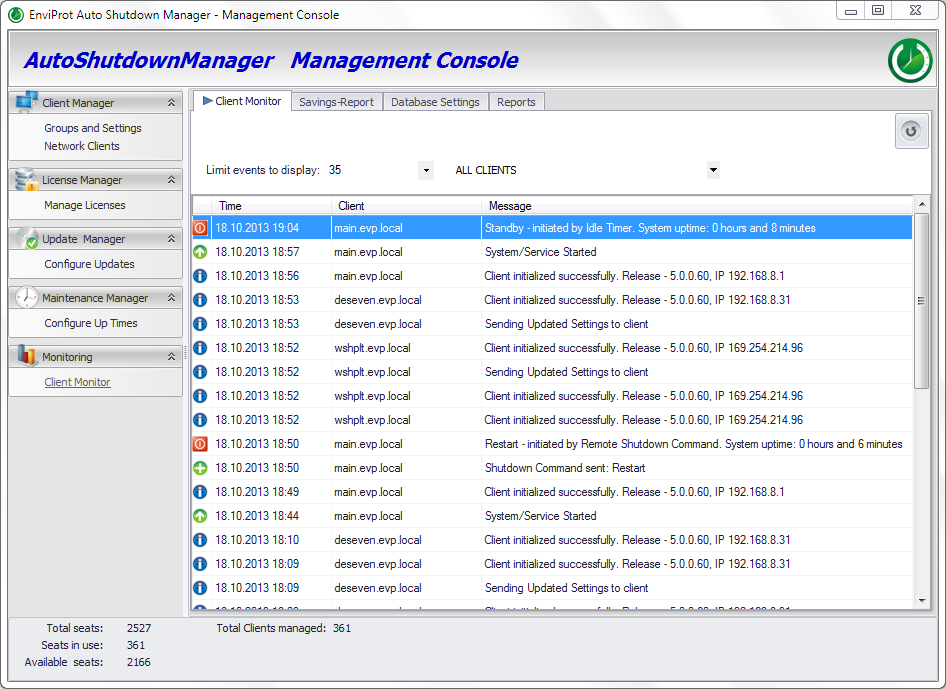
Controlled runtime, not security replacement
ASDM does not replace EDR, antivirus, patching, hardening or incident-response tools. It can support IT operations by reducing unnecessary runtime and by helping teams move selected endpoints into a controlled power state when an operational or security-related situation requires it.
Where it helps
Remote PC Power Control is strongest when IT needs speed, consistency and fewer manual interruptions across many endpoints.
A support engineer needs to wake or restart a user PC in another office before using the existing remote-support tool.
IT prepares endpoints in a remote location for updates, scans or inventory without asking local employees to handle power state manually.
Devices can be made available for planned work and returned to the configured power policy afterwards.
Groups of non-personal endpoints can be started, restarted or shut down according to operational need and policy.
Sites, departments and time zones become manageable from one operational approach instead of local improvisation.
When a device should no longer remain powered, IT can initiate a controlled power action without waiting for someone near the device.
FAQ
No. Those tools connect to a reachable machine. ASDM handles the power control around them: waking, restarting, shutting down and returning endpoints to policy.
No. ASDM complements Microsoft endpoint management by helping ensure PCs are available when needed and not left running unnecessarily afterwards.
Yes, where the network, hardware and ASDM configuration support the required wake or power-control scenario. Enterprise networks should validate Wake-on-LAN, Wake-on-WAN and WOL Proxy behavior in their own environment.
ASDM can apply configured shutdown, standby, hibernate, logoff or restart actions according to policy and current endpoint conditions. The exact action should match your operational rules.
It is an operational power-control capability, not a replacement for security tooling. In security-related situations it may help IT move selected devices offline faster, while endpoint protection, investigation and remediation remain separate responsibilities.
Shut down safely. Wake reliably. Prove the savings.
Start with a controlled pilot: wake selected PCs, validate network behavior, test remote actions and measure the effect before scaling across sites.
Solutions · Multi-Site & VLANs
In real networks, energy savings only help if the right PCs can still be reached. Auto Shutdown Manager by EnviProt brings shutdown, wake, maintenance and remote availability into one managed process across VLANs, routed subnets and branch locations.
The enterprise Wake-on-LAN gap
Wake-on-LAN may look simple inside one local subnet. Enterprise environments are different: endpoints sit behind VLANs, routers, firewalls, branch networks and remote-access paths. That is where wake reliability becomes an operations topic, not just a packet.
A signal that works in one subnet may stop once VLANs, routers or firewall rules sit between ASDM and the target device.
IT still needs to wake machines in branch offices, labs or remote locations where nobody is standing next to the PC.
Routers and firewalls can block, limit or redirect the traffic that basic Wake-on-LAN tools rely on.
For IT, the value is not the packet itself. The value is predictable wake, shutdown, maintenance access and proof that the process works.
Operational model
The practical question is simple: where does the wake signal need to be generated, and who controls it? ASDM provides central orchestration while local broadcasts, WOL Proxies, explicitly approved subnet-directed broadcasts and portal-based wake paths address the respective network conditions.
01 · Network map
Start by understanding where endpoints actually sit: which site, VLAN, subnet, building, branch or remote-access path they belong to.
02 · Wake reach
Use local broadcasts within the same segment, WOL Proxies near the target network, or subnet-directed broadcasts only where Network Operations and IT Security have explicitly approved them. This keeps target networks reachable without leaving every PC powered on.
03 · Operations
Bring wake, shutdown, maintenance windows, remote support and reporting into one controlled process instead of letting each site invent workarounds.
Important condition
No Wake-on-LAN product can bypass every BIOS, network adapter, sleep-state, switch, router or firewall condition. ASDM provides management and wake infrastructure; your rollout should still validate the wake path before it becomes operationally important.
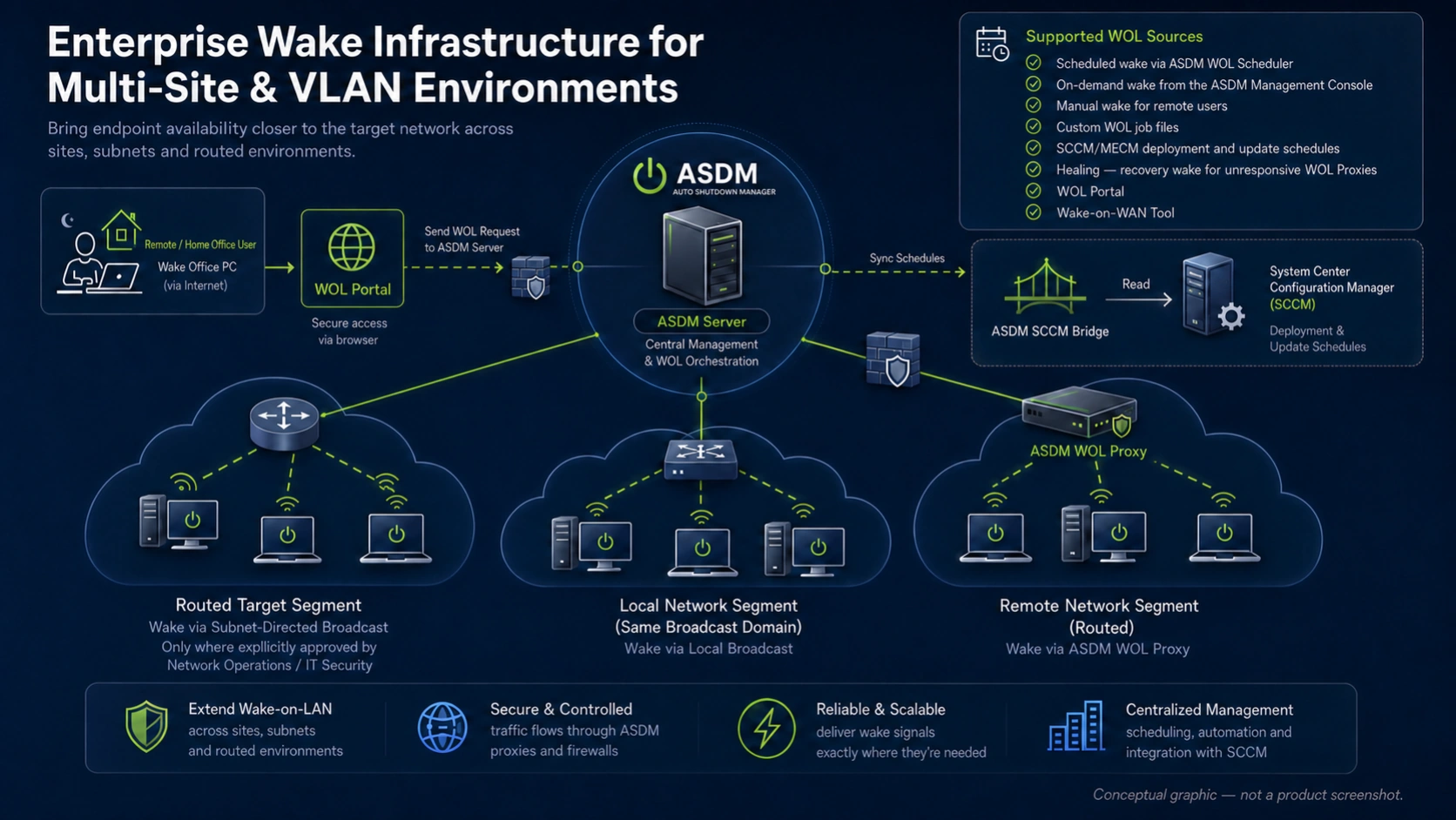
Architecture visual
A shared architecture view helps IT leaders and administrators discuss the same model: WOL Portal access, ASDM Server orchestration, local broadcasts, WOL Proxies, approved subnet-directed broadcasts, routed segments and SCCM/MECM schedule integration.
Where standard tools usually stop
Windows, SCCM/MECM, Intune, GPO, scripts and basic WOL tools can all help with parts of the job. ASDM complements them by connecting wake reachability, endpoint power actions, maintenance protection and central control.
IT needs to reach devices across routed networks, branch sites and VLAN boundaries.
Basic Wake-on-LAN depends on traffic behavior that may not cross routers, VLANs or firewalls unless the path is deliberately designed.
ASDM supports enterprise wake scenarios and WOL Proxy approaches, so wake capability can be placed closer to the target network where conditions allow.
Remote sites should not depend on someone walking over to a PC just to press the power button.
When wake is unreliable, support teams fall back to phone calls, local staff or simply leaving machines powered on.
ASDM helps IT wake, shut down, restart and return endpoints to policy centrally, reducing the need for local intervention.
Energy savings should not mean every remote-access PC has to stay on 24/7.
If users or IT cannot reliably wake a remote PC, the practical workaround is often to leave it running.
ASDM can be combined with WOL Portals and enterprise wake scenarios so endpoints can sleep or power down and still be made available when needed.
Devices still need to be awake for updates, scans and administrative work at planned times.
A power plan may save energy but cause maintenance problems if wake and policy return are not part of the workflow.
ASDM connects wake scheduling, maintenance windows and endpoint power policies so devices can be available for planned work and avoid unnecessary runtime afterwards.
Distributed environments deserve a controlled pilot before broad rollout.
Different switch, router, subnet, firmware and adapter settings can produce different wake behavior.
ASDM supports a staged rollout by site, group or organizational unit so IT can validate network behavior before scaling.
Safe adoption path
Wake reliability varies by environment. Start with a controlled network group, validate the full path and then expand by site, VLAN, department or organizational unit.
Choose a limited group of endpoints where network boundaries, firewall rules and maintenance expectations are already understood.
Confirm firmware, adapter settings, sleep states, WOL Proxy placement, local broadcast reachability, and the approval and configuration of any subnet-directed broadcasts before relying on the result.
Expand only when wake behavior, user impact, maintenance availability and policy return are predictable in your own environment.
Complement, not replacement
Keep your network design, SCCM/MECM, Intune, GPO and endpoint security responsibilities. Auto Shutdown Manager by EnviProt coordinates shutdown, wake, remote access and maintenance availability across distributed environments.
Routing, VLANs, firewall policy and endpoint configuration remain the foundation. ASDM works with those realities instead of pretending they do not exist.
SCCM/MECM, Intune, GPO and scripts can stay part of endpoint operations. ASDM adds wake, shutdown and runtime control.
WOL Portals and wake infrastructure can help make distributed endpoints reachable where policy, hardware and network conditions allow.
View WOL PortalsFAQ
Yes, but it depends on network design, endpoint hardware, firmware, adapter settings and security controls. ASDM provides enterprise wake and power-management capabilities; the actual wake path should still be validated before broad rollout.
A WOL Proxy or local wake component can bring wake capability closer to the target subnet or branch site. That reduces dependence on subnet-directed broadcasts from a central network. Where these are used, Network Operations and IT Security must explicitly approve and tightly restrict them.
No. ASDM complements these tools. They remain important for endpoint management, policy, deployment and compliance. ASDM adds wake, shutdown, runtime control and reporting.
Usually through WOL Portals or related remote-wake scenarios, if the organization allows and validates that workflow. Multi-site wake infrastructure can support it, but portal permissions and network behavior need careful planning.
No. Start with a site or subnet where the network path is understood, validate wake behavior, and then expand by group, site or organizational unit.
Shut down safely. Wake reliably. Prove the savings.
Start with a controlled pilot across your real VLANs, sites and branches. Then connect wake reliability with safe shutdown, maintenance windows and remote access workflows.
Solutions · Maintenance windows
Auto Shutdown Manager by EnviProt helps IT teams keep endpoints available for patching, scans and admin work, then return them safely to policy afterwards. Where SCCM/MECM maintenance plans are used, ASDM can synchronize scheduled maintenance windows into the power-management workflow so the right devices are awake, protected during the window and shut down again when the work is done.
The maintenance gap
Deployment tools can schedule updates, scans and scripts. The operational problem is simpler and more stubborn: the right PCs must be awake at the right time, users and running tasks must not be interrupted, and machines should not stay powered all night after maintenance has finished.
Night or weekend maintenance can miss PCs that are already shut down, asleep or unreachable across network boundaries.
Wake-on-LAN becomes more complex across VLANs, subnets and remote sites. A simple magic packet is often not enough in enterprise networks.
Automation must not shut down a PC during active work, presentations, remote sessions, backups, scans or other protected tasks.
Leaving endpoints powered all night can make maintenance easier, but it wastes energy and creates unnecessary runtime.
Maintenance workflow
ASDM is not a replacement for your deployment platform. It is the endpoint power-management workflow around it: synchronize or define the maintenance plan, prepare the right PCs, keep them reachable, protect exceptions, shut them down again and document the result.
Import or synchronize scheduled maintenance windows from SCCM/MECM where configured, or define ASDM maintenance plans directly.
Apply the window to managed clients, departments, sites or collections instead of treating every PC the same way.
Use scheduled wake-up and Wake-on-LAN options so endpoints are available before patching, inventory, scans or support actions start.
SCCM/MECM, Intune, GPO, scripts, antivirus, inventory or backup tools can do their job while the PC is intentionally online.
Warnings, time rules, idle checks and maintenance controls help avoid false shutdowns while users or protected tasks are still active.
After the window, endpoints can return to a configured power state and reporting can document availability and savings results.
IT can keep defining deployment or maintenance timing in Microsoft tooling. Where the integration is configured, ASDM can synchronize those scheduled windows and turn them into a wake-and-shutdown process around the actual deployment work.
Wake timing, endpoint availability, protected exceptions, controlled post-window shutdown and reporting are handled centrally, so teams do not need to rely on always-on fallback or scattered scripts.
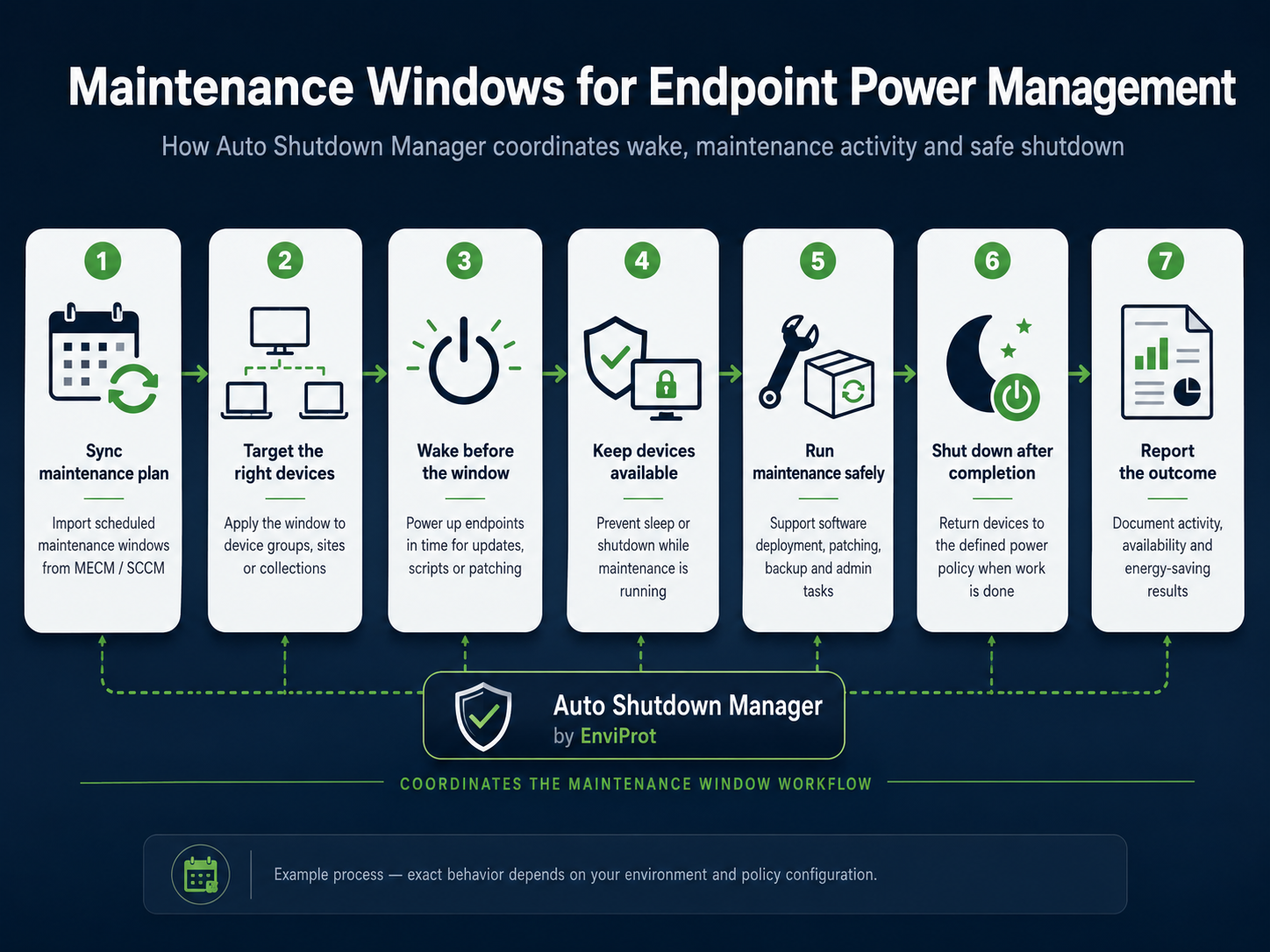
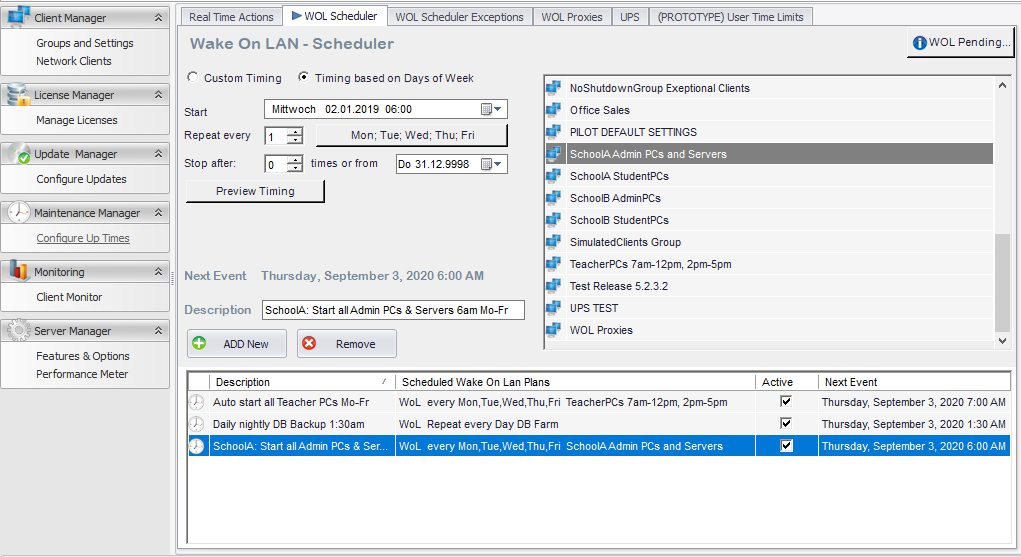
Workflow and product proof
The workflow starts with the maintenance plan, not with a generic power policy. Auto Shutdown Manager adds scheduled wake, availability protection, controlled shutdown and reporting around the tools that perform the actual maintenance work.
Microsoft endpoint management fit
Deployment platforms are good at deploying software, updates and policies. ASDM coordinates the power and wake tasks around those deployments, including synchronizing scheduled maintenance windows from SCCM/MECM where this integration is configured.
Keep endpoint availability aligned with the planned maintenance window.
SCCM/MECM can schedule deployments and maintenance windows, but endpoint power state remains a separate operational dependency: devices may be off, asleep, unreachable, or left running after the window.
ASDM synchronizes configured SCCM/MECM maintenance windows into the power-management workflow, wakes targeted endpoints before the window, keeps them available during maintenance, and returns them to policy afterwards.
Use off-hours for patching without creating uncontrolled overnight runtime.
Off-hours maintenance often leads to an always-on fallback because basic policies and scripts do not reliably prepare, protect, and shut down only the right endpoints after the work is complete.
ASDM schedules wake-up before the window, keeps endpoints available while deployment tools run, and powers them down again after completion where policy, hardware, and current conditions allow.
Keep distributed devices reachable across real enterprise network conditions.
Wake-on-LAN across VLANs, subnets, routed networks, and remote sites is fragile. Basic magic packets often stop at network boundaries or require custom handling.
ASDM provides enterprise wake patterns with central scheduling and WOL Proxy or Wake-on-WAN scenarios where supported, reducing manual wake work and script sprawl.
Keep maintenance practical without interrupting real work or protected tasks.
Basic shutdown rules or scripts may not know whether a user, backup, scan, presentation, or remote session is still active. False shutdowns create helpdesk friction.
ASDM applies policies, idle checks, warnings, exclusions, and maintenance controls before power actions, making automation more predictable and less disruptive.
Avoid leaving endpoints online longer than the maintenance window requires.
If maintenance success depends on “keep everything on,” energy cost and avoidable runtime accumulate, and savings are difficult to prove to management or procurement.
ASDM returns endpoints to a controlled power state, records availability and savings evidence, and supports ROI reporting for validating the business case.
Controls for IT admins
The goal is not aggressive shutdown. The goal is predictable endpoint availability with controlled power states before and after planned work.
Apply synchronized or manually defined schedules by groups, sites, departments or maintenance collections so each scenario can use the right policy.
Wake endpoints before the imported or defined window and combine scheduled wake with WOL infrastructure where conditions allow.
Use time rules, maintenance mode and activity checks to avoid interfering with real work or protected operations.
Return endpoints to shutdown, standby or hibernation instead of leaving them online after the update window.
Run configured scripts or actions before shutdown or after wake-up where policy allows, and centrally wake, restart, log off, hibernate, standby or shut down selected clients or groups.
Use reports and savings views to validate runtime reduction and support the business case for controlled endpoint energy management.
Pilot path
A practical rollout can begin with a limited group of managed PCs, a defined maintenance window and a measurable before/after result.
Choose a department, lab, site or test collection where maintenance behavior can be measured safely.
Verify Wake-on-LAN, user warnings, exclusion rules and post-maintenance shutdown in your network and hardware environment.
Roll out to more groups once availability, disruption protection and reporting meet your operational requirements.
FAQ
No. Auto Shutdown Manager complements Microsoft endpoint management. SCCM, MECM and Intune can deploy updates and policies; ASDM focuses on the wake, shutdown, exception handling and reporting workflow around endpoint availability. Where configured, ASDM can also synchronize scheduled maintenance windows from SCCM/MECM into that workflow.
Yes, ASDM supports scheduled wake and Wake-on-LAN scenarios. Success depends on hardware, firmware, network configuration and routing conditions, so the setup should be validated in the target environment.
Policies can include warnings, cancellation behavior, idle checks, time rules and exclusions. The intention is controlled power management, not blind forced shutdown.
Yes, ASDM can return endpoints to a configured power state after the maintenance period when policy and current conditions allow it.
Yes. GPO and scripts can solve parts of power management. ASDM is intended to reduce script sprawl and provide a central, repeatable process for wake, protection, shutdown and reporting.
Shut down safely. Wake reliably. Prove the savings.
Use the 45-day Enterprise Trial to validate scheduled wake, user protection, post-maintenance shutdown and reporting with your hardware, network and deployment tools.
Why Auto Shutdown Manager · Endpoint power management workflow
Auto Shutdown Manager by EnviProt is not just a shutdown command. It is a managed endpoint power workflow: detect real idle, protect users and maintenance tasks, shut down safely, wake endpoints reliably and prove the savings.
The operating model
ASDM works best when it is understood as a complete operating process. Windows power policies, GPO, SCCM/MECM, Intune and scripts can solve parts of the job. ASDM focuses on the full power-management workflow: decide when a PC is really safe to power down, keep availability for users and maintenance, then show the result in reporting.
Idle can be defined with more than keyboard or mouse inactivity: workload, applications, services, network traffic, sessions and other signals can be part of the decision.
Warnings, time rules, maintenance mode and pre-shutdown actions help prevent automation from interrupting active work, presentations, scans, backups or IT operations.
Administrators can manage settings, groups, schedules and remote actions centrally instead of maintaining disconnected scripts or desk-by-desk settings.
Depending on policy and environment, endpoints can be shut down, restarted, put into standby or hibernated when they are no longer needed.
Availability is restored through timer wake-up, Wake-on-LAN, WOL Scheduler, WOL Proxy and Wake-on-WAN scenarios where hardware and network conditions allow.
Reports and savings views help turn power management into a measurable business case instead of a hidden background task.
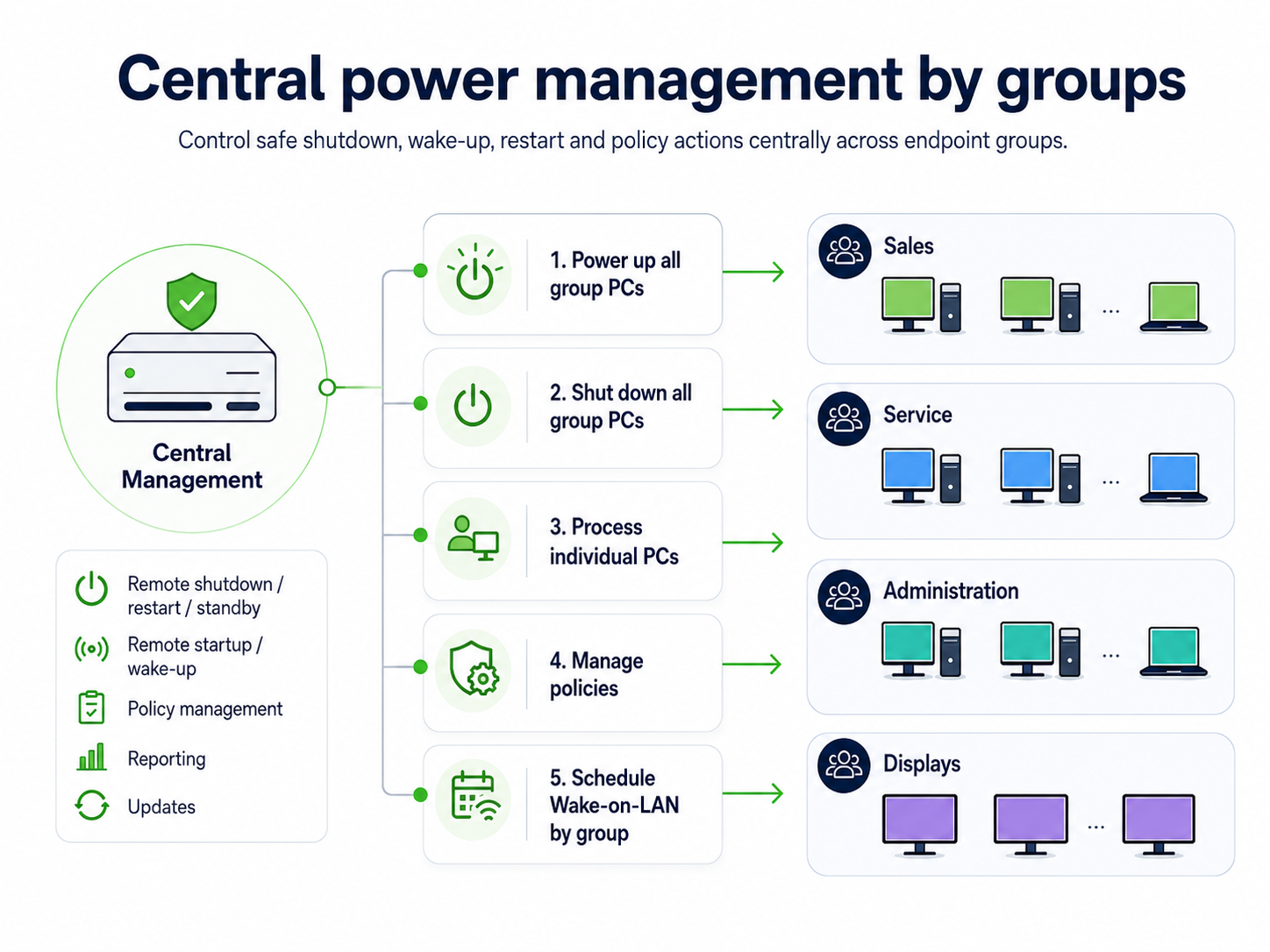
Product proof
The workflow is not just a diagram. ASDM exposes central groups, real-time actions, wake scheduling and savings reporting as operational tools for IT.
Step 1 · Decide safely
The first risk in endpoint power management is false shutdown. ASDM lets administrators model idle in a way that fits the environment, not only a generic timeout.
Mouse and keyboard activity, active sessions and visible warning/cancel paths help distinguish idle machines from active users.
CPU, hard-disk utilization, scheduled tasks and sound activity can be considered before a shutdown decision is made.
Selected applications, processes, services and drivers can prevent or prepare shutdown where business workflows require it.
Network traffic, terminal sessions, printer queues and monitored TCP/IP devices can be part of the idle decision.
Step 2 · Avoid disruption
Power automation should not become forced interruption. ASDM supports the controls IT needs to avoid shutting down the wrong PC at the wrong time.
Users can be warned before shutdown, and organizations can define when cancellation should be allowed.
Policies can change by time, day, business hours, night, weekend or maintenance window.
Applications or batch files can run before shutdown, documents can be saved and services or drivers can be handled as part of the process.
Maintenance can keep endpoints available while work is still running, instead of fighting a local idle rule.
Different rooms, departments, OUs, user groups or device groups can use different policies instead of one global timeout.
The goal is not aggressive shutdown. The goal is safe shutdown that IT, users and management can trust.
Step 3 · Restore availability
Organizations often leave PCs running because wake-up is unreliable. ASDM treats wake-up as part of the same process: scheduled wake, WOL routing, WOL Proxy scenarios and user-facing WOL Portals where they fit the environment.
Endpoints or groups can be woken for known schedules, support windows or planned maintenance tasks.
ASDM supports Wake-on-LAN approaches for local networks and routed environments, including WOL Proxy scenarios where required.
Wake-on-WAN concepts and WOL Portals can help remote users or helpdesk teams wake assigned PCs without keeping everything on 24/7.
Important: Wake behavior depends on hardware, firmware, operating-system power state and network configuration. ASDM provides the workflow and tooling; wake behavior should be validated in your own environment.
Step 4 · Scale through central management
ASDM is designed to reduce one-off scripts and manual configuration. Central Management lets IT work with clients, groups, settings, real-time actions, energy profiles and asset information from one operational console.
Assign power policies to groups instead of maintaining separate local configurations.
Wake, restart, shutdown, hibernate, standby or log off selected clients or groups when the operation requires it.
Monitor client status, events and operational conditions to understand what happens across the environment.
Microsoft endpoint management fit
Windows, Group Policy, SCCM/MECM and Intune are important endpoint-management tools. ASDM is not positioned as a replacement. It adds a dedicated power, wake, availability and reporting workflow around the parts those tools do not fully operationalize.
Step 5 · Prove the result
The business case depends on showing avoidable runtime, estimated savings and operational status. ASDM reporting helps turn endpoint power management into evidence that IT leaders, procurement and management can evaluate.
Use reported client and server data to support the energy and cost-saving business case.
Events and statistics help IT understand shutdown, wake and client behavior instead of guessing.
Estimate potential savings, validate the result in your environment and use the ROI Calculator as part of the evaluation path.
Practical rollout
ASDM does not need to start as a large project. A practical evaluation can begin with one group, room, site or use case and then expand after idle rules, wake behavior and reports are validated.
Choose a department, lab, classroom, office area or site with measurable runtime and clear availability needs.
Define signals, business hours, protected tasks, user warnings and maintenance windows.
Test WOL behavior, scheduling, proxy scenarios and remote-access needs where they apply.
Use reports and the ROI Calculator to decide how to scale the workflow across groups and sites.
FAQ
No. ASDM complements Microsoft endpoint management. Windows policies, GPO, SCCM/MECM and Intune remain important for endpoint configuration, deployment and management. ASDM adds the dedicated shutdown, wake, availability and savings-reporting workflow.
ASDM can consider multiple signals such as user activity, CPU and disk load, selected applications, processes, services, network traffic, sessions, scheduled tasks and other environment-specific conditions.
Depending on policy, users can be warned before shutdown and may be allowed to cancel. Administrators can also use time rules, exceptions and maintenance controls to prevent the wrong shutdown at the wrong time.
ASDM supports enterprise Wake-on-LAN approaches such as scheduled wake-up, WOL Proxy scenarios and Wake-on-WAN concepts. Actual wake behavior depends on hardware, firmware, power state and network configuration, so it should be validated in your environment.
ASDM provides reporting and savings views that help estimate and validate the business case. For planning, use the ROI Calculator and then compare the estimate with operational reporting from your environment.
Evaluate the complete workflow
Use Auto Shutdown Manager to test the full endpoint power-management workflow: safe shutdown, reliable wake, maintenance availability, WOL Portals, central management and reporting.
Why Auto Shutdown Manager · Vs. Custom Scripts
Custom scripts can solve narrow endpoint power tasks. Auto Shutdown Manager by EnviProt is different: it gives IT a ready-made system for safe shutdown, reliable wake-up, remote availability, maintenance windows and savings proof — without turning endpoint power management into a fragile script stack.
Fair comparison
PowerShell, batch files, scheduled tasks and command-line workflows are valuable tools in an administrator’s toolbox. They can run a defined action at a defined time. The problem appears when the task becomes a daily enterprise process: deciding when a PC may safely shut down, waking it again across real networks, protecting users and maintenance windows, and proving the result.
Operational difference
Most organizations do not fail because an administrator cannot write a shutdown command. They fail because the surrounding process grows: exceptions, permissions, logs, wake reliability, user impact, reporting and long-term ownership.
A custom script often depends on the person who wrote it. Auto Shutdown Manager provides a documented product workflow with central configuration, policies and operational visibility.
Power actions need context. ASDM is designed around controlled idle detection, user-aware shutdown decisions, business-time rules and maintenance availability.
Saving power is only credible if PCs can return when needed. ASDM connects shutdown with scheduled wake-up, Enterprise Wake-on-LAN, WOL Proxies and self-hosted WOL Portals.
A small script may be manageable for a few PCs. Enterprise environments need groups, policies, rollout control, update management and repeatable administration.
Management needs more than “the script ran”. ASDM supports estimation, pilot validation and reporting for runtime, energy, cost and CO₂ impact.
ASDM does not ban scripts. It can coexist with endpoint-management workflows, scheduled tasks, command-line operations and Microsoft environments where that makes operational sense.
Requirement map
This is where a simple automation task becomes a maintained endpoint power-management system.
Script stack: Often starts with timers, scheduled tasks or a shutdown command. Exceptions must be added and maintained manually.
ASDM: Provides controlled shutdown policies, idle rules and user-aware behavior as part of the product workflow.
Script stack: Needs custom checks for active users, open work, business hours, important processes and maintenance situations.
ASDM: Focuses on avoiding disruptive shutdowns while still reducing unnecessary runtime.
Script stack: Wake-on-LAN often becomes a separate project involving subnets, router behavior, client settings and troubleshooting.
ASDM: Connects scheduled wake-up, manual wake, WOL Proxy routing and client-side WOL reliability settings into one operational flow.
Script stack: A shutdown script does not solve how authorized users wake assigned office PCs later.
ASDM: Self-hosted WOL Portals can provide controlled wake-up paths while IT keeps authentication, assignment and routing under control.
Script stack: Requires coordination between shutdown logic, wake timing, patch windows, support work and exceptions.
ASDM: Helps keep clients available for planned administration and return them to power-saving behavior afterwards.
Script stack: Logs usually prove execution, not business value. Energy and cost reporting must be built separately.
ASDM: Supports ROI estimation, pilot validation and operational reporting for energy, cost and CO₂ impact.
Hidden operating cost
Custom scripts look attractive because the first version can be quick. The long-term cost is usually hidden in testing, exception handling, ownership transfer, documentation, troubleshooting and proof.
Write shutdown, wake, exception and logging logic for the first environment.
Keep scripts compatible with OS changes, endpoint tools, permissions and operational requirements.
Investigate failed shutdowns, failed wake-ups, user complaints and edge cases across locations.
Collect enough data to justify the project to IT leadership, finance, sustainability or procurement.
Practical adoption
A realistic approach is to keep useful scripts where they are low-risk integration glue, and move the critical power-management workflow into a ready-made, centrally managed tool.
Scripts can still support local tasks, exports, scheduled jobs or integration around your endpoint-management platform.
Shutdown safety, wake reliability, user-facing wake-up and savings proof should not depend on undocumented script chains.
Use the ROI Calculator and 45-day Enterprise Trial to test behavior, wake reliability and reporting in your own environment.
Evaluation path
Start with the scripts that already carry operational risk: shutdown jobs, Wake-on-LAN workarounds, maintenance timing and reporting exports.
List current scripts, scheduled tasks, owners, permissions, logs and known failure cases.
Identify where failed shutdowns, failed wake-ups or missing proof create the most operational risk.
Test ASDM with a controlled group, site, lab or department before rollout.
Keep low-risk scripts where useful. Replace brittle power/wake workflows where a managed product is safer.
FAQ
No. Scripts can remain useful for integration and local automation. ASDM focuses on the operational power-management workflow: safe shutdown, reliable wake-up, user protection, maintenance availability and reporting.
That can work for a narrow case. The challenge is not the shutdown command itself; it is the surrounding logic: when shutdown is safe, when the PC must wake again, how exceptions are handled, and how results are reported.
Yes. ASDM is designed for power management and wake-up and can complement existing Microsoft endpoint management, scheduled operations and administrative workflows.
No. Power management is not a security product. But unnecessary runtime can mean unnecessary exposure. ASDM can support operational exposure reduction by helping avoid unnecessary runtime while endpoint protection, patching and hardening remain separate responsibilities.
Start with a small pilot. Validate shutdown safety, Wake-on-LAN reliability, maintenance windows, user impact and reporting in your own environment before scaling.
Evaluate Auto Shutdown Manager where custom scripts usually become expensive to maintain: safe shutdown, reliable wake, remote availability, maintenance windows and proof of savings.
Why Auto Shutdown Manager · Enterprise Wake-on-LAN
Basic Wake-on-LAN tools can be useful on a simple local network. Auto Shutdown Manager by EnviProt is different: it connects wake-up with managed endpoint power control, routed networks, WOL Proxy and Wake-on-WAN scenarios, WOL Portals, scheduled wake-up, File Scanner XML jobs and remote availability.
Fair comparison
A simple WOL tool can send a wake request. That may be enough for a small LAN, a lab bench or a one-off support task. The challenge starts when wake-up must work across routed subnets, VLANs, branch offices, remote users, maintenance windows and energy-saving shutdown policies.
Visual quick scan
Basic WOL tools send a packet. Auto Shutdown Manager gives IT a managed wake workflow: trigger, route, verify and support endpoints across complex networks with less manual firefighting.
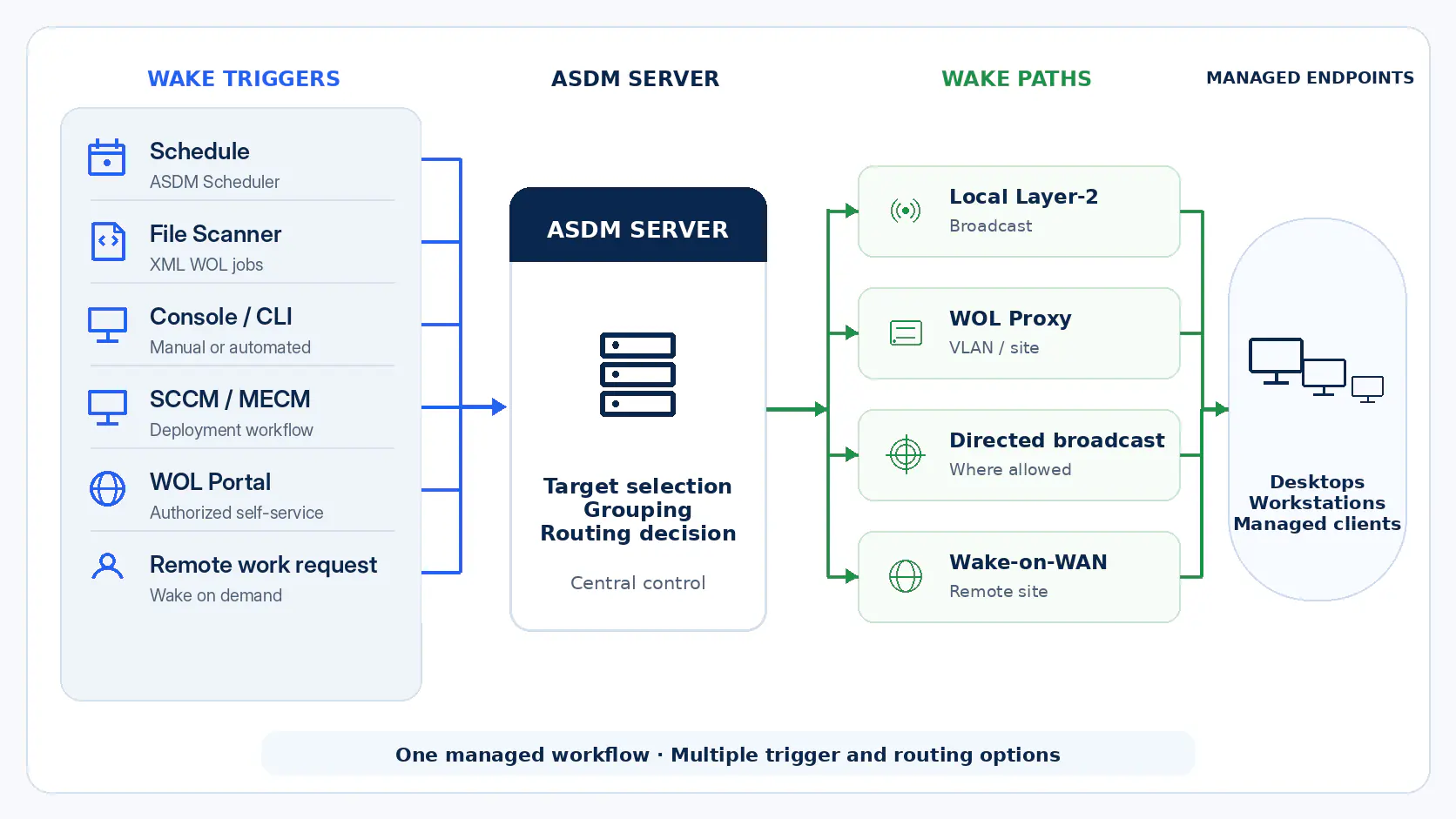
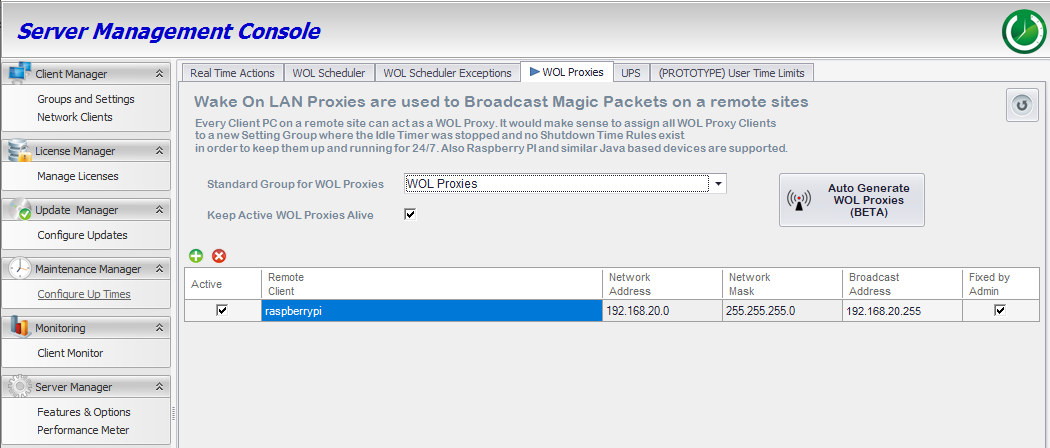
WOL Proxy routing helps IT generate the wake packet inside the target network segment where local broadcast is needed.
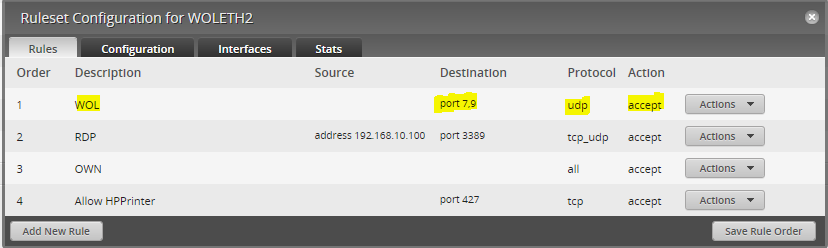
Directed broadcast remains a network-controlled path. ASDM can fit that path where routers and security policy allow routed broadcast forwarding.
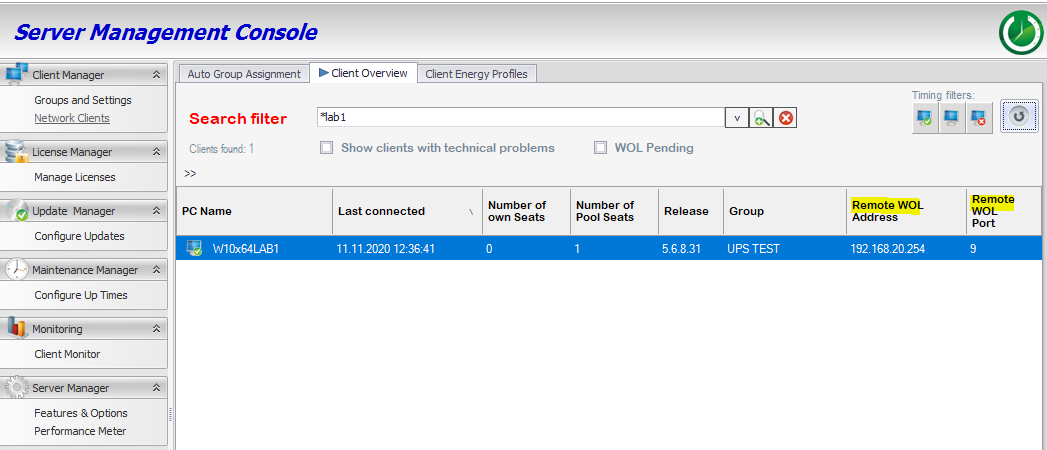
Remote WOL Address / Port is available for special router topologies, such as static-ARP or broadcast-target cases, instead of leaving every exception in separate scripts.
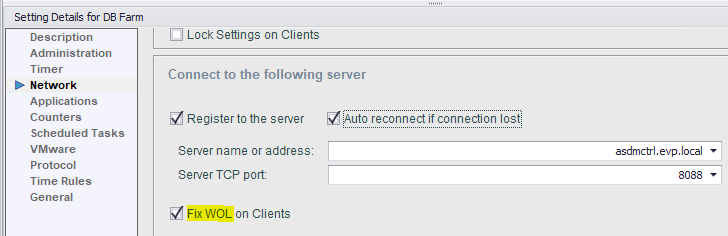
Wake reliability is not only routing. ASDM helps keep client-side wake settings part of policy instead of repeated per-PC troubleshooting.
Wake-up becomes part of a managed workflow instead of scattered tools, one-off scripts and remembered router exceptions.
Routing choices, client readiness and policy control are handled together, which reduces avoidable failure points.
IT can keep endpoint availability without leaving machines powered on simply because wake-up is unreliable.
Admins can explain the wake path, the exception path and the support model without relying on tribal knowledge.
Operational difference
Wake-up becomes reliable when it is designed together with shutdown, user access, network routing, central policy and maintenance operations. Otherwise, IT saves power only to create a new availability problem.
Power savings begin with safely shutting down idle or unused PCs. Wake-up only has value if the device can be brought back when users, admins or maintenance tasks need it.
Enterprise networks often block or limit simple broadcast behavior. ASDM supports WOL Proxy routing, directed broadcast where the network allows it, and Remote WOL Address / Port settings as a special-case override for router topologies that need a static-ARP or broadcast-target path.
Self-hosted WOL Portals can let authorized users or helpdesk teams wake assigned PCs without keeping those systems running all day.
Scheduled, immediate or File Scanner XML job based wake-up helps keep endpoints available for support, patch windows and planned administration without abandoning power-saving behavior.
ASDM is not positioned as a replacement for Microsoft Configuration Manager or similar endpoint-management platforms. It can complement them with centralized power and wake control for maintenance, support and availability workflows.
Client readiness matters as much as network routing. Wake settings, hardware behavior and power states need to be part of the operating model, not left to ad-hoc tools.
Wake reliability protects the energy-saving case. If PCs cannot return when needed, the organization will fall back to leaving them on.
Requirement map
The difference is not just the magic packet. It is the controlled path from “PC is safely off” to “PC is available again”.
Basic WOL tools: Often depend on local broadcast behavior or manual network exceptions.
ASDM: Supports enterprise WOL routing approaches so wake-up can fit segmented endpoint networks.
Basic WOL tools: Usually require separate scripts, router-specific exceptions or manual site-by-site configuration.
ASDM: Lets IT use WOL Proxy routing, directed broadcast where the network allows it, or Remote WOL Address / Port as a special-case override where the environment requires it.
Basic WOL tools: Give admins a wake command, but do not solve controlled user self-service or remote-work wake-on-demand.
ASDM: WOL Portals can let authorized users wake assigned PCs while IT keeps authentication, assignment and ASDM wake routing under control.
Basic WOL tools: Often handle manual wake-up, but not the wider maintenance schedule, external job input or automation workflow.
ASDM: Supports scheduled, immediate and File Scanner XML job based wake-up as part of central endpoint power-state control.
Basic WOL tools: May sit beside Microsoft Configuration Manager or other endpoint tools, but usually remain separate one-off wake utilities.
ASDM: Complements SCCM/MCM and similar tools with centralized power and wake control instead of replacing endpoint management.
Basic WOL tools: Can send a packet, but do not make firmware, NIC settings, power states or network paths reliable by themselves.
ASDM: Keeps client readiness, wake settings and operational validation part of the managed endpoint power process.
Basic WOL tools: Do not decide when a PC should safely shut down or how to avoid disrupting users.
ASDM: Combines shutdown policies, wake reliability and maintenance availability in one power-management workflow.
Basic WOL tools: Usually prove only that a wake command was sent.
ASDM: Helps connect power-state control with reporting, ROI validation and a measurable energy-management process.
Enterprise scenarios
Wake-on-LAN is most valuable when the organization can shut down confidently and still recover availability for real work.
Wake endpoints across segmented locations without treating every router or site as a separate custom project.
Wake clients for planned administration, updates and support work, then return to power-saving behavior afterwards.
Let authorized users wake assigned office PCs on demand instead of keeping those PCs running 24/7.
Keep labs, classrooms and shared endpoints power-managed while still available for schedules and support.
Practical adoption
Do not start by replacing every tool. Start where basic WOL creates the most operational risk: routed sites, remote users, failed wake-ups and maintenance availability.
List the subnets, VLANs, sites and user groups where wake-up needs to work reliably.
Decide where local broadcast, directed broadcast, WOL Proxy routing, Wake-on-WAN or special-case Remote WOL Address / Port settings fit the environment.
Connect wake-up with safe shutdown policies, maintenance windows and user or helpdesk access paths.
Use a controlled site, lab or department to verify wake reliability before scaling the workflow.
Availability and exposure
Enterprise Wake-on-LAN supports a balanced operating model: shut down endpoints when they are not needed, then wake them reliably for users, support and maintenance. Endpoint protection, patching and hardening remain separate responsibilities.
Power-managed endpoints do not need to stay on simply because wake-up is unreliable.
WOL Portals and central wake operations help restore availability when the endpoint is needed.
ASDM supports operational exposure reduction, but it does not replace endpoint security tools.
FAQ
Basic tools can work well on a simple LAN. Enterprise networks often include routed subnets, VLANs, branch offices and remote access requirements. Wake-up then needs routing, policy, user control and operational validation.
No single approach fits every network. Auto Shutdown Manager supports practical enterprise WOL approaches such as WOL Proxy scenarios, directed broadcast where the network and security policy allow routed broadcast forwarding, and Remote WOL Address / Port as a special-case override where the environment requires it.
No. Microsoft Configuration Manager has its own Wake-on-LAN functions for deployment and maintenance scenarios. ASDM adds centralized power and wake control where endpoint availability, shutdown policy, portals, routing and proof need to be managed together.
Yes. The Auto Shutdown Manager File Scanner can process XML job files, so wake-up can be connected to structured operational workflows instead of only manual button clicks.
No. Wake success depends on compatible endpoint hardware, firmware and NIC settings, the current power state and a working network path. Enterprise Wake-on-LAN reduces operational uncertainty, but it does not remove those technical dependencies.
Yes, WOL Portals can provide controlled self-service wake-up for assigned PCs. IT keeps control over access, assignment and routing instead of leaving PCs running all day.
Energy savings depend on being able to shut down safely without losing availability. Enterprise Wake-on-LAN gives IT a path to wake endpoints again for users, support and maintenance after power-saving shutdown.
Not necessarily. Keep simple tools where they are low-risk and useful. Use ASDM where wake-up is part of a managed endpoint power process with routed networks, remote users, maintenance windows and savings proof.
Use Auto Shutdown Manager to connect safe shutdown, Enterprise Wake-on-LAN, WOL Proxy and Wake-on-WAN routing, WOL Portals, automation, maintenance availability and reporting in one managed endpoint power workflow.
Why ASDM · Vs. Native Tools
Windows, Group Policy, Microsoft Configuration Manager and Intune are essential endpoint-management tools. Auto Shutdown Manager does not replace them. It adds centrally managed shutdown and wake-up for organizations that need remote-user wake-up, maintenance-window availability, measurable savings and less avoidable endpoint runtime.
Fair comparison
Windows power settings, GPO, SCCM/MCM and Intune all have a place in endpoint management. They are strong for configuration, compliance, deployment and administration. The gap appears when endpoint power management becomes a daily operating process across users, sites, maintenance windows, remote access and reporting.
Visual quick scan
GPO, Intune and SCCM/MECM remain useful for policy, configuration and deployment. The operational gap appears when user safety, running jobs, maintenance windows, Wake-on-LAN, reporting and daily support have to work together.
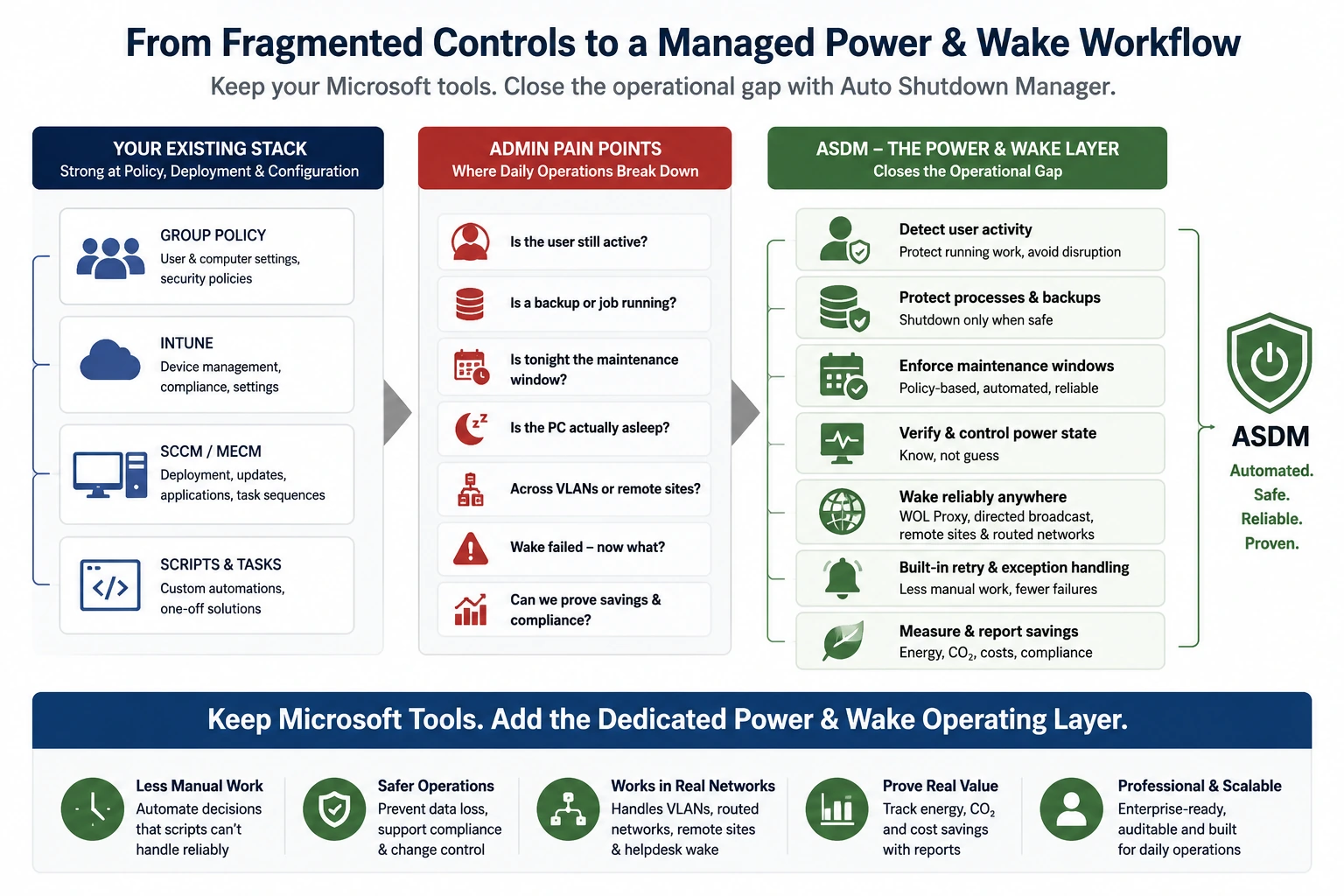
Operating gap
The problem is not that Microsoft endpoint tools are weak. The problem is that power state, user safety, wake-up, routed networks and proof become one daily operating workflow.
Windows power settings / GPO
Baseline settings do not know whether work is still active, whether an exception is justified, or whether runtime savings are actually being achieved.
Auto Shutdown Manager adds safe idle detection, user-aware power workflows and central runtime, savings and CO₂ reporting.
SCCM / MECM / Microsoft Configuration Manager
Maintenance windows need endpoints awake at the right time, while shutdown, wake, support and remote access must not conflict.
ASDM connects shutdown reduction with scheduled wake, maintenance readiness, WOL Portals, remote availability and proof.
Microsoft Intune
Cloud policy does not wake sleeping PCs across real network paths, remote sites and routed networks on its own.
ASDM provides self-hosted Wake-on-LAN functions for routed networks and assigned PCs.
Custom scripts and scheduled tasks
Scripts depend on the people who wrote them. Routing exceptions, retry behavior, handover and reporting stay fragile.
ASDM turns these exceptions into a supported product workflow with central policies, retries, reporting and less script sprawl.
Operational gap
Once power management has to support real users, distributed networks, patch windows, remote access and reporting, IT needs a controlled process from detection to proof.
Is the endpoint really idle, or is work still happening?
Avoid interrupting users, business hours, jobs and maintenance.
Apply controlled shutdown, sleep, hibernate, restart or logoff policies.
Bring PCs back for updates, support, remote access or scheduled work.
Report runtime, savings, cost and CO₂ impact.
Requirement map
The practical difference is ownership. Native tools provide important controls; Auto Shutdown Manager adds the daily operating workflow around shutdown, wake, exceptions and proof.
Native-tool fit: Strong fit for standard settings and policy distribution.
ASDM: Turns policy into a managed runtime process with decisions, exceptions and reporting.
Native-tool fit: Basic timers or custom logic may cover simple cases.
ASDM: Adds controlled idle detection, rules and user protection before shutdown.
Native-tool fit: Supported in some endpoint-management scenarios.
ASDM: Connects reduced runtime with scheduled wake and maintenance readiness.
Native-tool fit: Depends heavily on network design and the deployment scenario.
ASDM: Adds enterprise wake concepts for routed networks, sites and daily operations.
Native-tool fit: Not the main focus of native policy tools.
ASDM: Self-hosted WOL Portals can provide controlled user wake-up paths.
Native-tool fit: Usually not the main focus of configuration tools or scripts.
ASDM: Supports estimation, pilot validation and reporting for management decisions.
Native-tool fit: Depends on policy coverage, scripts and operational discipline.
ASDM: Reduces unnecessary runtime while preserving wake-up and maintenance availability. ASDM does not replace endpoint security tools.
Where it matters
Endpoint management tasks need PCs to be available at the right time. ASDM helps reduce unnecessary runtime while waking machines when planned work needs them.
Explore remote shutdown and wake-up →Remote access tools solve the session. They do not solve the availability problem before the session starts. WOL Portals help users wake assigned PCs on demand.
Explore WOL Portals →Power management projects need more than assumptions. ASDM supports estimation, trial validation and reporting for energy, cost and CO₂ impact.
Open ROI Calculator →Power management is not a security product. But unnecessary runtime can mean unnecessary exposure for unattended office PCs that do not need to stay online.
Explore safe idle shutdown →Evaluation path
Start small. Validate the behavior in your own environment. Then decide whether the ASDM power and wake functions are worth scaling.
Use the ROI Calculator to estimate potential energy, cost and CO₂ savings.
Test with a controlled group, site, lab or department before rollout.
Check shutdown safety, Wake-on-LAN reliability, maintenance windows and user impact.
Use reporting and operational feedback to decide how far to scale.
FAQ
No. ASDM is designed to complement existing endpoint-management tools. It adds a dedicated power and wake workflow for safe shutdown, reliable wake-up, user self-service wake and savings proof.
Yes, Configuration Manager supports Wake-on-LAN for supported deployment scenarios. ASDM focuses on the broader operational workflow: safe shutdown, scheduled availability, routed Wake-on-LAN concepts, WOL Portals and reporting.
Group Policy is useful for baseline settings. ASDM adds runtime logic, central operations, Wake-on-LAN infrastructure, reporting and user-facing wake workflows.
Scripts can solve narrow tasks, but they often become difficult to maintain, audit and scale. ASDM provides a ready-made product with central policies, logs, reporting, portals and a trial path.
No. ASDM is not an endpoint security product. It can support operational exposure reduction by helping avoid unnecessary runtime, while endpoint protection, patching and hardening remain separate responsibilities.
Yes. Start with the ROI Calculator and the 45-day Enterprise Trial. Validate shutdown behavior, wake reliability, maintenance windows and reporting in your own environment.
Evaluate Auto Shutdown Manager where native tools and scripts usually stop: safe shutdown, reliable wake, remote availability, less avoidable runtime and proof of savings.
Product · Release notes
Review new capabilities, improvements and fixes by version. Each release can be opened individually, so IT administrators can reach the relevant technical details quickly.
Select any release below to view its documented changes.
Faster technical review
The release history is organized by version, so you can quickly jump to the updates that matter most to your deployment.
Managed clients: On the server, open Client Overview and check the Release column. It shows the currently installed release for each client.
Stand-alone installation or the server itself: Open Auto Shutdown Manager and check the release number in the lower green area of the application window.
Expand only the versions relevant to your deployment or update path.
Use the Download Center for available packages or the upgrade guide for Release 5 preparation.
Release archive
The newest product changes, maintenance releases and platform updates. Select a version to view its documented changes.
Unwanted scheduled tasks or applications that unexpectedly wake PCs can now be permanently disabled or deleted directly in the GUI under Scheduled Tasks.
Server: Settings can now be retrieved from clients to create new settings groups or to add time rules, monitored counters, applications, and IP monitoring clients to existing policy groups.
Added asset reports with export options for PDF, Excel, and CSV.
Assets: Fixed memory reporting for integrated GPUs.
Added monitor DDC management for S0-based PCs / Modern Standby PCs with external monitors. This allows (most) external monitors to be turned off automatically during longer or unattended runtimes, and PCs can optionally be locked for improved energy savings and security.
Fixed a bug in client savings calculations that caused savings to be underreported.
Fixed an issue affecting German umlauts on some systems
Resolved minor issues in File Scanner and Asset Management
Update for Auto Shutdown Manager Server – File Scanner XML jobs:
Update for Auto Shutdown Manager Server – File Scanner XML jobs:
Bug fix for the Auto Shutdown Manager Server:
Auto purge of outdated clients has been fixed and should now work even on systems with a modified sliding window (Days for pool license lease).
FileScanner
From this version onward, .NET Framework version 3.5 is no longer supported. Instead, .NET Framework 4.x is required, which, however, has already been preinstalled as a standard Windows component since Windows 8.
New feature added: Visual Time Rules Editor, which helps adjust the times of Time Rules via mouse and keyboard. It also provides a better visual overview of days and weeks.
Fix for Devices in Modern Standby:Laptops that are in S0 mode (Modern Standby) will now transition to hibernation more reliably when running on battery power and the lid is closed. This prevents battery drain and overheating.
New feature added: Visual Time Rules Editor, which helps adjust the times of Time Rules via mouse and keyboard. It also provides a better visual overview of days and weeks.
Fix for Devices in Modern Standby:Laptops that are in S0 mode (Modern Standby) will now transition to hibernation more reliably when running on battery power and the lid is closed. This prevents battery drain and overheating.
5.7.8.5: Additional internal fixes for safer hibernation from Modern Standby
Fix for Devices in Modern Standby:Laptops that are in S0 mode (Modern Standby) will now transition to hibernation more reliably when running on battery power and the lid is closed. This prevents battery drain and overheating
Fix for devices in Modern Standby:
Laptops that are in S0 mode (Modern Standby) will now transition to hibernation more reliably when running on battery power and the lid is closed. This prevents battery drain and overheating.
Replaces version 5.7.7.49
Update: Enhanced Time-Rules user interface based on user feedbackIf you are using the EnviProt Modern Standby Wake Driver, please update it to the latest version (1.3) as well. You can find it under Downloads.
ADD-ON: Waking Notebooks and PCs from Modern Standby (S0)
Auto Shutdown Manager now includes an S0 Wake Driver to address the difficulties many users have reported when waking from Modern Standby on Windows 11/10. Update to version 5.7.7.46 or later, install the .msix package from ModernStandByWakeDriver.zip (which includes a manual), and then configure TimeRules in Auto Shutdown Manager to schedule wake events from S0 or hibernation as usual.
Fix: Asset Management:
Removed clients and their associated resources (monitors, HDDs, RAM modules, GPUs, motherboards, BIOS versions, printers, software, operating systems, etc.) are now immediately reflected in Asset Management.
Fixed: The user interface was not loading correctly on some multilingual systems.
Fixed: Modern Standby (S0):
Systems that inadvertently wake during Modern Standby will still transition to hibernation after the configured timeout.
This prevents overheating and battery drain, especially for laptops stored in a bag. It also significantly reduces power consumption.
Added some minor updates to the GUI.
Change in Service Startup from 'Delayed' to 'Automatic'
The Auto Shutdown Manager Client now starts more quickly after a system reboot. This change takes effect only during a fresh installation.
For updates to existing installations, the startup mode remains set to 'Delayed'. If needed, you can manually change this setting by navigating to:
Services ➔ ASDM_Service ➔ PropertiesAdditionally, the recovery action for the first service failure has been set to "Restart the Service". Previously, no action was specified for this scenario.
Improved the user interface for editing time rules.Improved overall system stability.
New Features:
1) Modern Standby* (S0iX):
Limited support has been added for low power mode S0, also known as "Connected Standby" or "Modern Standby."
Background: Microsoft is increasingly replacing the traditional Standby (S3) with "Modern Standby" (S0). In S0, the CPU remains active, which, despite operating in a lower power mode, can drain the battery in some mobile devices and cause overheating when the lid is closed, and the laptop is stored in a bag. Modern Standby activates as soon as the monitor is turned off.
The Auto Shutdown Manager now switches the system from Modern Standby to Hibernation after a predetermined period to avoid these issues. The session is fully preserved, similar to Standby. Additionally, the Auto Shutdown Manager can prevent the monitor from turning off if the device is in use or if time rules are defined to prevent automatic shutdown, such as during office hours. After work hours, the system can automatically hibernate or shut down completely.
Features added:
1) Set a timer to hibernate the system after it has remained in Modern Standby for X minutes while running on AC power - for example, 2 hours.2) Set a timer to hibernate the system after it has remained in Modern Standby for X minutes while running on DC power (batteries) - for example, 10 Minutes.3) Option to prevent the screen from turning off to avoid unwanted Modern Standby when the system is needed for productive use (even if users are not actively working).When energy saving is desired (e.g., when the idle timer reaches 0) and the default shutdown mode is set to standby, S0 is used. With the hibernation timers mentioned above, the system can be set to hibernate after a delay. To avoid overheating or drained batteries on mobile devices, set the hibernation time on DC to a low value, such as 5-10 minutes.
*) Please note that this is currently a BETA feature.
2) Advanced Input Detection:
This new option detects user activities from touch screens, pens, and other input devices, leading to more reliable idle detection.
Fixes:
The user interface is now more responsive to high-resolution displays and zoom values.Some other minor fixes have been added such as better noise detection for example to prevent unwanted shutdowns during phone calls or meetings, Asset Management reports improved and more.
Smaller fixes in Asset Management.
Smaller fixes in user interface (UI).
Bug fixes:Small fix in Asset Management
Bug fixes:GUI: Completely hide the Auto Shutdown Manager GUI from the ALT-TAB list.
Asset Management: size of GPU Memory fixed
Release archive
Release notes covering product development from 2019 through 2023. Select a version to view its documented changes.
Feature update:
Remotely restart, shut down, or wake-on-LAN (WOL) PCs from a controlling PC. For instance, in educational settings, you can set up control shortcuts on the desktops of teachers' PCs to remotely restart, shut down, or wake the PCs in the same room as the teacher's PC.
Fixes:
The idle shutdown timer counted down for the remainder of the minute even if a "Disable Auto Shutdown" Time-Rule was enabled. This was just a lagging display issue that has now been fixed.
Features:
Added "Remakrs" column to client overview. Now administrators can add comments or their own notes to each client.
Fix (5.7.5.7):Improved idle analysis of complex performance counters such as video rendering via GPUs.
Fixes:
Sometimes the screen gets locked if the user logs in a long time after the PC has started up.
Improved performance and reduced load on the database
Descriptions & manuals updated
Minor fixes.
Fix for the MECM/SCCM plugin. FQDNs are now created even if they are missing. This is important to correctly identify the clients on the Auto Shutdown Manager server to process WOL and shutdown commands directly from MECM/SCCM and for the deployment plans.
Minor bug fixes
Minor bug fixes for Asset Management
Minor bug fixes
The start behavior of the application has been improved
Replaces 5.7.3.42 / 5.7.3.32 / 5.7.3.31 / 5.7.3.29 / 5.7.3.28
New Features:
PC Asset Management in BETA version. The newly introduced asset management functionality in the Auto Shutdown Manager Management Console helps IT administrators and managers stay up to date on important assets in their IT environment. The asset data is read directly on the clients and automatically updated on the server. PC Assets supportedCurrently, the reports provide detailed information on the following PC assets:• BIOSes ($am.bios) incl. TPM Chip• Computer Models ($am.pcmodel)• Computer Types (Desktops, Mobile, Servers, Workstations,…) ($am.pcmodel.Type)• CPUs ($am.cpu)• Hard drives ($am.nic)• Installed Software ($am.soft)• Monitors ($am.monitor)• Motherboards ($am.mb)• Network Interface Controllers ($am.nic)• Operating Systems ($am.os)• Printers ($am.printer)• Video Controllers ($am.vc)Example Windows 11 TPM: for the upcoming Windows 11, find all clients that do offer the required TPM (Trusted Platform Module) support.To find out, navigate to "Client Overview" and enter the following filter: $am.bios.TPM_Exists = yes All clients that support TPM will be shown. With $am.bios.TPM_Exists = no , all clients that do not support TPM will be shown.Open the client asset details to get more details such as if TPM is enabled, the TPM version, the supported TPM Spec version and more.Further featuresClients can be found by specifying certain asset parameters. For example, find all clients with network drivers older than 10 years:Enter the search filter starting with $am., which stands for asset management: following by the asset category like NIC (network interface controller) followed by the asset detail like DriverDate like this: $am.nic.driverdate < 2011/1/1 (the date format ma depend on your local region)Another example. Find all clients where the Hotfix KB5003637 is currently missing (missing is marked by the ! symbol):$am.soft.version! = KB5003637
Minor Bug fixes: GUI did not start on some systems when there were issues with the config file. This is fixed now.
PLEASE NOTE: WHEN UPDATING THE AUTO-SHUTDOWN-MANAGER SERVER TO THIS RELEASE, PLEASE MAKE SURE THAT ALL CLIENTS ARE AT LEAST AT RELEASE 5.2.3.2 (Build April 2016) or newer
New Features:
Auto WOL configuration: configure required WOL parameters on clients automatically. Let Magic Packets only wake the PCs to make sure the PCs only wake up when they should. Disable Fast Startup on Windows 10 to avoid general WOL problems. Some other required options are automatically configured to make WOL usage as reliable as possible by minimizing administrative burden.
Limit total time spent on computer per user account (prototype): Enter individual users or AD user groups that should be monitored with regard to their daily PC time usage. Based on an assigned time profile, users are given a certain time per day as well as a certain time window in which they are allowed to use certain PCs.
Windows 10: Locking / Unlocking Computer improved: Now PCs can be locked in sleep mode but will remain unlocked if only the display is turned off.
When using the Windows-Key + L (lock computer), the monitor can be switched off immediately to save energy.
Advanced Time Rules
More complex timing rules can now be created. In addition to the previous format, two other actions have been added:• Run Scripts or Applications at the given time• Change the Idle Timer timing from the given time
In addition to the older “Daily, Weekly, OneTime” patterns, more complex timing patterns can now be used, including:• Run every last day of every x month (e.g. run last day of January, - March, - May, aso.).• Run every last Monday, Tuesday, ..., Sunday every x month• Run every Friday or every x Mon-Fri (e.g. run every second Friday)• Run X times only • Stop after the date (e.q. run daily but stop after December 31 2021)• And more
Time rules can now be modified.A new timing preview window helps check the timing pattern.
Auto Group Assignment: added Active Directory Group selection dialog. This simplifies assigning of client PCs to Setting Groups based on their AD Group membership
New Advanced WOL Portal
A new managed, Active Directory based Intranet / Internet WOL Portal has been added to the download area. Enable home office users to remotely activate their office PCs in a secure and easy way.
Fixes:
New Features:
none
Fixes:
The "Time Limit" function did not shut down the PC
New Features:
EnviProt now supports uninterruptible power supply devices (UPS) from Alltronic Powersystems GmbH. In the event of a power failure in the server room or data center, individual computers and servers - or entire computer groups - can be shut down immediately or with a delay using the UPS Manager. After the power has been restored, selected computers or entire computer groups can be restarted automatically via Wake On LAN.
Fixes:
A few minor fixes within the user interface
Fixes:
Under certain circumstances, some clients were locked immediately after logging in. The user had to log in again.
Fixes:
PLEASE NOTE: WHEN UPDATING THE AUTO-SHUTDOWN-MANAGER SERVER TO THIS RELEASE, PLEASE MAKE SURE THAT ALL CLIENTS ARE AT LEAST AT RELEASE 5.2.3.2 (Build April 2016) or newer
Fixes:
Wrong calculation of "Seats in use" on the server in some special cases like after the server ran out of licenses.
Fixes:
New Feature / Improvements:
The tab Client Structure has been removed and replaced by additional Group Filters in Client Overview.
Now clients can be assigned to- or moved between groups much easier.New client search filters added. Find clients now by IP ranges, AdGroup memership, Distinguished Names and much more.Added new Server Monitoring and Server Manger Editor. Now, it is easy to change the default 90 days license lease period for clients
Some other fixed and other minor improvements were added.
Release archive
Earlier Release 5 updates and the first Release 5 publication. Select a version to view its documented changes.
The Auto Shutdown Manager GUI und Service now start faster on Windows 10 after a system restart.
New minor feature added:
Now, when starting the AutoShutdownManager.exe while it is already running the GUI is shown.
This is a bug fixing release.
Clients that were not assigned to a group and if the "Default Group" wasn't set, the clients were not visible in Client Structure.
This is a bug fixing release.
Auto Group Assignment Filters for Active Directory Groups (@ADGROUP:) did not work in some circumstances.Some other smaller bugs were also fixed.
This is a bug fixing release for 5.5.2.8, which should be urgently installed.Background: With 5.5.2.8, there was a file missing called “asdm_ds_s.xml”This file was used in previous versions prior to 5.5.2.8. The previous release 5.5.2.8 expects it to be within the installation folder. If it is missing, saving of client changes, group assignments, licensing data and others will not work properly or could be event reset to default values.
New feature added.File Scanner: reads external XML based job files to automatically schedule WoL plans, delete or move clients, and add or remove WoL-Proxies.
In a mixed environment of .NET3.5 and .NET4x based clients some older clients possibly didn’t update setting changes made on a server running the previous release 5.5.0.12. This update solves this issue. It needs to be installed on the server only. Updating the clients isn't necessary.
Starting with the Auto Shutdown Manager release 5.5 the Microsoft .NET Framework Version 4.x is required for new installations. Updates to clients with the .NET Framework 3.5 only are supported via the internal Auto Shutdown Manager Update Manager.
Minor internal fix to improve saving of client data.
+ Performance and stability update: tested with over 30.000 clients per server+ Support for Raspberry Pi as WOL Proxy+ WOL Proxy Monitor: automatically monitor and wake up WOL proxies+ Support for Server Core installations (gui and management console can be made visible via new command line option)+ Minor Bugs fixed
+ Performance and stability update: tested with over 30.000 clients per server+ Support for Raspberry Pi as WOL Proxy+ WOL Proxy Monitor: automatically monitor and wake up WOL proxies+ Support for Server Core installations (gui and management console can be made visible via new command line option)
This update includes several internal optimizations and improvements.New search- and timing filters in Clients Overview and Client StructureTurn off the display after computer was locked Lock computer after the turning off the display
New Wake On LAN feature: FileScannerNow, the Wake on Lan Scheduler on an Auto Shutdown Manager Server can process so called WOL Job files containing information about the timing, recurrence, weekdays, expire timing and lists of PCs to schedule and wake remote PCs. The WOL job files are plain text files following an easy XML format that is explained in the manual.
SCCM Bridge doens't open: The SCCM Bridge didn’t open in some environments. This was a bug and it is fixed now.
Others:Few other minor fixes and improvements
SCCM:Packages: added support for Package deployment WOL schedules . Now Auto Shutdown Manager Server can be used to wake (WOL = Wake on LAN) SCCM based deployments of Applications,Updates and Packages.SCCM Bridge optimized: now the SCCM bridge is able to limit the deplyoments to a few days in ahead, this reduces the overall overhead.
VM:Fixed VMware Workstation 12Pro support (start, suspend and WOL virtual machines). Start or suspend selected VMs together with the host – or automatically wake VMs per WOL (via magic packet broadcast).
Others news and fixes:Auto saving of open MS Office documents before shut down:Added support for MS Project documents. Now, Auto Shutdown Manager can save open Outlook, Word, Excel, Power Point, Visio and Projekt documents before shutting down or suspending the system. Documents can be saved back to their origin or as a local copy.Some smaller fixes in the user interface
Fixed: WOL Scheduler Exceptions Days.
Fixed Windows 10 Timing issues at startup.
Fixed SCCM WOL issue for SCCM collections which contain clients not connected to ASDM.Now WOL is executed correctly for these collections too, and reports can be found in the Management Console -> Client Monitor.
Fixed timeout problem at startup for Windows 10Changed code signatures from SHA1 to SHA256Improved auto configuration for installed applications
Added WOL for Windows Update Plans to SCCM WOL Application Deployment Scanner. In addition to application deployments, now, the Auto Shutdown Manager Server also wakes PCs based on the Windows Update Plans defined in SCCM.
SCCM WOL Application Deployment Scanner bug fixes and efficiency improvements
Key news and functions:Own Tool (or Application) can now be executed by a time rule to display own messages or just to be started. The application is started in the context of the currently logged on user. Enter the complete application path into the message field of a Display Message Time Rule. Parameters can be added after the application path. Path names with white spaces should be enclosed within quotation marks “”
Mass changes of Remote WOL Address and Remote WOL Port within the Management Console -> Client Details added.
Key news and functions:WOL for SCCM Application Deployments: WOL via Auto Shutdown Manager now only wakes PCs that are in the selected SCCM Collection. Other PCs that belong to the same Auto Shutdown Manager group won’t be awoken.
(BETA)Own Tool (or Application) can now be executed by a time rule to display messages or just to be started. The application is started in the context of the currently logged on user.Enter the complete application path into the message field of a Display Message Time Rule. Parameters can be added after the application path. Path names with white spaces should be enclosed within quotation marks “”
Key news and functions:Added filters into Client Monitor (Management Console, only usable with Database).
Key news and functions:Added SCCM Application Deployment Scanner. Now, the Auto Shutdown Manager Server can be used to process Wake On LAN (using the reliable Auto Shutdown Manager WOL infrastructure incl. WOL Proxies, etc.) scheduled by SCCM application deployments (German: Anwendungsbereitstellungen).Optional: Anotehr SMS Provider can now be addedOptional: further ASDM Server addresses can now be provided
This update has some internal optimizations and improvements.
Fixed SCCM Plugin - Default installation path can now be changed correctlyRemote Shutdown of PC-Groups can now be performed form an admin PC other than the ASDM Server. For example a teacher PC can now restart or shutdown all student PCs in the same room.Some other smaller fixes and improvments.
Some fixes for display handling.
New functions and features include
WOL for VMs (BETA). Now Auto Shutdown Manager can start VMs when a WOL Magic Packet was received. The virtual machine is identified based on the coded MAC address within the Magic Packet and automatically started like if it was a physical PC.VMware Player is now also supported to start virtual machines.
SCCM 2012R2 Plugin Integration:Auto Shutdown Manager now comes with a Plugin for the Microsoft System Center 2012R2 Configuration Manager©. This PlugIn allows the shutdown and Wake-On-LAN (WOL) of individual PCs or entire collections via the Auto Shutdown Manager Server. This is very helpful to use all the configured WOL capacities like Directed Broadcasts or WOL Proxies within the Auto Shutdown Manager Server to achive a working and reliable WOL system across various IP Networks, VLANs or even the Interent directly from the SCCM Console.
Added some fixes to the user interface.
New feature added: Wake On Lan Proxy (WoL Proxy).This feature is helpful in order to wake up PCs via WOL in different IP Segments or VLANs when directed broadcasts can’t be used. In this case one WOL Proxy PC per segment can be setup and kept on running 24/7. Auto Shutdown Manager Server then redirects WoL commands depending on the IP address of the Client to a particular WoL Proxy PC where a local broadcast is being generated. Some smaller modifications of the user interface were implemented.
Some minor fixes and handling improvments.
Fixed issues around detection of running applications on some systems.TimeRules are more accurate now.
Please note that this is the first Auto Shutdown Manager Release 5.
Release archive
Archived notes from releases preceding Release 5. Select a version to view its documented changes.
Several changes have been made to the initial setup and startup process of Auto Shutdown Manager after installation. Also, smaller bugs have been fixed.If a PC Wakeup Time Rule is used to automatically wake up the PC at a specified time, Auto Shutdown Manager always checks if the Windows wake timers are enabled (Vista, Windows 7, Windowds 8, Server 2008R2, -2012) and enables them if needed.
- New Update build May 2009New Features added:- Central Database support. Now, all client events and reports can be logged into a central database.- Central report about the overall savings for all clients and servers- Product icon now can be hidden on all clients or specified client groups- Soft-Sleep-Mode: to avoid wakeup problems with some 3rd party Software
Next step
Check the upgrade prerequisites, then use the Download Center for the currently available installation resources.
EnviProt technical guide
PC power management controls when workplace PCs, notebooks, and comparable endpoints are active, in a low-power state, or shut down. In enterprise environments, the objective is not the shortest possible timer. It is controlled runtime: avoid disruption during defined working hours, identify genuine idle time, protect active work, wake devices for maintenance, and measure the results.
In brief
PC power management encompasses the rules, tools, and operating processes organizations use to control endpoint power states. This includes automated shutdown or transitions to low-power states, scheduled or on-demand wake-up, and analysis of actual device runtime.
In professional environments, a policy must reconcile two objectives: reducing avoidable runtime and keeping required devices available. A shutdown is therefore useful only after working hours, user activity, applications, background processes, maintenance, and defined exceptions have been considered.
Why it matters
PC power management solves a common conflict in IT operations: workplace computers should not remain powered on overnight, at weekends, or during long periods of inactivity when nobody needs them—but they still have to be available for users, remote access, patching, software deployment, and maintenance.
The practical answer is neither to leave every PC running around the clock nor to shut devices down at a fixed time regardless of actual use. Professional PC power management matches runtime to real demand: protect active work, avoid unnecessary operating hours, wake devices when needed, and evaluate the results.
PCs run only for as long as users or IT processes actually need them. This reduces avoidable electricity consumption outside working hours and the associated energy costs.
Running PCs release electrical energy as heat into their surroundings. In air-conditioned offices and technical areas, a lower IT load can therefore also reduce cooling demand.
When a device fleet consumes less electricity, the emissions associated with that consumption also fall. The actual impact depends on the device mix, previous runtime, and the electricity mix being used.
Patching, software deployment, and maintenance do not require workplace PCs to remain powered on every night. Devices can be woken for a maintenance window and returned to the intended power state afterwards.
Fully shut-down workplace PCs that are not needed are not running operating systems or services on the network outside their usage periods. This does not replace patch management or EDR, but it reduces the time unnecessary endpoints remain active.
IT teams do not have to rely on every user shutting down correctly or switch devices on manually before maintenance. Rules, exceptions, and maintenance periods can be managed centrally.
The real savings potential depends primarily on the number of devices, their power draw, previous runtime, and existing energy-saving policies. Measuring actual runtime first provides the baseline for targeted optimization.
Good to know
Wake-on-LAN is widely supported by current business PCs, and many fleets already have the technical prerequisites in place. When the function is enabled in BIOS/UEFI and for the network adapter, suitable systems can also be started from the ACPI state G2/S5 (“Soft Off”). This keeps them available for scheduled patching or maintenance without leaving them powered on all night.
Reliable Wake-on-LAN depends on the whole chain: client readiness is just as important as routing. A pilot with representative device models quickly shows which firmware, driver, and power settings are needed in the environment and how Windows Fast Startup affects the result.
ASDM supports both the client and network sides of this process. Supported client-side WOL settings such as Wake on Magic Packet and—where supported—the handling of Windows Fast Startup can be managed centrally. Depending on the network, delivery can use local broadcasts, directed broadcasts, or WOL proxies. This turns an existing hardware capability into a predictable wake-up workflow.
Technical perspective: the exact S5 path remains model- and configuration-dependent. That is why it belongs in the pilot; it is not a reason to default to 24/7 operation.
S5 / Soft Off in the glossary · Enterprise Wake-on-LAN: client readiness and routing
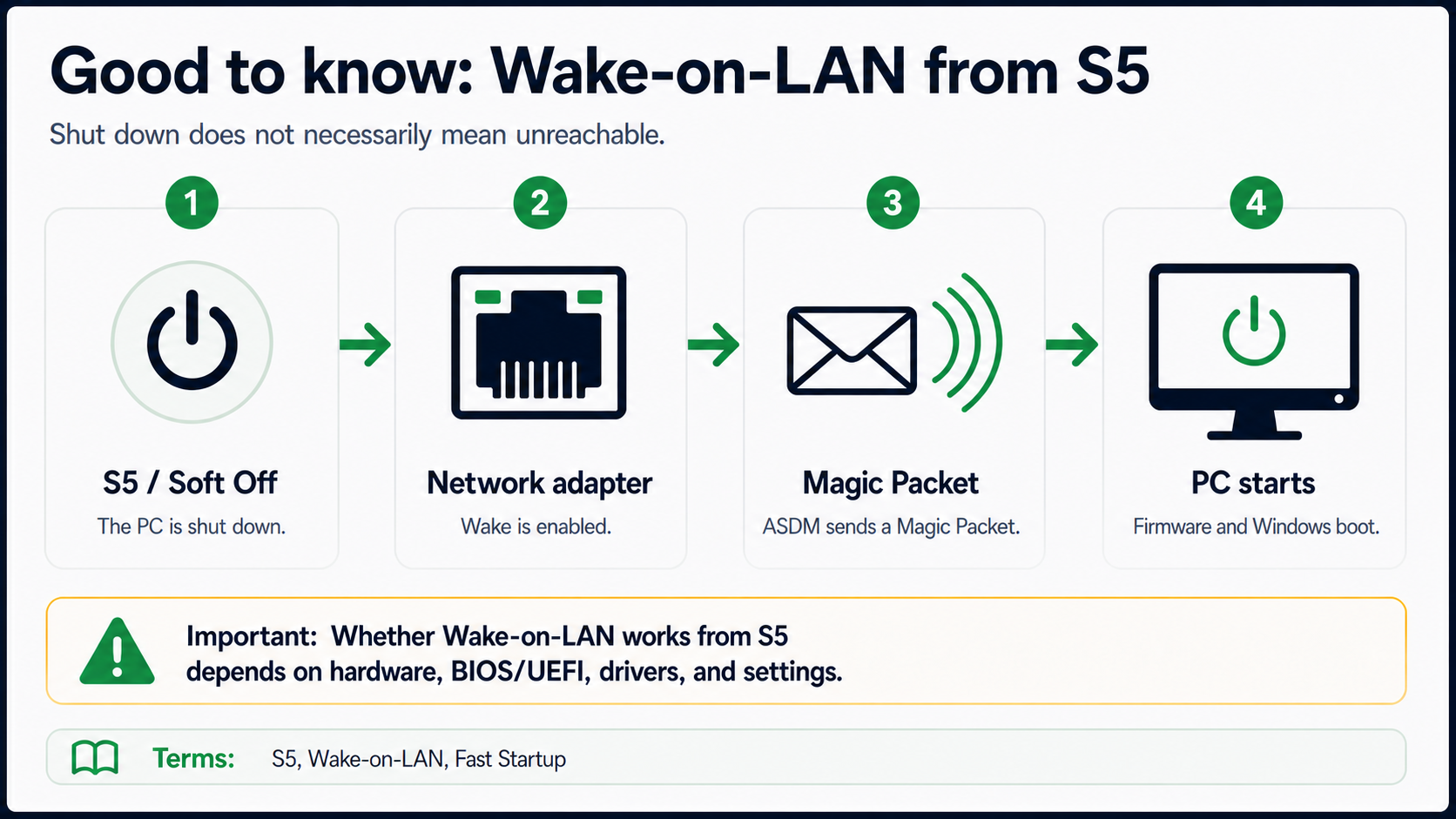
Operational challenge
Windows power options provide a useful technical foundation. Managed environments introduce additional requirements when different user groups, maintenance windows, remote access, or multiple sites must be handled together.
PCs remain powered on after work although neither users nor scheduled tasks need them. Fixed shutdown times also fail to accommodate shift work, flexible hours, or different departmental rules.
Keyboard and mouse activity alone do not establish whether a device is unused. Applications, file transfers, presentations, remote sessions, or background processes may still be doing productive work.
Updates, software distribution, and maintenance tasks require reachable endpoints. Devices must be woken before the maintenance window and returned to the intended policy afterwards.
Local Wake-on-LAN broadcasts normally stop at router and VLAN boundaries. Branch offices and routed networks therefore require a deliberately designed, manageable delivery path.
Windows and hardware
ACPI distinguishes global power states (G) and the system states (S) within them. The appropriate state depends on the device, its use, required availability, and available wake support. Actual behavior remains dependent on hardware, firmware, drivers, and Windows configuration.
| ACPI state | Technical meaning | Operational use |
|---|---|---|
| G0 / S0 – Working | The computer is operating; processor, memory, and devices are ready for use. | The system remains in S0 even when the display is off. “Display off” is not a separate S-state. |
| G0 / S0 Low Power Idle – Modern Standby | The system remains in S0 but transitions dynamically between active and low-power phases. | Modern Standby devices do not also use the classic S1-to-S3 sleep model. Network and background activity depend on the platform and policy. |
| G1 / S1 – light sleep state | Processor and system-bus clocks are stopped while system context is retained. | Fast resume, but rarely implemented as a regular Windows sleep state today. |
| G1 / S2 – deeper sleep state | Processor and cache context are lost while memory and system context are retained. | Also rarely implemented; technically and energetically between S1 and S3. |
| G1 / S3 – traditional standby | Only memory retains system context; most other components are powered off. | Fast resume on supported PCs. Wake-on-LAN and other wake sources depend on hardware, firmware, and configuration. |
| G1 / S4 – hibernation | Windows writes system context to the hibernation file, so memory no longer needs to remain powered. | Suitable for longer absences while retaining the session. Resume takes longer than from S3. |
| G2 / S5 – Soft Off | The operating-system session has ended; only circuitry for defined wake events may remain powered. | Typical after work and during long unused periods. Open work must be saved before shutdown. |
| G3 – Mechanical Off | The system is mechanically disconnected from its normal power supply. | No normal software- or network-controlled wake-up; unsuitable for centralized Wake-on-LAN processes. |
Important special cases: Hybrid Sleep combines a sleep state such as S3 with a copy in the hibernation file, but it is not an additional S-state. Windows Fast Startup may use S4 instead of a complete S5 shutdown. powercfg /a lists the states available on a specific PC. The IT administrator glossary explains the terminology.
The technical basis is provided by the ACPI definitions in the UEFI Forum specification and Microsoft's documentation of System Power States and Modern Standby. External technical references
Tools and responsibilities
These approaches are not mutually exclusive. In many organizations, Windows provides the foundation, an endpoint-management system distributes configuration, and a specialized solution adds operational control of shutdown, wake-up, and reporting.
| Approach | Well suited to | Typical limitation |
|---|---|---|
| Windows power options and Group Policy | Consistent baseline settings, local timeouts, and centrally distributed configuration | Complex user, process, wake, and reporting workflows require additional logic. |
| UEM, Intune, or Configuration Manager | Device configuration, compliance, software distribution, and maintenance organization | The complete power workflow is only one part of a much larger management system. |
| Scripts and Task Scheduler | Narrowly defined, stable individual tasks | Exceptions, routing, error handling, document protection, and evidence increase maintenance effort. |
| Wake-on-LAN infrastructure | Waking supported devices locally or through planned relay paths | Wake-on-LAN does not decide when a shutdown is safe and does not provide runtime reporting by itself. |
| Specialized endpoint power management | Shutdown, wake, maintenance, and reporting workflows across groups and sites | Policies and wake paths must still fit the environment and be tested before rollout. |
For a more detailed assessment, see the comparison with SCCM, Intune, and Group Policy. For in-house development, the comparison with custom scripts shows which operational tasks frequently remain.
Selection criteria
A dependable solution should do more than send shutdown commands. What matters is how it combines normal operations, exceptions, maintenance, and distributed networks.
No unwanted shutdowns occur during defined office, core, or shift hours. Flexible idle and exception rules apply outside those periods.
In addition to input devices, relevant signals may include applications, CPU, disk and network activity, processes, sessions, and administrator-defined exceptions.
Warnings, postponement options, and a defined process for open or unsaved documents reduce the risk of data loss.
Devices are made available before updates or deployments and are not shut down by competing rules during protected maintenance periods.
Controlled paths such as authorized directed broadcasts or WOL proxies are available for VLANs, subnets, and branch offices.
Runtime and derived energy, cost, or CO₂ values remain traceable together with their assumptions, periods, and limitations.
Practical introduction
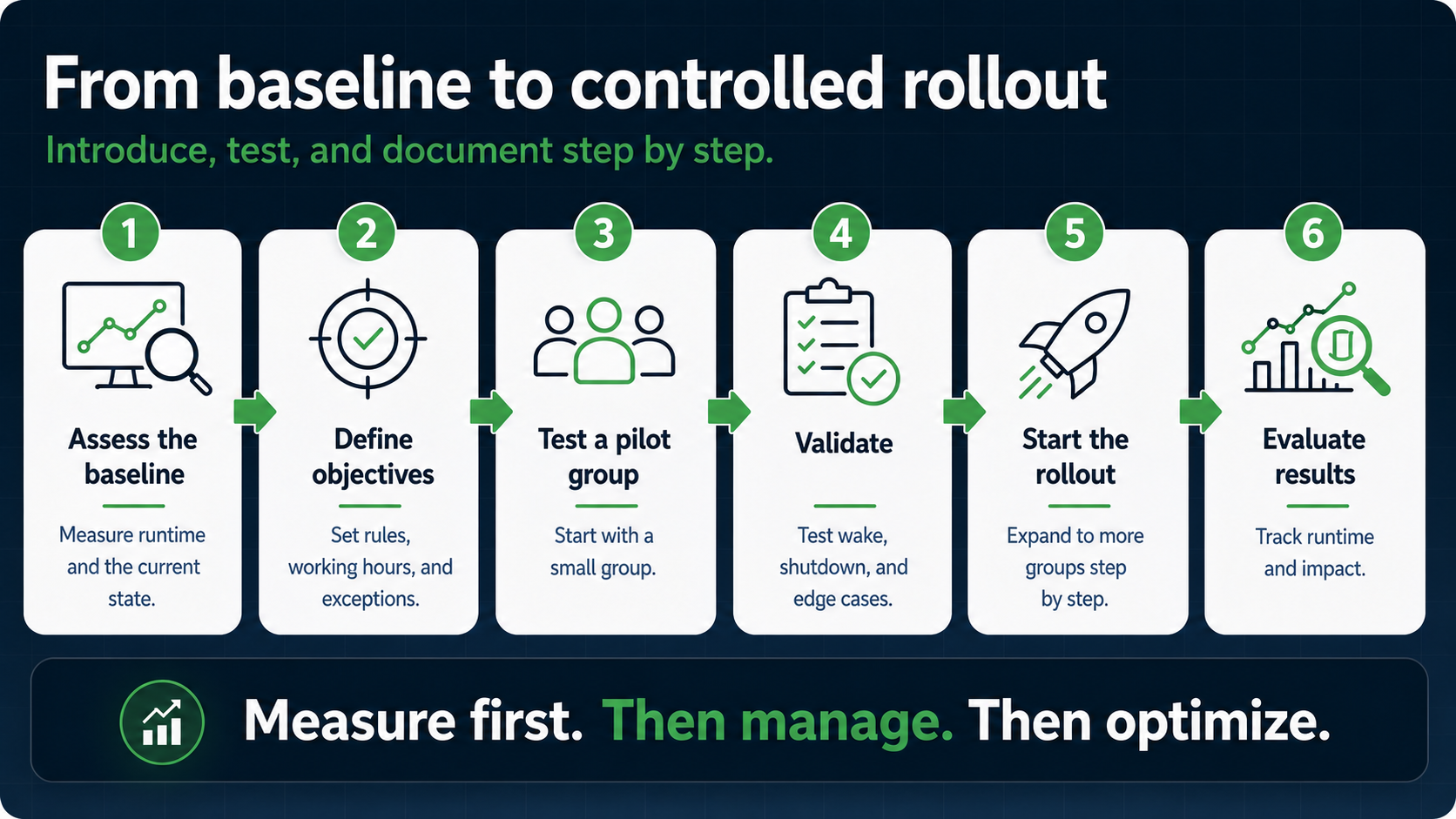
First determine when devices actually run and how much runtime occurs outside their intended use.
Office PCs, notebooks, training rooms, shift systems, and special-purpose devices do not necessarily need the same policy.
Coordinate working hours, activity signals, applications, processes, maintenance, and exceptions with the responsible teams.
Validate shutdown and wake behavior first with representative devices and real working situations.
Test firmware, network adapters, power states, routing, VLANs, and proxies for every relevant target network.
Review runtime changes, exceptions, failed actions, and support incidents before rolling the policy out more broadly.
Realistic assessment
The impact can only be assessed against the actual baseline. Device mix, previous runtime, power draw, electricity price, electricity mix, and existing policies all influence the result.
Potential savings should therefore not be promised as a fixed amount. The ROI calculator makes assumptions visible; actual results should then be checked against runtime and reporting data from the organization's own environment.
Transparent product context
EnviProt develops Auto Shutdown Manager. The software is designed for centrally managed PC power management in enterprises, educational institutions, and public-sector organizations, and complements existing endpoint-management tools.
Idle shutdown can evaluate multiple activity signals, protected periods, warnings, and exceptions. For Office applications, ASDM can also save unsaved documents.
Scheduled wake processes and protected maintenance windows help make endpoints available for updates or deployments.
Enterprise Wake-on-LAN and WOL proxies support controlled wake paths across subnets, VLANs, and distributed sites.
Group-based policies, central management, and reporting combine runtime control and evaluation in one product. The feature list shows the full scope.
Frequently asked questions
PC power management encompasses rules and tools for controlling the power states of workplace PCs, notebooks, and comparable endpoints. It includes controlled shutdown, low-power states, scheduled or on-demand wake-up, and runtime analysis.
Windows power options and Group Policy may be sufficient for consistent baseline settings. Additional tools become relevant when genuine idle time, open user work, different working hours, maintenance windows, Wake-on-LAN across network boundaries, and centralized reporting must be managed together.
That depends on the expected absence, required resume time, hardware, and wake requirements. Standby is suitable for fast resume, hibernation retains the session during longer breaks, and a controlled shutdown ends the operating-system session for long unused periods.
A local broadcast is normally not forwarded across router or VLAN boundaries. Remote networks require a planned delivery path, such as an authorized directed broadcast or a WOL proxy in or near the target network.
A safe policy combines protected working hours with activity checks, exceptions, user warnings, and a defined process for open or unsaved documents. The rules should be tested with real user and application scenarios before a broad rollout.
At minimum, the calculation requires device count, avoidable runtime, average power consumption, electricity price, and the period being assessed. CO₂ values additionally depend on the emission factor used. Calculated values remain estimates and should be compared with actual runtime data after rollout.
External references
The following references lead to external Microsoft and UEFI Forum websites:
Next step
The product overview shows how Auto Shutdown Manager combines shutdown, Wake-on-LAN, central management, and reporting. The ROI calculator and 45-day Enterprise Trial let you test the assumptions in your own environment.
See few examples how easy and flexible Auto Shutdown Manager can be used
Read more: Auto Shutdown Manager: Real-World Examples & Scenarios
Network Uptime Analyzer was designed to help you find out whether and how many PCs, servers and other IP enabled devices are left on overnight or at weekends. It is free - very easy - no installation - no agents. Get enterprise-wide reports about energy costs, energy consumption, and the related CO2 production.
Read more: Free Network Uptime Analyzer: Uncover IT Energy Waste
Auto Shutdown Manager operates even if no users are logged on in a so-called full background or service mode. All operations are supported in this mode, including power up, power down, restart, standby, updates and patches, deployment and receiving of new settings, and the execution of time rules.
The operation modes provided by Auto Shutdown Manager are highly flexible.
Depending on the required policies, the system can be configured in a "Can", "Should" or "Must" shutdown mode. Shutdowns can be prevented during core business times or while maintenance tasks are being performed.
Outside of business hours, the idle shutdown timer will start monitoring the PC for productive tasks and active users. If no one can be detected for a specified period, open documents will be saved and the PCs shut down in a default or specified mode such as standby, hibernation, or power off. The default shutdown mode can be specified depending on the time, day of week or date.
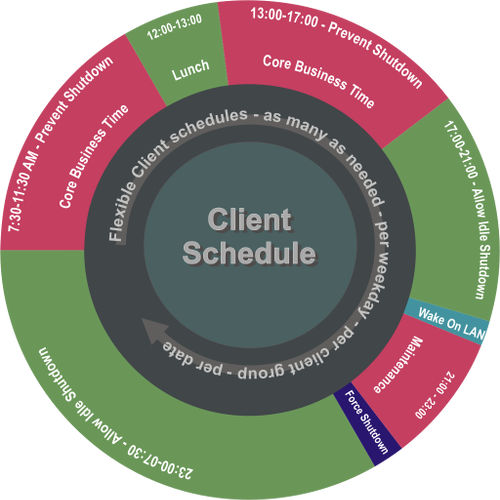
This is an example what a day could look like:
RED: The PC will not shut down
GREEN: The PC may shut down (for example, Standby), if detected as idle (not productive)
Light Blue: The server starts the PC for maintenance via WoL
Dark Blue: The PC will shut down
All Systems can be grouped by required policies:
One group of PCs could be configured to be allowed to go into a defined sleep mode
during lunch hours. This means that, if no activities are detected during a defined
period, the systems would be allowed to go into a defined sleep mode such
as Standby.
Thus, the logical rule for lunchtime could be:
Another group of PCs could be set up to go into sleep mode during lunch hours, for example at 12:15 pm, regardless of other options. In this case, the users would receive a warning message notifying them about the planned shutdown. If the users want to continue their work, they just simply disagree and continue their work.
Finally, the idle shutdown timer would shut down the PCs when the users forget to do so after their work is done. Of course, unsaved documents would be saved automatically before the shutdown.
Another group of PCs could be used to display stock prices, for example. This only makes sense until the market closes, plus some extra time for aftermarket deals. Therefore, these PCs could definitely be switched off at 6 pm every day. In this case, the shutdown could be enforced without any user interaction.
In enterprise environments, as well as in an increasing number of networked homes, - it is essential for the systems to run reliably and to be available during core business hours or whenever needed. Furthermore, systems might depend on each other. For example, clients’ computers cannot be operated properly if their servers are not available. To map these requirements, Auto Shutdown Manager was built with network-aware logic. This means that clients’ computers can wake their servers on demand and keep then running for as long as required. On the other hand, the servers know about the clients and keep up and running until the last client disconnects. In addition, other IP-enabled equipment can be used to control the idle shutdown decision.
See the manual for more details, or get your free 45-day evaluation copy now.
Platform · IT Asset Management
Auto Shutdown Manager (ASDM) by EnviProt includes practical IT asset inventory for managed clients. It helps IT teams find hardware, driver, operating-system and software conditions that can affect energy efficiency, endpoint stability, security review and lifecycle planning.
Operational scope
The asset view in Auto Shutdown Manager is focused on managed ASDM clients. It helps IT teams find hardware, driver, operating-system and software conditions that may influence endpoint power behaviour, reliability, user productivity and lifecycle planning.
Use collected inventory data to narrow down affected clients before troubleshooting power behaviour, driver reliability, software compatibility or hardware refresh questions.
ASDM does not replace a dedicated IT asset management suite, CMDB or vulnerability scanner. It provides supporting endpoint inventory for ASDM-managed clients and operational review workflows.
Admin use cases
The value is not only the inventory itself. It is the ability to narrow a question down to the affected clients: which machines have a certain software version, an older network driver, a specific operating system, a hardware model or a virtual/physical endpoint type?
Use collected software, driver, BIOS and operating-system data to identify clients that may need closer review by IT security or endpoint management teams.
Outdated drivers and unstable endpoint components can affect sleep, wake, display power handling and user productivity. Asset visibility helps admins find the candidates faster.
Compare PC models, CPUs, disks, memory, network adapters and operating systems to support hardware refresh, standardisation and support planning.
Console proof
The Management Console lets admins move from a high-level asset overview into concrete client lists and detailed hardware or software records.


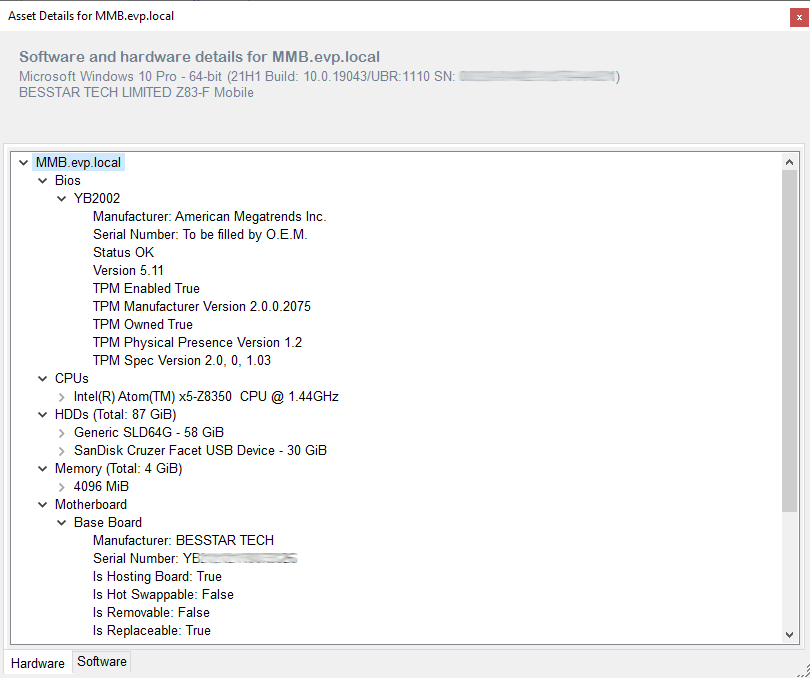
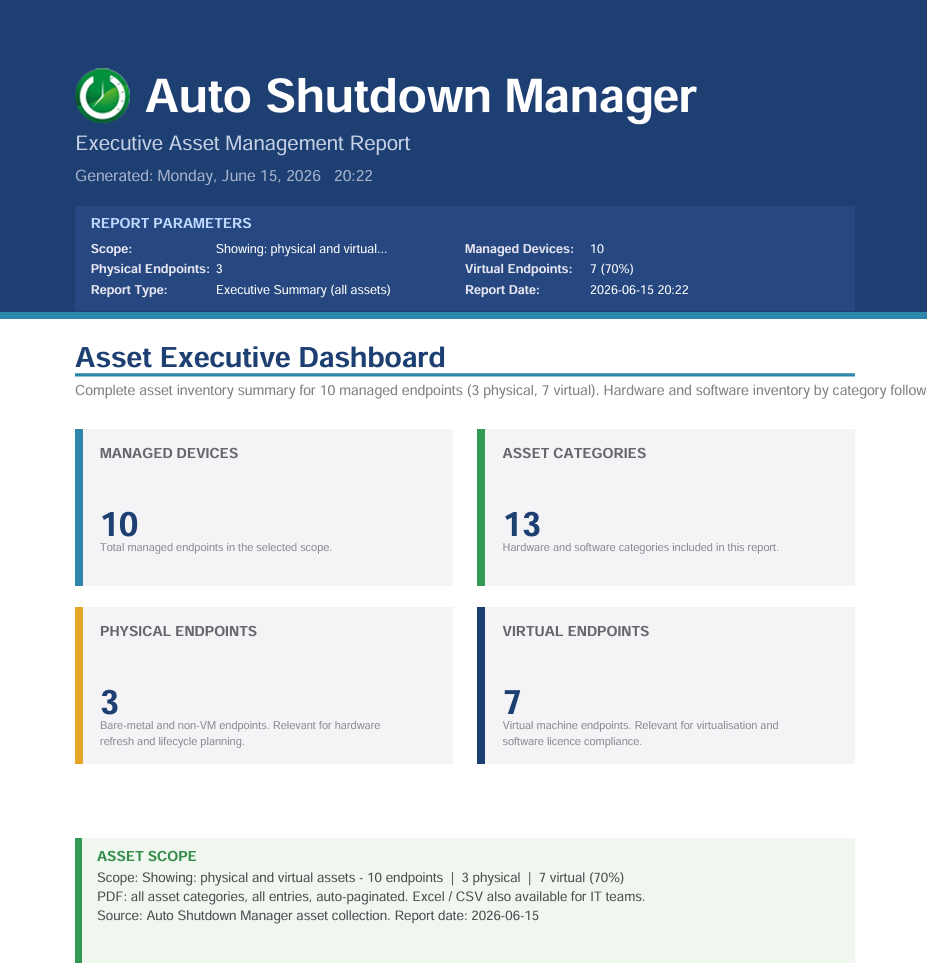
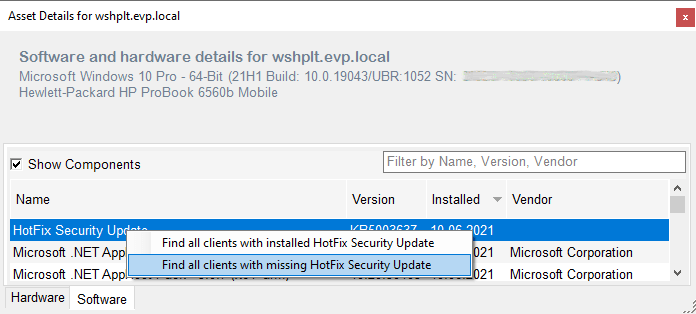

Collected inventory
Asset data is collected from managed ASDM clients and can be used to support troubleshooting, standardisation and reporting workflows. The available detail depends on the client environment and collected system data.
Review operating-system distribution, desktop/mobile split and physical or virtual endpoint balance.
Inspect PC models, CPU models, disk models, memory modules, monitors, video controllers, printers and motherboards.
Use BIOS, network-adapter and driver-related information to support stability reviews and endpoint lifecycle decisions.
Search installed software entries and versions to find clients that may need review, cleanup, updates or license discussion.
Asset information is gathered automatically from client systems and updated on the server, reducing manual checks during day-to-day operations.
Asset reports can be exported for operational review, lifecycle planning and management discussions.
Reports for IT and leadership
The Executive Asset Management Report groups collected assets by category and can separate physical and virtual endpoints. This supports lifecycle planning, software review, standardisation and stakeholder communication.
Summarise the number of managed endpoints in the selected reporting scope.
Group hardware and software inventory into reportable asset categories.
Distinguish bare-metal endpoints from virtual machines where the collected data allows it.
Use PDF, Excel or CSV export for IT operations, lifecycle planning or review meetings.
Operational fit
ASDM asset inventory is most useful where endpoint inventory meets power-management operations.
Database options
ASDM core operation does not require a configured database. For IT Asset Management and other database-backed analysis, local SQLite support is included and available as the default option; alternatively, use Microsoft SQL Server 2012 or newer, including SQL Server Express. SQLite is recommended for pilots and smaller environments.
Admin questions
No. ASDM does not try to replace a dedicated asset management suite, CMDB or vulnerability scanner. Its inventory is focused on managed ASDM clients and supports power management, stability analysis, lifecycle planning and operational troubleshooting.
Yes. The software inventory can help identify managed clients with specific installed software entries or versions, where that information is collected and available from the client system.
It can support that workflow. ASDM can show hardware, BIOS, network-adapter and driver-related information that helps IT narrow down clients for further review. Dedicated security or vulnerability tools may still be required for formal risk assessment.
Yes. Asset information can be exported as PDF, Excel or CSV reports for IT operations, lifecycle planning and management review.
Asset information is collected automatically from managed client systems and updated on the server. The current page focuses on the operational use of that data; exact collection behaviour should be validated in your ASDM environment.
FIND THE AFFECTED CLIENTS
Start with a managed group, review collected asset data and validate how ASDM inventory supports your endpoint power-management rollout.
Central Management
Auto Shutdown Manager’s Management Console gives IT one place to configure power policies, organize clients, run maintenance actions, manage licensing, roll out updates and review operational events.
Control plane
Power management only works at enterprise scale when IT can target the right clients, avoid uncontrolled shutdowns, support maintenance windows and keep endpoint availability under control. The Management Console controls that process centrally.
Assign clients to groups with different power policies, security options and administrative settings. Assignment can be done manually or automated by PC name filters and Active Directory structure.
Wake, shut down, restart, log off, standby or hibernate selected PCs or complete PC groups directly from the console when operational work requires it.
Management categories
The Management Console keeps the core administration tasks visible and repeatable, instead of spreading power settings, updates, licensing and maintenance actions across scripts and manual routines.
Create client groups, assign policy sets and organize PCs by function, department or Active Directory structure.
Manage client licensing centrally, either with permanent client licenses or leased licenses from the server.
Keep Auto Shutdown Manager clients up to date across selected groups after the server has been updated.
Wake clients for administration tasks, keep them running while needed and power them down again after maintenance is complete.
Review recent operational events such as wake-ups, shutdowns, client initialization, updates and issues.
Use management data to support the business case for endpoint energy management and to validate savings in your environment.
Console proof
These console views show the operational work behind central endpoint power management: policy groups, maintenance wake-up, event monitoring and savings reporting.

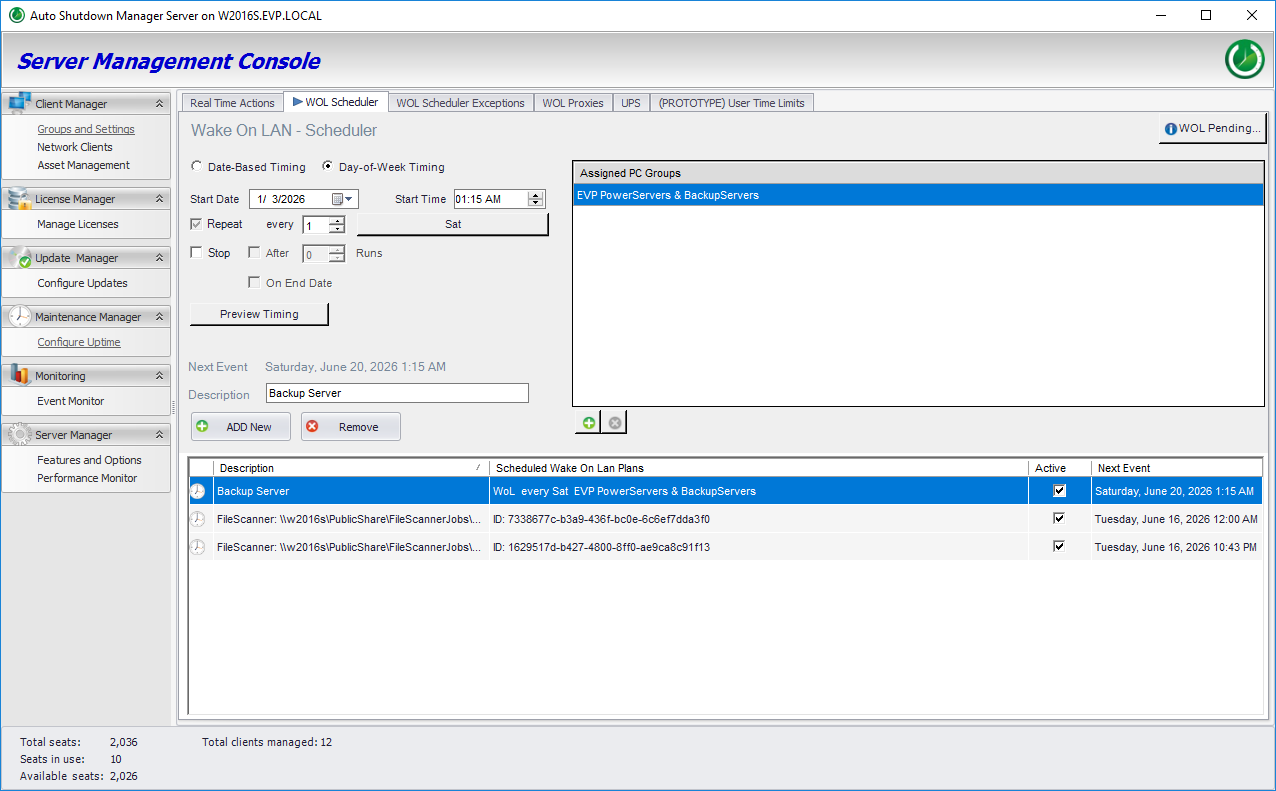
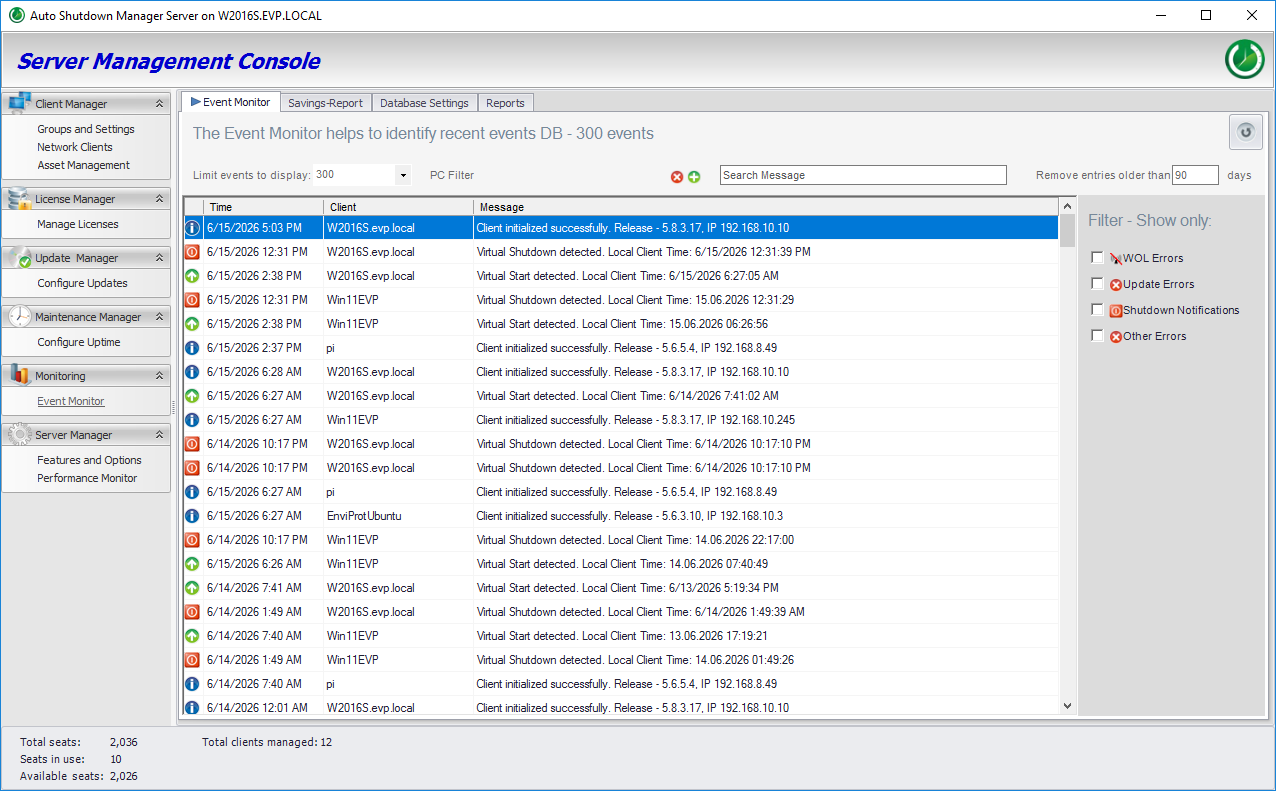
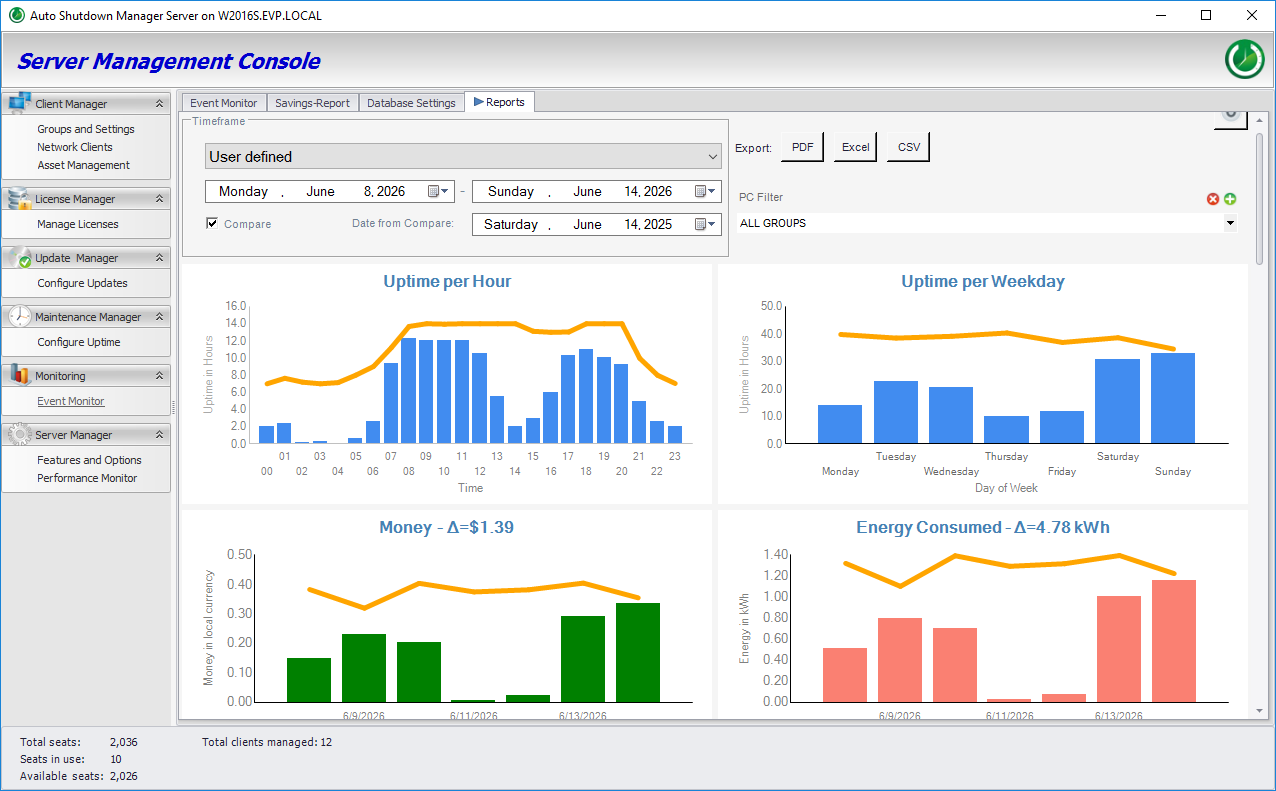
Deployment & provisioning
Auto Shutdown Manager clients can be rolled out as MSI packages using Group Policy, Microsoft Configuration Manager/SCCM or other MSI-capable deployment tools. After installation, clients can receive the server connection data automatically and start retrieving their first configuration from the ASDM Server.
New client PCs can receive the ASDM server address and TCP port during installation by using a simple server.ini file in the MSI source folder.
Use the deployment process you already operate. When file-based provisioning is used, target computers need read access to the shared MSI source folder.
For scripted or managed installations, the server name or IP address and port can also be passed directly to the MSI command line, for example through deployment-tool parameters.
For provisioning or image-based environments, documented setup strategies cover preserved installation folders, unique client IDs and separate local data paths for session-based data.
Microsoft environment fit
Windows, GPO, SCCM/MCM, Intune and scripts can all help with parts of endpoint administration. Auto Shutdown Manager focuses on the operational power-management process: safe shutdown, reliable wake-up, maintenance availability, group targeting and savings visibility.
Use groups and automated assignment to apply different power-management behavior to offices, support teams, sales, marketing, laptops or other client sets.
Wake clients for maintenance tasks, keep them available while administrative work runs and power them down afterwards where the environment allows it.
Use event and savings reports as a practical basis for rollout validation, ROI discussions and continuous optimization.
Admin questions
No. Auto Shutdown Manager is designed to complement existing endpoint-management tools with dedicated power-management operations, Wake-on-LAN workflows, group-based actions and savings visibility.
Yes. Client PCs can be assigned manually or automated by PC name filters or the Active Directory structure, depending on how you want to organize policies.
Yes. The Maintenance Manager can wake clients for maintenance tasks, keep them running as long as needed and power them down again after the work is complete.
The Client Monitor provides a high-level event and savings overview. Report details can also be written to a Microsoft SQL database for further analysis.
ASDM clients can be deployed as MSI packages through Group Policy, Microsoft Configuration Manager/SCCM or other MSI-capable deployment tools. During installation, clients can receive the server address and port automatically via a server.ini file or MSI command-line parameters.
START SMALL. SCALE SAFELY.
Start with a small set of managed PCs, validate policies in your own environment, then expand by groups, sites or departments.
ASDM product tour
Auto Shutdown Manager (ASDM) gives IT teams one place to organise endpoints, apply safe shutdown rules, coordinate wake and maintenance workflows, support remote access and verify the results.
The screenshots use demo or anonymised data. Available panels and details can vary by ASDM version and enabled modules.
Central control
Start with the operational view: which clients are online, which systems need attention and which policy group controls each endpoint.
Review endpoint events, connectivity and current state from the central management console instead of checking devices one by one.
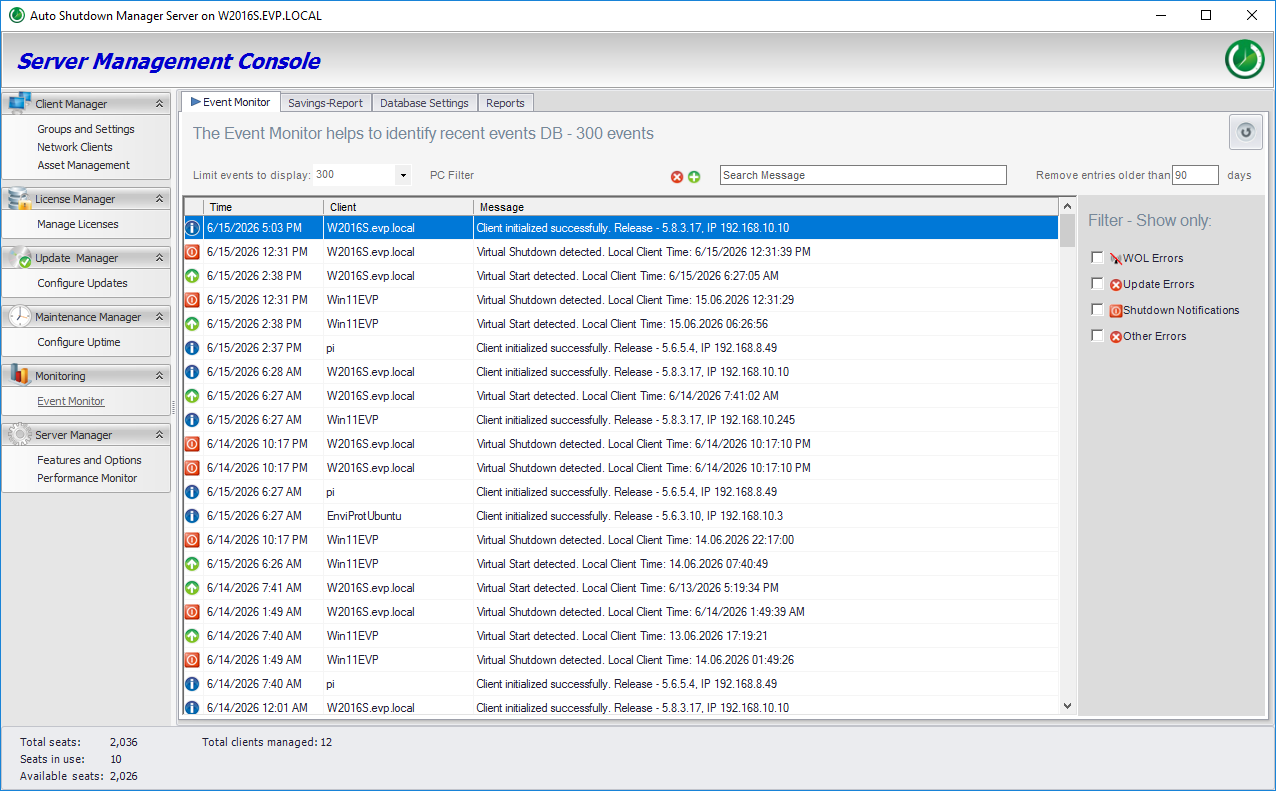
Group endpoints by department, location or operational role, then apply the appropriate shutdown, wake and maintenance settings centrally.
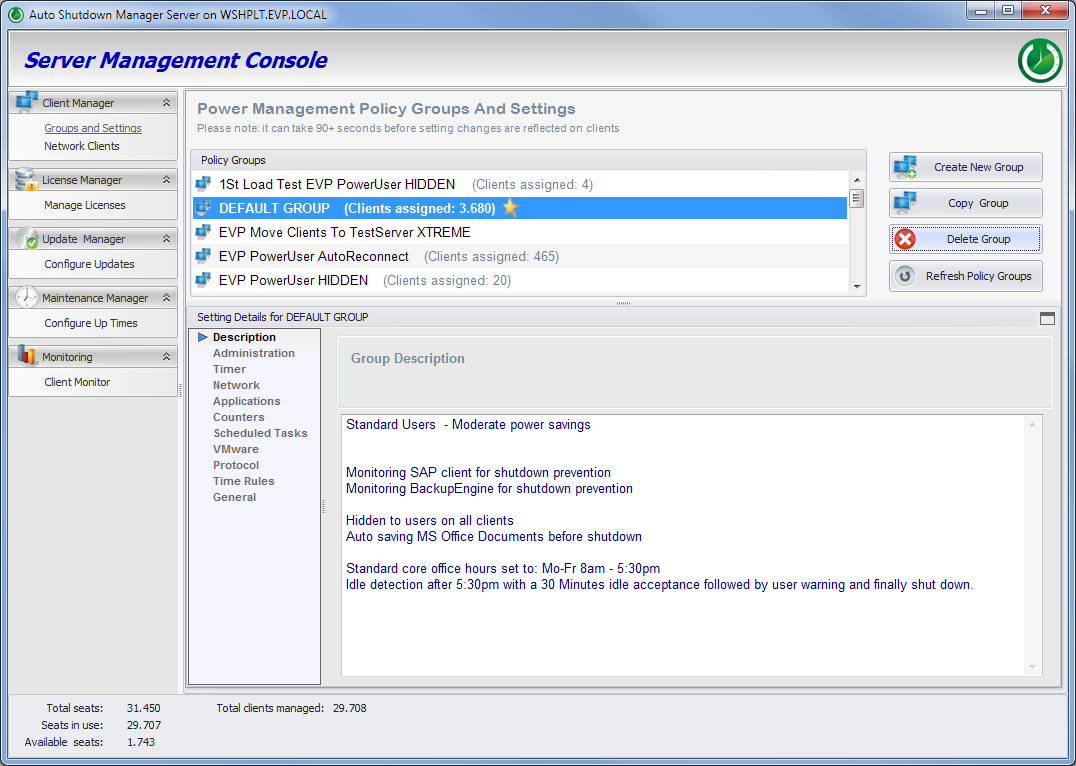
Power and maintenance workflows
ASDM combines time rules, activity checks, remote actions and scheduled wake events so maintenance can happen without leaving every PC running.
Define when time rules apply, how idle devices should react and which safeguards must be respected before a shutdown starts.
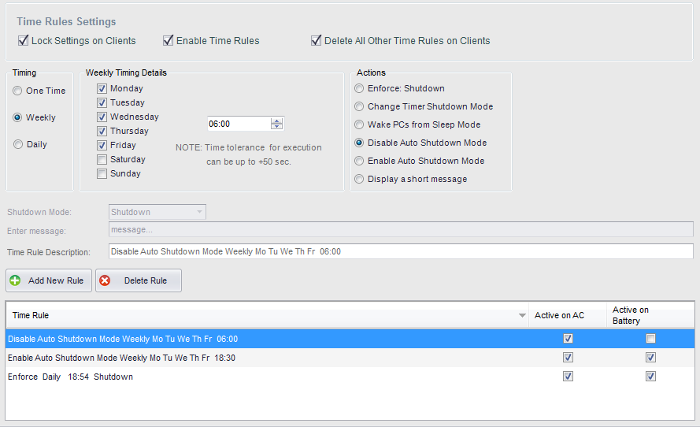
Wake selected groups before updates, maintenance or the start of the working day, then return them to the correct power state afterwards.

Bring wake, readiness checks, patching, reporting and safe shutdown into one controlled sequence instead of treating power management as a separate afterthought.
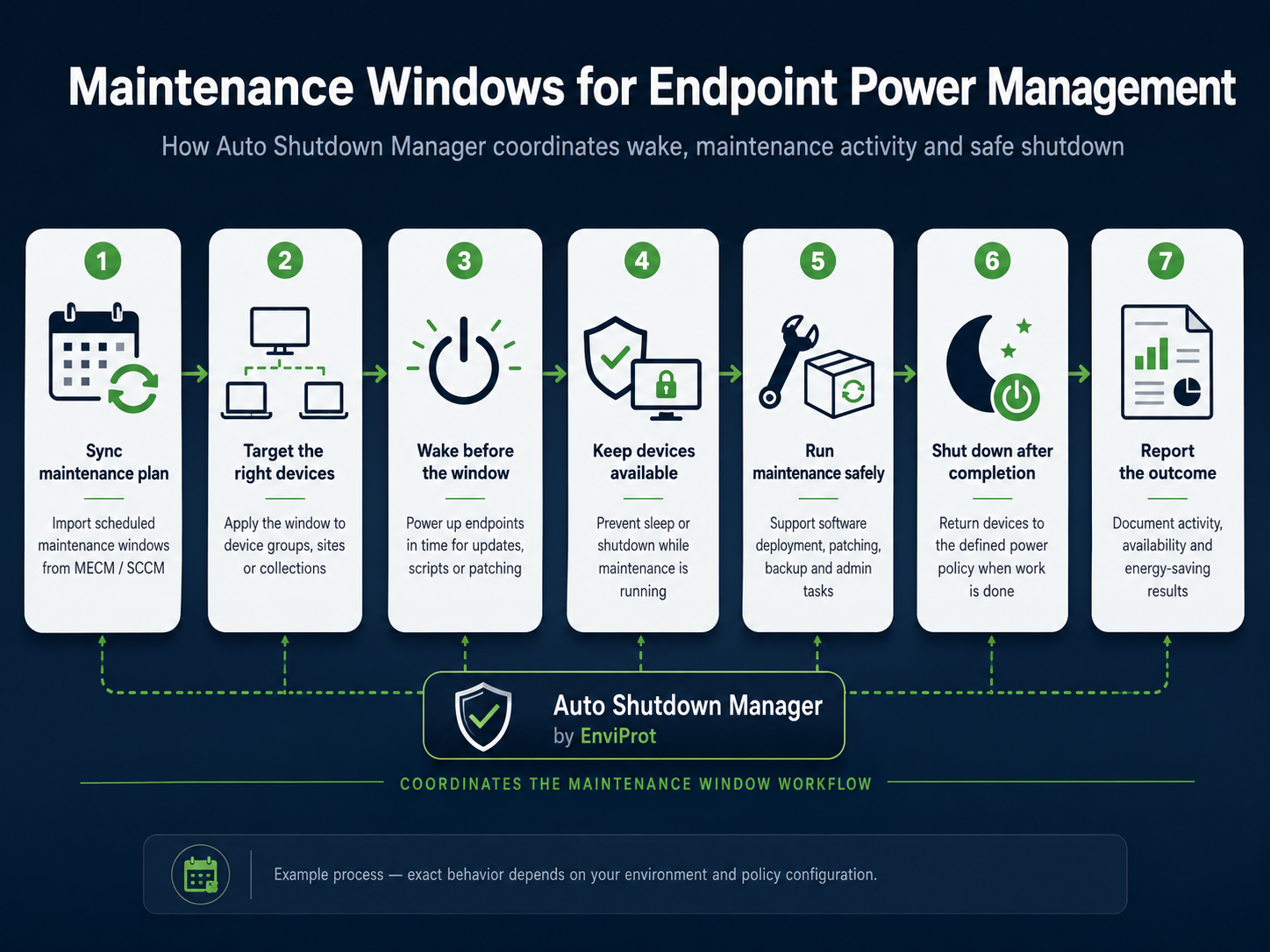
Remote access and portals
Browser-based access can expose only the assigned computers and actions needed for remote work, while central policy remains with IT.
Users see the computers assigned to them, their current status and the permitted wake action without receiving access to the full management console.
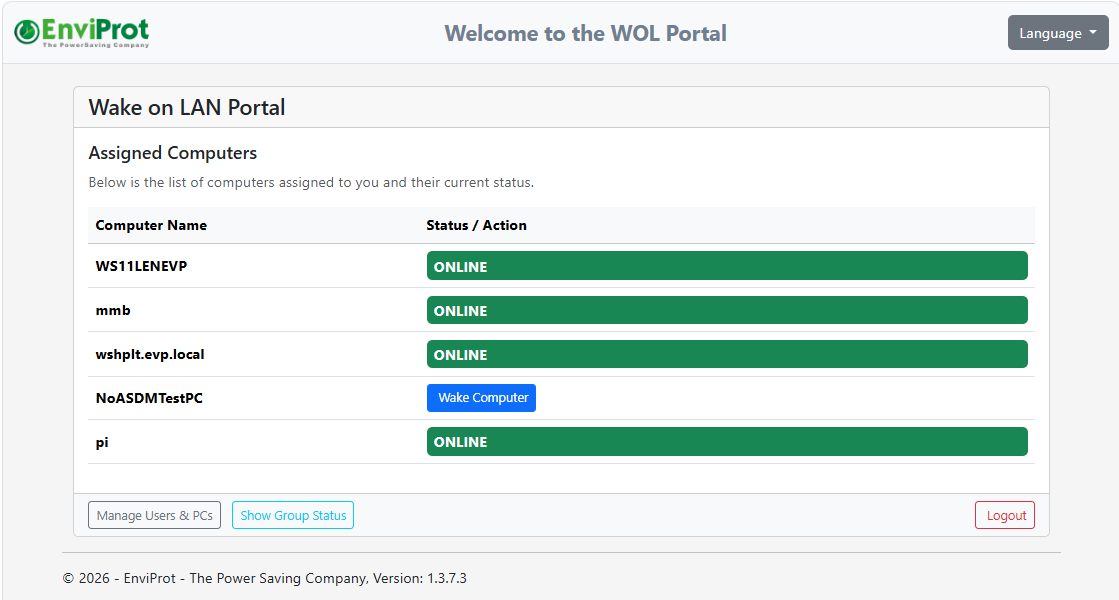
Authorised users can submit a wake request through the web-based experience and immediately see whether the target system was found, requested and brought online.
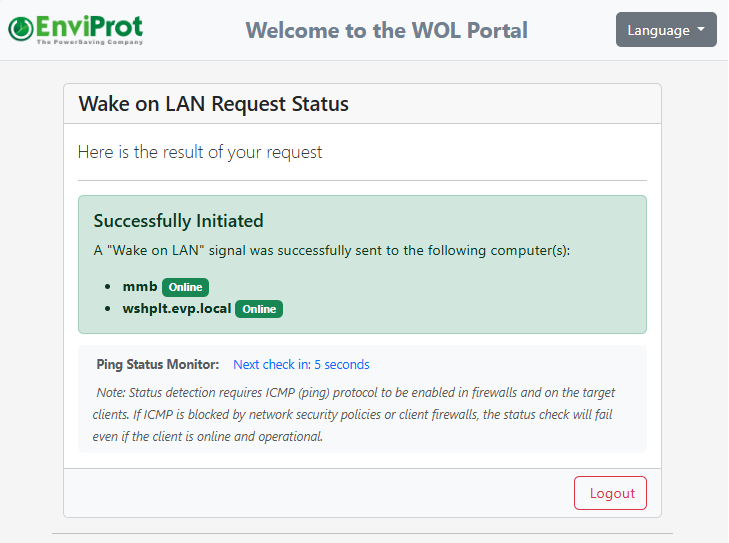
Existing IT operations
ASDM complements deployment and management workflows by making endpoints available for the work, then returning them to the required power state.
The workflow connects deployment plans, ASDM scheduling, network wake paths and endpoint readiness without replacing Microsoft Configuration Manager.
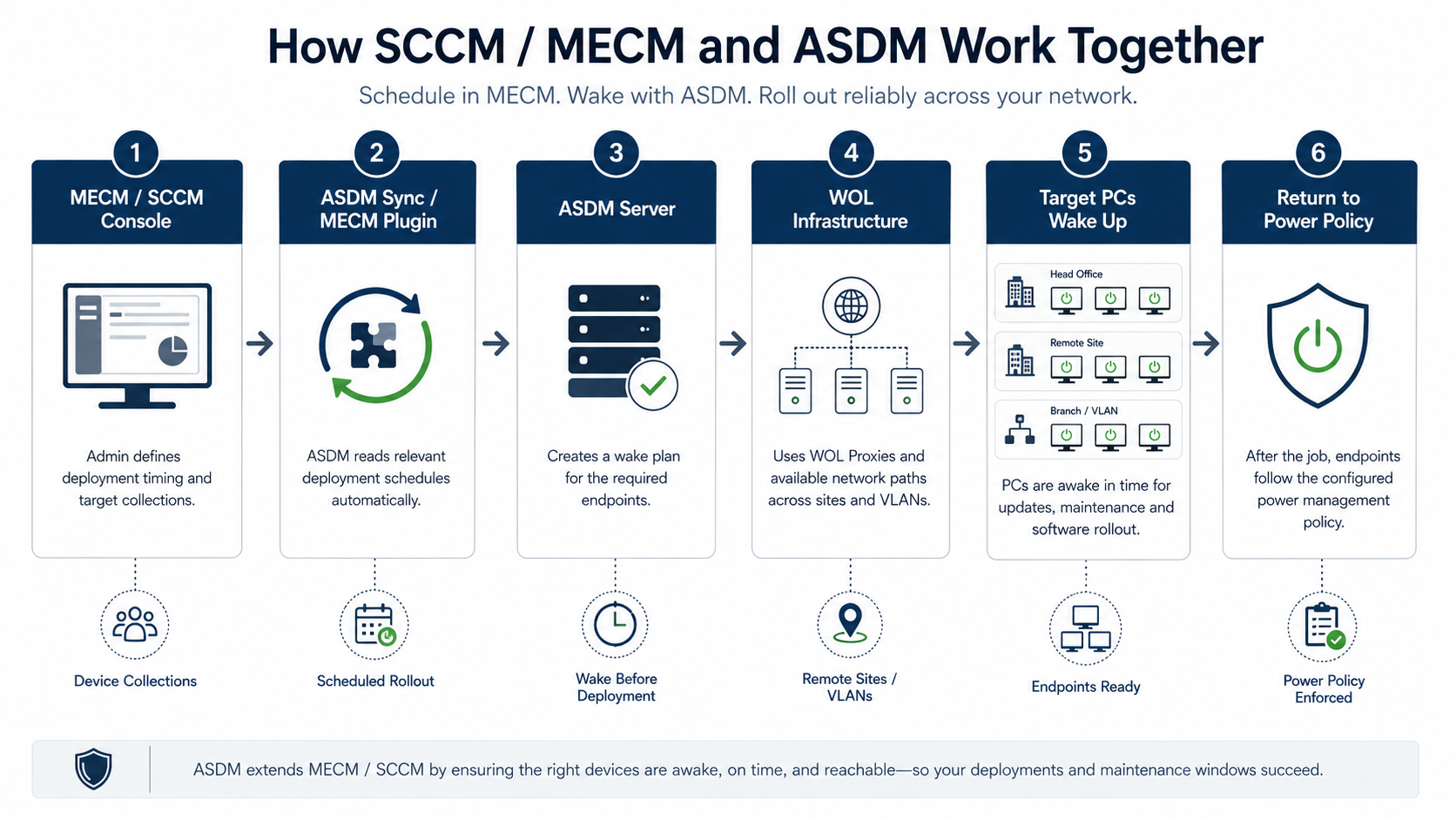
Administrators can see the deployment-related schedule and target context used to wake systems before software distribution starts.

Reporting and technical detail
Power management needs evidence. ASDM combines operational reporting with the device-level detail needed to investigate outliers and support decisions.
Use central reports to compare activity patterns, runtime and energy-related outcomes across the selected scope.
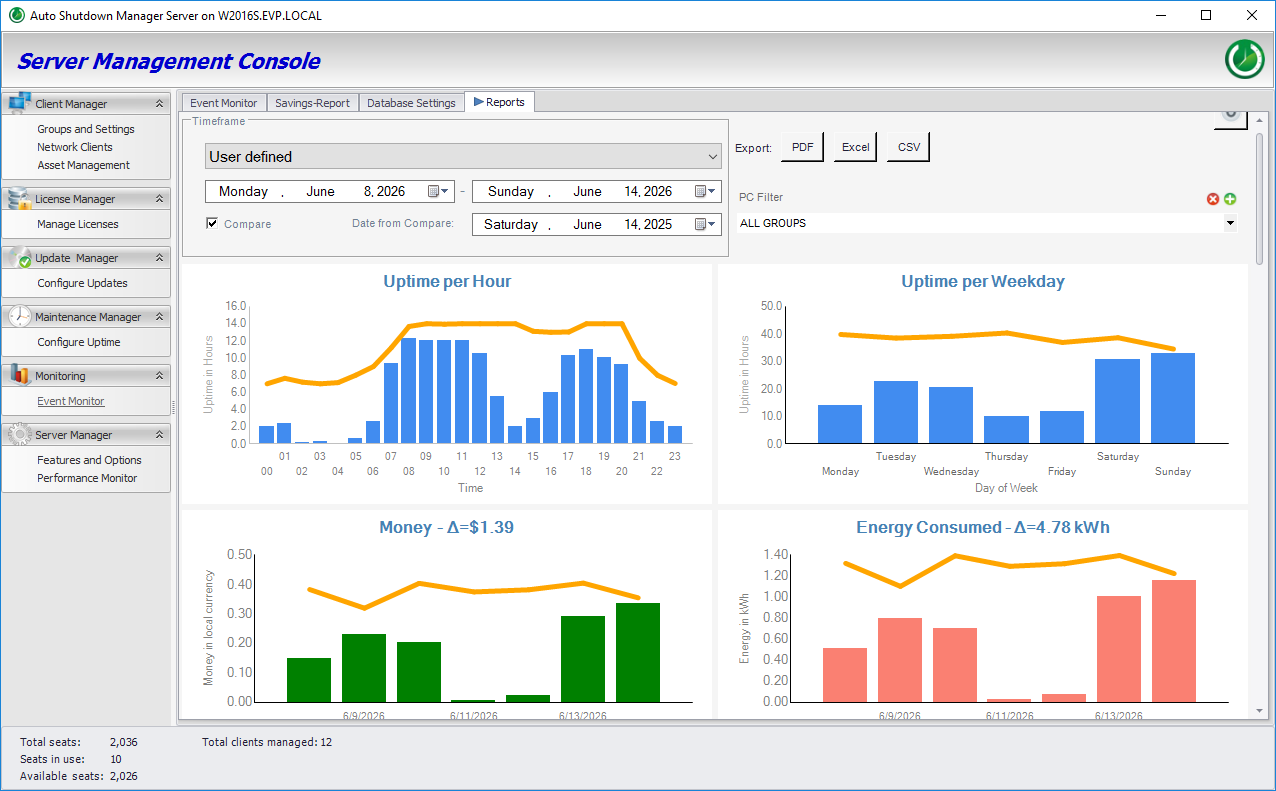
Drill into an endpoint when a report, driver issue or deployment question requires more technical context.

Wake architecture
Reliable enterprise Wake-on-LAN depends on more than a single broadcast. ASDM can combine central scheduling, WOL proxies, directed broadcast and remote requests within one managed flow.
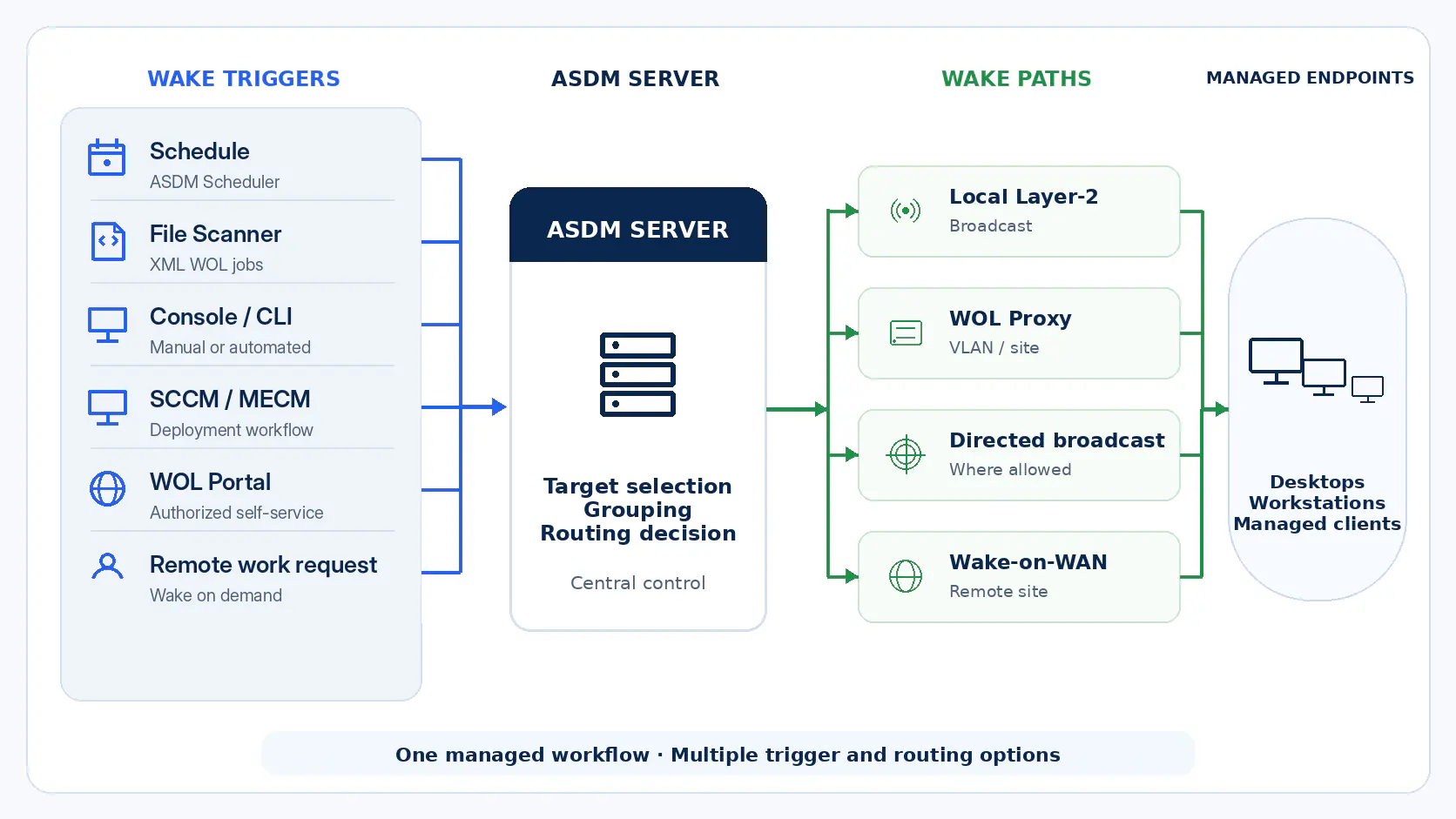
Before shutdown, ASDM can display an administrator-defined message that includes the company name, the warning text and the support contact details relevant for that environment.
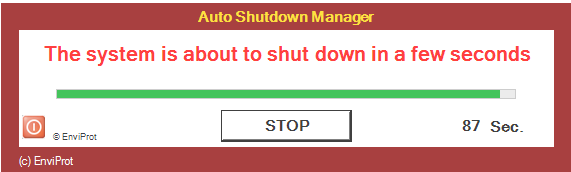
The trial and sales process can focus on the exact workflow that matters in your environment, including policy exceptions, network wake paths, reporting or deployment integration.
Product-tour questions
Yes. The screenshots and technical visuals come from real ASDM product views or accepted technical pages. Demo or anonymised data may be used.
Yes. Available panels, labels and data can vary by ASDM version, enabled modules, permissions and the workflow being configured.
Yes. Select any real screenshot to open the full-size image in the site viewer.
Use the enterprise trial or contact Sales for a walkthrough focused on your deployment, wake, shutdown, remote-work or reporting requirements.
Evaluate with your own endpoints
Test the management console, safe shutdown logic, wake reliability and reporting in your own environment before deciding on a wider rollout.
Auto Shutdown Manager feature list
Compare the capabilities available in Auto Shutdown Manager Enterprise, Education/Government/NPO and Free Light editions. The feature set covers safe shutdown, Wake-on-LAN, central policy management, reporting, remote operations and integration with existing endpoint-management workflows.
Editions at a glance
Enterprise and Education/Government/NPO licenses are built for managed environments. The Free Light edition is for private use and keeps a smaller local feature set.
For commercial and enterprise environments that need central management, policy control, WOL infrastructure, reporting and rollout support.
81 supported capabilitiesFor public sector, education and non-profit deployments with the managed feature set needed for labs, offices and controlled fleets.
81 supported capabilitiesFor private use only. Useful for local power management, but not intended as the managed enterprise deployment edition.
21 supported capabilitiesFeature areas
Use these groups to find the capabilities relevant to your rollout scenario.
Detailed comparison
Open each group to compare availability across editions. A check mark means supported; a dash means not included in that edition.
| Capability | Enterprise | Education / Gov / NPO | Free Light |
|---|---|---|---|
| Shutdown based on Timer countdown | ✓ | ✓ | ✓ |
| Forced Shutdown based on Time Rules | ✓ | ✓ | — |
| Time Rules (for further automation, e.g., starting applications, messages, power on/off, stopping/starting shutdown timers, and much more) | ✓ | ✓ | — |
| Detection of running Applications (e.g. PowerPoint) | ✓ | ✓ | ✓ |
| Wake-Up PC from Sleep | ✓ | ✓ | — |
| Auto shutdown mode selection (e.g. use Standby in the afternoon, Hibernate or PowerOff at night) | ✓ | ✓ | — |
| Dependent on Power mode (AC / DC) | ✓ | ✓ | — |
| Windows Power Management: Respect / Ignore Windows Power Management settings | ✓ | ✓ | ✓ |
| Screen Saver Management Keep display always on Keep display on while selected applications are running Switch display off after x minutes of PC idle time (optional: and lock PC) Switch display off as soon as PC is locked (WIN+L or by system) | ✓ | ✓ | ✓ |
| User warnings before Shutdown | ✓ | ✓ | ✓ |
| Save unsaved documents before shutdown (Word, Excel, PowerPoint, Project, Visio, Outlook, ...) | ✓ | ✓ | ✓ |
| Business Times Management for example prevent shutdown during core business times | ✓ | ✓ | — |
| Scheduled Shutdown of local or remote PCs | ✓ | ✓ | — |
| Scheduled Wake-Up of local or remote PCs | ✓ | ✓ | — |
| Capability | Enterprise | Education / Gov / NPO | Free Light |
|---|---|---|---|
| MCP Server extends Wake-On-LAN to AI-driven agents (VS Code, N8N, etc.) | ✓ | ✓ | — |
| Wake On LAN - Local Broadcast - Server -> Clients | ✓ | ✓ | — |
| Wake On LAN - Local Broadcast - Clients -> Server | ✓ | ✓ | — |
| Wake On LAN - Directed Broadcast - Server -> Clients | ✓ | ✓ | — |
| Wake On LAN - Directed Broadcast - Clients -> Server | ✓ | ✓ | — |
| Wake On WAN – Remote PC -> Internet -> Server -> Clients, optionally with VPN | ✓ | ✓ | — |
| Wake on Wan Client | ✓ | ✓ | — |
| Wake On LAN/WAN- WOL Proxy (local, segments, VLANs, Internet) | ✓ | ✓ | — |
| Wake On LAN/WAN- WOL Proxy for RaspBerry Pi (Java) | ✓ | ✓ | — |
| Auto-generate WOL Proxies (updates WOL Proxies automatically to ensure reliable WOL after network changes are detected) | ✓ | ✓ | — |
| Wake on LAN Scheduler with exceptions | ✓ | ✓ | — |
| Scheduled Maintenance WoL Wake-Up | ✓ | ✓ | — |
| Support for the free Advanced EnviProt Wake On LAN WEB Portal with AD and SSO support | ✓ | ✓ | — |
| WOL - Start virtual machines via Wake On LAN | ✓ | ✓ | — |
| Capability | Enterprise | Education / Gov / NPO | Free Light |
|---|---|---|---|
| Central Management | ✓ | ✓ | — |
| Organize Power Management Policies by Groups | ✓ | ✓ | — |
| Automatically assign PCs to Power Management Policies by: PC Name filters Active Directory Attributes (like OU=, CN=...) Membership in active directory groups | ✓ | ✓ | — |
| Settings Management and remote deployment | ✓ | ✓ | — |
| Centralized Updates | ✓ | ✓ | — |
| Maintenance Manager | ✓ | ✓ | — |
| License Manager | ✓ | ✓ | — |
| Hidden operation on clients | ✓ | ✓ | — |
| Auto Configurator for easiest initial setup | ✓ | ✓ | ✓ |
| Operation in Background - Windows Service Mode | ✓ | ✓ | ✓ |
| Operation as Client | ✓ | ✓ | — |
| Operation as Server | ✓ | ✓ | — |
| Capability | Enterprise | Education / Gov / NPO | Free Light |
|---|---|---|---|
| Remote Power ON / Power Off | ✓ | ✓ | — |
| Remote Management | ✓ | ✓ | — |
| Remote Power On from Shutdown Mode (completely off) | ✓ | ✓ | — |
| Remote Shutdown | ✓ | ✓ | — |
| Remote Standby | ✓ | ✓ | — |
| Remote Hibernate | ✓ | ✓ | — |
| Remote Log-Off users | ✓ | ✓ | — |
| Remote Restart | ✓ | ✓ | — |
| Remote Wake-Up (LAN and WAN) | ✓ | ✓ | — |
| Capability | Enterprise | Education / Gov / NPO | Free Light |
|---|---|---|---|
| ITAM - IT Asset Management. Collect and report key assets from your client PCs (CPUs, GPUs, RAM, HDDs, serial numbers, drivers, software, and much more) | ✓ | ✓ | — |
| Performance Counters for in-depth system analysis Some examples: Network traffic & utilization Detection of processes and their utilization Active user sessions VPN Tunnel active Backup is going on And many more | ✓ | ✓ | — |
| Analysis of other TCP/IP equipment such as receivers, printers, production machines for shutdown procedures | ✓ | ✓ | — |
| Mouse / Keyboard | ✓ | ✓ | ✓ |
| CPU Utilization | ✓ | ✓ | ✓ |
| HDD Utilization | ✓ | ✓ | ✓ |
| Sound analysis | ✓ | ✓ | ✓ |
| Log Up and Down times | ✓ | ✓ | ✓ |
| Power consumption and CO2 reduction analysis | ✓ | ✓ | ✓ |
| Central Monitoring | ✓ | ✓ | — |
| Protocol stored in Central Database | ✓ | ✓ | — |
| Identify Clients with Power Supply Problems | ✓ | ✓ | — |
| Identify Clients with Thermal Problems | ✓ | ✓ | — |
| Identify Clients with Power Management Problems | ✓ | ✓ | — |
| Detect IP Clients to prevent shutdown | ✓ | ✓ | — |
| Network Clients prevent server shutdown for dynamic servers | ✓ | ✓ | — |
| Capability | Enterprise | Education / Gov / NPO | Free Light |
|---|---|---|---|
| MEM/SCCM Plug-In - Integration into Microsoft® Endpoint Manager / System Center Configuration Manager® | ✓ | ✓ | — |
| File Scanner: create own XML based jobs to schedule WoL, delete clients or move them to other settings groups, add or remove WoL-Proxies | ✓ | ✓ | — |
| Run Scripts or Application on Startup | ✓ | ✓ | ✓ |
| Run Scripts or Application before Shutdown | ✓ | ✓ | ✓ |
| Support Command Line Arguments | ✓ | ✓ | ✓ |
| Scheduled Tasks analysis | ✓ | ✓ | — |
| Capability | Enterprise | Education / Gov / NPO | Free Light |
|---|---|---|---|
| UPS support (Uninterruptible Power Supply): Automatically switch off selected PCs or PC groups in the event of a power outage, and restart them when power is restored | ✓ | ✓ | — |
| VMware service analysis | ✓ | ✓ | — |
| Start virtual machines at Startup | ✓ | ✓ | — |
| Suspend virtual machines before Shutdown | ✓ | ✓ | — |
| Capability | Enterprise | Education / Gov / NPO | Free Light |
|---|---|---|---|
| Auto Login User on Startup (Disable / Enable) | ✓ | ✓ | ✓ |
| Prevent users from blocking public PCs by staying logged in for long times | ✓ | ✓ | — |
| Simple PC time limitation (access protection) Limit the PC time per local user and per day on a local machine | ✓ | ✓ | ✓ |
| Extended PC time protection | ✓ | ✓ | ✓ |
| Work safety: Limit total PC usage time per user account and weekday centrally managed and based on Active Directory | ✓ | ✓ | — |
| Maintenance reboot after x sleep states | ✓ | ✓ | ✓ |
Next step
The full-featured Enterprise trial lets your team test shutdown behavior, Wake-on-LAN, reporting, document preservation and central management before rollout.
Release 4 → Release 5
A practical migration guide for existing Release 4 environments: understand the license change, prepare the required Microsoft .NET Framework, upgrade the server first, and then move managed clients in controlled groups.
Important upgrade note
A Release 4 license does not activate Release 5. Obtain a valid Release 5 license before changing the server or a stand-alone installation. For current upgrade options, contact our Sales Team.
Why upgrade
Release 5 expands Auto Shutdown Manager beyond scheduled power actions. These highlights help administrators manage modern endpoints, segmented networks and larger rollouts from one central management system.
Support scheduled wake-ups and apply dedicated controls for Modern Standby scenarios.
Explore Modern StandbyReport on operating systems, software, BIOS versions, processors, storage, video controllers and other endpoint details.
Explore IT Asset ManagementUse WOL scheduling, WOL Proxies, Wake-on-WAN and web-based WOL Portals across supported network scenarios.
Explore WOL PortalsCoordinate power actions with Microsoft Endpoint Configuration Manager and System Center Configuration Manager workflows.
View the Feature ListReview client timing, power consumption and savings data with more detailed central reporting.
Explore Reporting & CO₂Extend scheduled operations with XML job files and use the available MCP Server for supported AI-agent workflows.
See Current DownloadsBefore installation
A short preflight keeps the server change predictable and makes the client rollout easier to control.
1
Have the new Release 5 license available before upgrading the server or a stand-alone PC. Ask our Sales Team for the currently available upgrade option.
2
Install the framework required by the exact Release 5 build on the server and clients before deploying the software.
See the .NET requirements3
Schedule the rollout and divide clients into manageable groups. The existing guidance recommends group-by-group updates to reduce network load.
Migration sequence
Use this order for an Auto Shutdown Manager Server or a stand-alone installation, followed by centrally managed clients.
01
Confirm the new license and the required Microsoft .NET Framework. Record the existing installation directory before making changes.
02
Uninstall the old version through Windows Control Panel → Programs. Do not begin until the Release 5 license and prerequisites are ready.
03
Use the same installation directory to retain the existing configuration and settings, then enter the new license key to register Release 5.
04
Open the Management Console on the Auto Shutdown Manager Server and use Update Manager. Process clients group by group rather than upgrading the entire estate at once.
Runtime prerequisite
The framework requirement depends on the exact Release 5 build being installed.
5.5.x+
Release 5.5.x and newer require Microsoft .NET Framework 4.x on the Auto Shutdown Manager server and clients.
5.4−
Release 5.4 and earlier require Microsoft .NET Framework 3.5 on the server and clients.
Post-upgrade acceptance
After the server upgrade, confirm the essential management path with a controlled client group before expanding deployment.
Confirm that the Management Console opens, the new license is registered and existing settings are present.
Update a small group first and verify that those clients reconnect and report their expected state.
Test the power actions, schedules, WOL path and reports that matter to your environment before continuing.
FAQ
No. Release 5 is a major upgrade and requires a new Release 5 license. Contact our Sales Team for the current upgrade options.
The current upgrade guidance says to install Release 5 in the previous installation directory to retain the existing configuration and settings.
The documented upgrade path uses Update Manager in the server's Management Console to upgrade managed clients centrally.
No. The existing guidance strongly recommends processing clients group by group to reduce network bandwidth and keep the rollout controlled.
Open Auto Shutdown Manager and check the release number shown in the lower green area of the application window.
Ready to migrate?
Talk to our team about the right Release 5 upgrade option, review the current feature set, and prepare the required installer before changing your environment.
Platform · WOL Portals
Give authorized users a controlled way to wake assigned office PCs before remote access begins. Deploy the Advanced WOL Portal in your own infrastructure, connect it to SAML 2.0 and Active Directory, manage users and PCs directly in the portal, or combine both approaches for selected exceptions.
What the portal solves
Auto Shutdown Manager (ASDM) handles endpoint wake-up before a remote session starts. The WOL Portal controls who can wake which PC. Your existing VPN, Remote Desktop, VDI, remote-support and endpoint-security tools continue to handle access and protection.
Users see only the PCs assigned to them instead of receiving unrestricted wake access to every managed endpoint.
Deploy the Advanced WOL Portal on Microsoft IIS in your own infrastructure and connect it to your existing identity, network and security controls.
The portal sends each approved request to the ASDM Server, which uses your configured WOL routing, proxy and Wake-on-WAN components where supported.
How it fits together
Choose where identities and PC assignments are maintained: in Active Directory, directly in the portal, or through a hybrid of both. Users still get one simple wake workflow, and ASDM performs the Wake-on-LAN action.
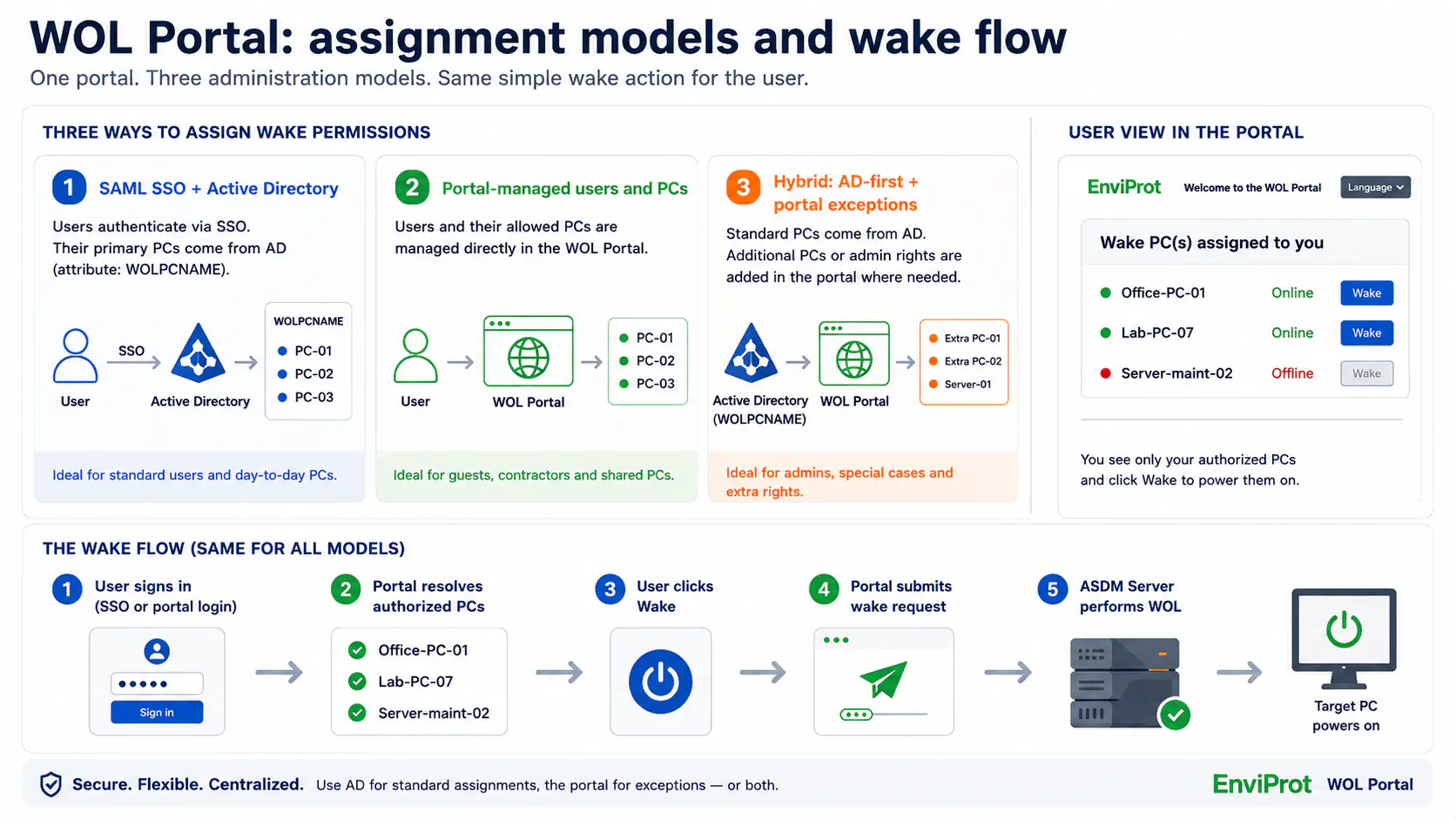
Three administration models
Use Active Directory for standard assignments, the portal for direct administration, or combine both when selected users need additional wake rights.
Mode 1
Sign-in: your corporate SAML 2.0 identity provider.
PC assignments: the user’s Active Directory object through the configurable WOLPCNAME attribute, or another attribute name you configure.
Best fit: organizations that keep day-to-day user-to-PC assignments in Active Directory.
Mode 2
Sign-in: the direct WOL Portal login.
PC assignments: maintained directly in the Advanced WOL Portal User Manager.
Best fit: deployments without SAML SSO, smaller scopes, pilots, guests, contractors, or teams that want direct portal-side control.
Mode 3
Sign-in: SAML SSO can remain the normal user path.
PC assignments: primary PCs come from Active Directory, while selected users receive additional PCs or wider wake rights directly in the portal.
Best fit: AD-first organizations that need controlled exceptions for admins, support teams, lab systems, shared PCs or servers.
The important hybrid point
Keep the standard workforce aligned with Active Directory and SAML SSO, then use portal management only where extra flexibility is needed. Normal office users can receive their primary PCs from AD, while an administrator or support user can also receive additional lab machines, shared PCs, servers or other explicitly assigned systems.
Mode 1 · SAML SSO + Active Directory
Users first authenticate through your corporate VPN and SAML 2.0 identity provider. The portal receives the configured identity claim and reads the user’s primary PC assignments from Active Directory. Once configured, the SSO path opens the assigned-PC workflow without a second portal password.
By default, the portal reads the user-principal-name value from the LoginName claim to identify the signed-in user.
Store one or more comma-separated PC names in WOLPCNAME, or configure a different Active Directory attribute name.
SSO users do not need a second portal user record for their normal AD assignments. Add a portal record only when that user also needs additional portal-managed PCs or roles.
SSO user path in screenshots
The first screen is your corporate identity-provider sign-in. After authentication, the portal opens the assigned-PC wake workflow without asking for another portal password.
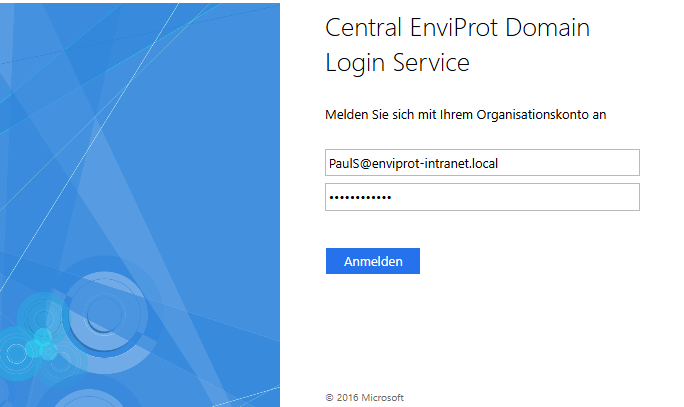
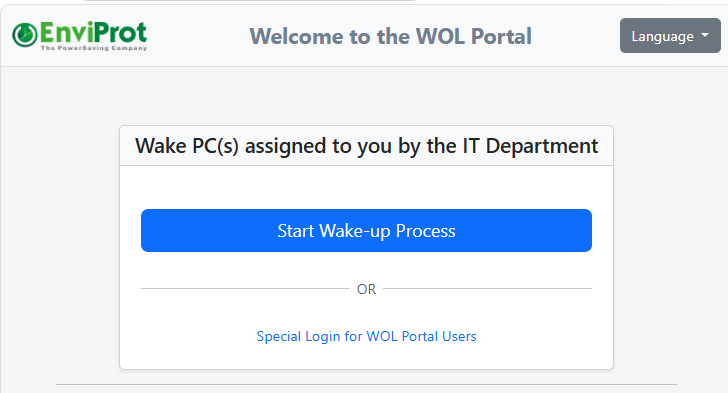
Mode 2 · Direct portal administration
Use the User Manager when you want to create portal users, assign roles and maintain wake permissions directly. This path works without SAML SSO and also adds controlled exceptions to an AD-first deployment.


Mode 3 · Hybrid assignment result
Keep standard users on SAML SSO with their primary office PCs from Active Directory. For selected admins, support users or special cases, add extra systems directly in the portal—such as lab PCs, shared machines or servers.

One wake workflow behind all three modes
The WOL Portal identifies the user, resolves the allowed PCs and submits the selected wake request to the ASDM Server. ASDM then performs the Wake-on-LAN action through your configured wake infrastructure.
Use SAML SSO or the direct portal login.
Combine Active Directory assignments with portal-managed PCs where configured.
Send the selected PC and authorized user request to the ASDM Server.
Show whether the wake request was accepted and display endpoint status where available.
After the user selects a PC and clicks Wake, the portal submits the request to ASDM and shows whether the request was accepted. Endpoint status can also be displayed when the required status path is available.
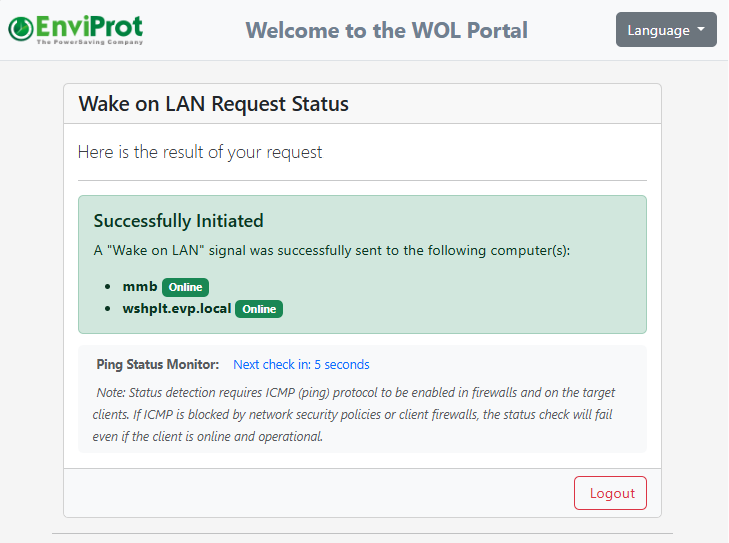
Technical fit
The Advanced WOL Portal is self-hosted. Install it on your IIS server, connect it to SQL Server and ASDM, secure it with HTTPS, and integrate SAML and Active Directory where required.
Use Microsoft IIS on Windows Server 2016 or newer with the required ASP.NET 4.x application-development features enabled.
Install Microsoft .NET Framework 4.8 or newer.
Use Microsoft SQL Server 2012 or newer, including SQL Server Express, for portal data.
Publish the portal over HTTPS and manage certificate trust and lifecycle through your IIS environment.
We recommend ASDM Server 5.7.4.x or newer for full compatibility with the current Advanced WOL Portal release.
For AD-based PC assignments, add the custom user attribute—by default WOLPCNAME—and validate the schema change in a test environment first.
Included portal software
Use the Advanced Portal for SAML SSO, assigned-PC workflows and enterprise administration. You provide and operate the Windows Server, IIS, SQL Server, certificates and network infrastructure in your own environment.
Portal capabilities
FAQ
No. They are three administration models for the same Advanced WOL Portal. Choose Active Directory assignments, direct portal administration, or a hybrid of both.
When configured correctly, yes. The portal can reuse the identity authenticated by your SAML 2.0 provider and open the assigned-PC workflow without a second portal password. The direct portal login remains available for other configurations.
Yes. Store the user’s primary PC assignments in a configurable custom attribute on the Active Directory user object. The default attribute name is WOLPCNAME. Plan and test the required AD schema extension before rollout.
Yes. Keep normal PCs in Active Directory for the SSO workflow, then assign additional PCs or wider wake rights directly in the portal for selected users. This is the hybrid model.
No. The portal submits the authorized request to the ASDM Server. ASDM then performs the wake action through the configured WOL routing and proxy infrastructure.
No. You deploy the Advanced WOL Portal on your own Microsoft IIS and SQL Server infrastructure.
No. The portal manages endpoint wake availability. Your VPN, RDP, VDI, remote-support, authentication and endpoint-security systems continue to handle the remote session and its protection.
Yes. We provide the Advanced WOL Portal software to ASDM customers at no additional software license cost. You provide and operate the required server, database, certificate and network infrastructure.
Controlled wake access for real environments
Start with representative users, PCs and network segments. Verify SAML claims, Active Directory assignments, portal-managed exceptions and ASDM wake routing before expanding the rollout.
Ready-made enterprise PC power management software
Stop leaving PCs on “just in case”. Auto Shutdown Manager is a ready-made tool for automated PC shutdown, reliable Wake-on-LAN, remote user wake-up, maintenance windows and measurable energy savings — built for real IT environments with VLANs, SCCM/MCM, Active Directory, WOL Portals and central reporting.
Estimate your savings first, then validate ASDM in your own environment with the full-featured 45-day Enterprise trial.
Windows power policies, GPOs, scripts, basic Wake-on-LAN tools and remote access software can all help with parts of the problem. But they rarely solve the complete operational challenge: shutting down only when users and background jobs are safe, waking PCs for updates and maintenance, handling VLANs and remote sites, giving users secure self-service wake-up, and proving results with usable reports.
Auto Shutdown Manager brings these pieces together in one finished tool. That is the difference: less custom scripting, fewer manual routines, more control, and a faster path from evaluation to measurable savings.
Use the ROI Calculator to estimate potential energy, cost and CO2 savings with your own assumptions before rollout.
Start with the full-featured 45-day Enterprise trial and validate shutdown, Wake-on-LAN, reporting and management workflows on real endpoints.
Use groups, central settings, Active Directory-based assignment, deployment options, updates and maintenance management from the ASDM Console.
Use a supported product with policies, WOL infrastructure, logging, reporting, portals and IT Asset Management instead of maintaining custom shutdown and wake-up scripts.
Automatically shut down idle PCs based on real activity and rules instead of leaving endpoints on overnight.
Wake PCs for users, patch windows, maintenance tasks and scheduled operations using Wake-on-LAN, WOL Proxies and wake schedules.
Manage policies, groups, settings, updates, deployment and maintenance centrally instead of relying on local manual configuration.
Use uptime/downtime logs, power consumption analysis, CO2 reduction analysis, central monitoring and ITAM data to support the business case.
ASDM can evaluate applications, CPU load, network traffic, HDD activity, background processes, business times and user warnings before shutdown. That helps reduce energy waste without blindly interrupting real work.
ASDM supports local broadcasts, directed broadcasts and WOL Proxies for segmented networks, VLANs, remote sites and Internet scenarios where properly configured.
With self-hosted WOL Portals, users can wake assigned office PCs when needed. The Advanced Portal supports Active Directory users and admin-assigned PC access.
ASDM supports current Windows environments, and the downloads page provides a Modern Standby Wake Driver for waking notebooks and PCs from Modern Standby / S0 Low Power Idle scenarios.
The feature list includes MEM/SCCM Plug-In integration into Microsoft Endpoint Manager / System Center Configuration Manager to help coordinate WOL and power actions with maintenance workflows.
Use the Management Console, groups, central settings, remote deployment, centralized updates and AD-based assignment using PC name filters, OU/CN and group membership.
ASDM can collect and report key assets such as CPUs, GPUs, RAM, HDDs, serial numbers, drivers, software and more.
The available MCP Server extends Wake-on-LAN capabilities to AI-driven agents for machine state query and WOL workflows without making the core product experimental.
Energy saving projects often fail when the business case is unclear. ASDM makes evaluation practical: estimate potential savings with the ROI Calculator, test the full-featured Enterprise trial in your own environment, then validate results with uptime/downtime logging, power consumption analysis and CO2 reduction analysis.
Where it helps: Good baseline for standard settings.
Where it falls short: Limited awareness of real user activity, maintenance workflows, WOL infrastructure and reporting.
What ASDM adds: Intelligent idle detection, warnings, document saving, business rules, central control and reporting.
Where it helps: Can automate narrow tasks.
Where it falls short: Hard to maintain, fragile, weak visibility, often dependent on one admin.
What ASDM adds: A finished tool with console, policies, logging, WOL infrastructure, reports and supportable workflows.
Where it helps: Can wake devices in simple local networks.
Where it falls short: Often limited to sending Magic Packets and not enough for VLANs, remote sites, scheduling and user self-service.
What ASDM adds: Directed broadcasts, WOL Proxies, Wake-on-WAN, schedules, maintenance wake-up and WOL Portals.
Where it helps: Useful for endpoint management and deployments.
Where it falls short: Endpoint power state still needs reliable shutdown and wake orchestration.
What ASDM adds: Dedicated power management plus MEM/SCCM plugin integration and WOL infrastructure.
Where it helps: Allow access to running PCs.
Where it falls short: They do not solve energy waste if PCs stay on 24/7.
What ASDM adds: Self-service WOL Portal access so assigned PCs can be woken when needed.
Where it helps: Can be tailored.
Where it falls short: Slow, expensive in internal time, harder to maintain, reporting and portals must be built separately.
What ASDM adds: A ready-made enterprise tool that can be evaluated with a 45-day trial and ROI Calculator.
8,500 PCs / 47 campuses
Mesquite Independent School District used ASDM to manage power and updates across 8,500 PCs on 47 campuses, integrate with SCCM 2012 R2, divide computers into six groups, shut down systems at 7 p.m. and wake them at 5 a.m. for updates before users arrived.
Value: The case study lists “Best value with easy licensing” among the benefits.
ROI in around 4 weeks
The University of Applied Sciences Osnabrück rolled out ASDM to more than 120 computers after a trial period in April 2009. The case study reports a complete return on investment in around 4 weeks and says the solution was stable from day one with very little administration.
77 PCs directly monitored
In the UC Berkeley LoCal project, several hundred computers ran ASDM and 77 were directly monitored with wireless power meters. The ENERGY STAR case study reports that over 60% of PCs with ASDM installed achieved energy savings of 90% or more.
Value: The case study also describes ASDM as much simpler than a home-grown solution.
Case study results are specific to each environment. Actual savings and ROI depend on runtime patterns, electricity costs, hardware, network configuration and rollout scope.
Reduce overnight runtime while checking real activity, applications, business times and user warnings before shutdown.
Power endpoints down when they are not needed and wake them before planned updates or maintenance tasks.
Avoid leaving office PCs on all the time just for remote access. Let authorized users wake assigned machines through the WOL Portal.
Use central policies and group-based management for shared computers in education, government and public-sector environments.
Use WOL Proxies and directed broadcasts where simple local Magic Packets are not enough.
Power down abandoned or unused endpoints instead of leaving them running when no user or maintenance task needs them.
Use logs, central monitoring, power consumption and CO2 analysis to document results.
Use the available MCP Server for AI-driven WOL workflows where appropriate.
Auto Shutdown Manager is a ready-made Windows Service-based PC power management tool with standalone and client/server operation, central management, Wake-on-LAN features, reporting, WOL portals and deployment options.
The Downloads page offers a free, full-featured Enterprise-Class 45-day trial. Use it with the ROI Calculator before wider rollout.
Windows power policies are useful, but ASDM adds central management, intelligent idle detection, business rules, warnings and document saving, Wake-on-LAN infrastructure, reporting and IT Asset Management.
Yes. ASDM supports local broadcasts, directed broadcasts and WOL Proxies, including WOL across IP segments, VLANs and the Internet where properly configured.
A WOL Proxy helps deliver Wake-on-LAN across local segments, VLANs, remote networks and Internet scenarios where a simple local broadcast is not enough.
Yes. ASDM provides free self-hosted WOL portals. The Advanced Portal supports Active Directory users and admin-assigned PC access.
The feature list includes a MEM/SCCM Plug-In for integration into Microsoft Endpoint Manager / System Center Configuration Manager.
The downloads page provides a Modern Standby Wake Driver for waking notebooks and PCs from Modern Standby / S0 Low Power Idle scenarios.
ASDM can check real activity such as applications, CPU/network/HDD activity, background processes, business times and user warnings before shutdown. Policies should be validated in your own environment before broad rollout.
Use the ROI Calculator to estimate potential energy, cost and CO2 savings, then validate the assumptions with the 45-day Enterprise trial and ASDM reporting.
Auto Shutdown Manager is positioned as a cost-effective enterprise tool that can be tested before rollout. Licensing and exact pricing depend on your environment and edition.
START SMALL. SCALE SAFELY.
Use the ROI Calculator to estimate your potential energy, cost and CO2 savings, then validate Auto Shutdown Manager in your own IT environment with the 45-day Enterprise trial.
Platform · Idle Shutdown
Idle shutdown should not feel like a timer waiting to interrupt people. Auto Shutdown Manager by EnviProt helps IT determine whether a PC is genuinely idle using more than simple mouse and keyboard inactivity, while protecting users, scheduled work, open documents, maintenance windows and the ability to prove savings.
The real problem
PCs are often left running after work, during lunch, after long backups, virus scans, patching or other scheduled tasks. But switching everything off at a fixed time can disrupt users, meetings, remote sessions and maintenance work.
A PC may be doing useful work even when nobody touches the mouse or keyboard.
Late meetings, webinars, remote access and shift work can make fixed “closing time” rules risky.
Maintenance jobs can run long after business hours and should not be broken by a blunt shutdown rule.
When shutdown is unreliable, users and IT often choose the safe but expensive habit: leave PCs powered on.
Operational model
Auto Shutdown Manager can combine fixed schedules with intelligent idle detection. The point is not to shut down as many PCs as possible at once; the point is to reduce avoidable runtime without interrupting productive work.
01 · Detect
Idle rules can consider more than input activity, including workloads such as backups, virus scans, terminal sessions, network activity, printer queues and running processes.
02 · Protect
Shutdown decisions should respect productive time windows, active tasks, open documents and organization-specific exceptions so savings do not create support incidents.
03 · Prove
Idle shutdown becomes easier to scale when IT can connect policy, endpoint behavior and savings proof instead of relying on assumptions.
Important condition
If a shutdown policy interrupts useful work or risks open documents, users will fight it. A good policy starts with cautious rules, visible warnings where appropriate, automatic document saving where configured and validation in the real environment before broad rollout.
Product proof
The existing Auto Shutdown Manager idle-shutdown configuration view shows the practical idea: define when a machine is considered productive, protect the work that is still open, then let policy reduce the remaining avoidable runtime.
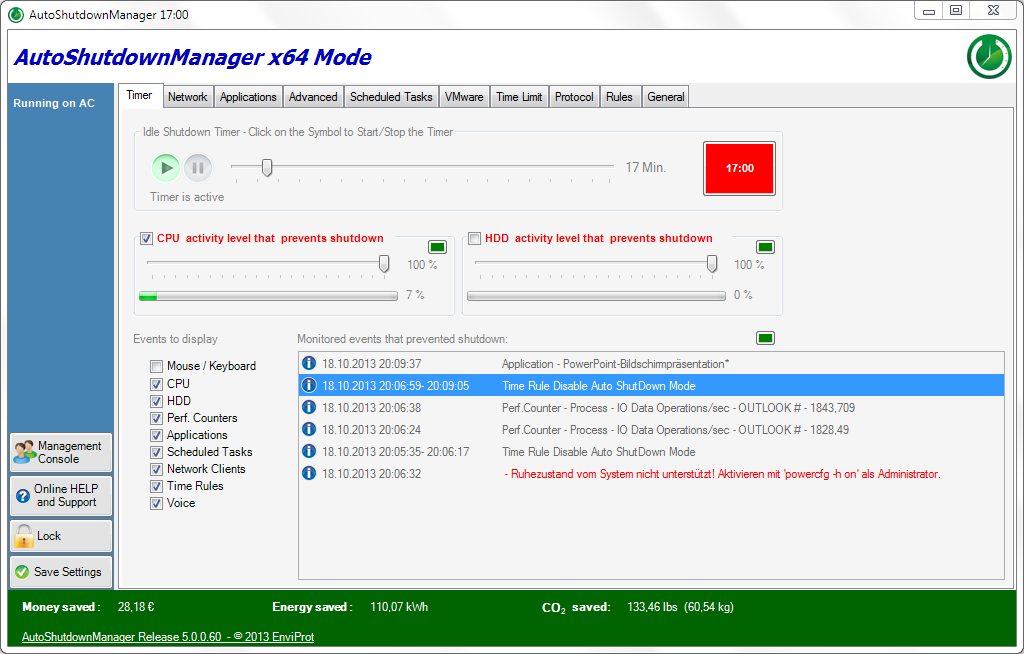
Give users a visible chance to understand what is about to happen where policy requires it.
Before shutdown, open documents can be saved automatically so idle shutdown does not become a lost-work event.
Protect productive tasks, maintenance work and endpoint groups that should not follow the default shutdown rule.
Multi-signal idle analysis
That is the difference an IT admin needs to see first. Windows power management is a useful baseline, but it is mainly built around direct PC interactivity. Auto Shutdown Manager by EnviProt can include a much wider set of user, application, system, network and environment signals before an endpoint is considered idle.
Typical Windows idle logic
Useful for basic power settings, but too narrow for many enterprise machines, classrooms, labs, kiosks, production environments and maintenance workflows.
ASDM idle analysis
ASDM can consider activity beyond mouse and keyboard input, so a PC is not treated as idle just because nobody is typing.
Mouse and keyboard activity, logged-on state and terminal sessions help distinguish absence from active or remote work.
Running applications, services, scheduled tasks, processes and their activity can prevent a false idle decision.
CPU load, HDD or disk utilization, memory usage and performance counters can show that the endpoint is still busy.
Network traffic, printer queues and TCP/IP-enabled devices such as machines, multimedia equipment or other endpoints can be part of the shutdown decision.
Where configured, microphone-based volume detection can delay shutdown during calls, presentations or meetings. ASDM measures volume level only; it does not record, store or process sound data.
Admin takeaway
The value is not only that ASDM can shut down idle PCs. The value is the broader decision before shutdown: users who work late, applications, performance, network dependencies, devices, sound level, time rules and document protection can all be considered where configured and validated.
Policy flow
After hours should not mean a hard cutoff. Time rules can define when idle shutdown is allowed to start working, but Auto Shutdown Manager by EnviProt can still respect users who continue working late, long downloads, active jobs, sessions or device dependencies. When useful work is finished and the endpoint is otherwise idle, documents can be saved and the configured power mode can be applied.
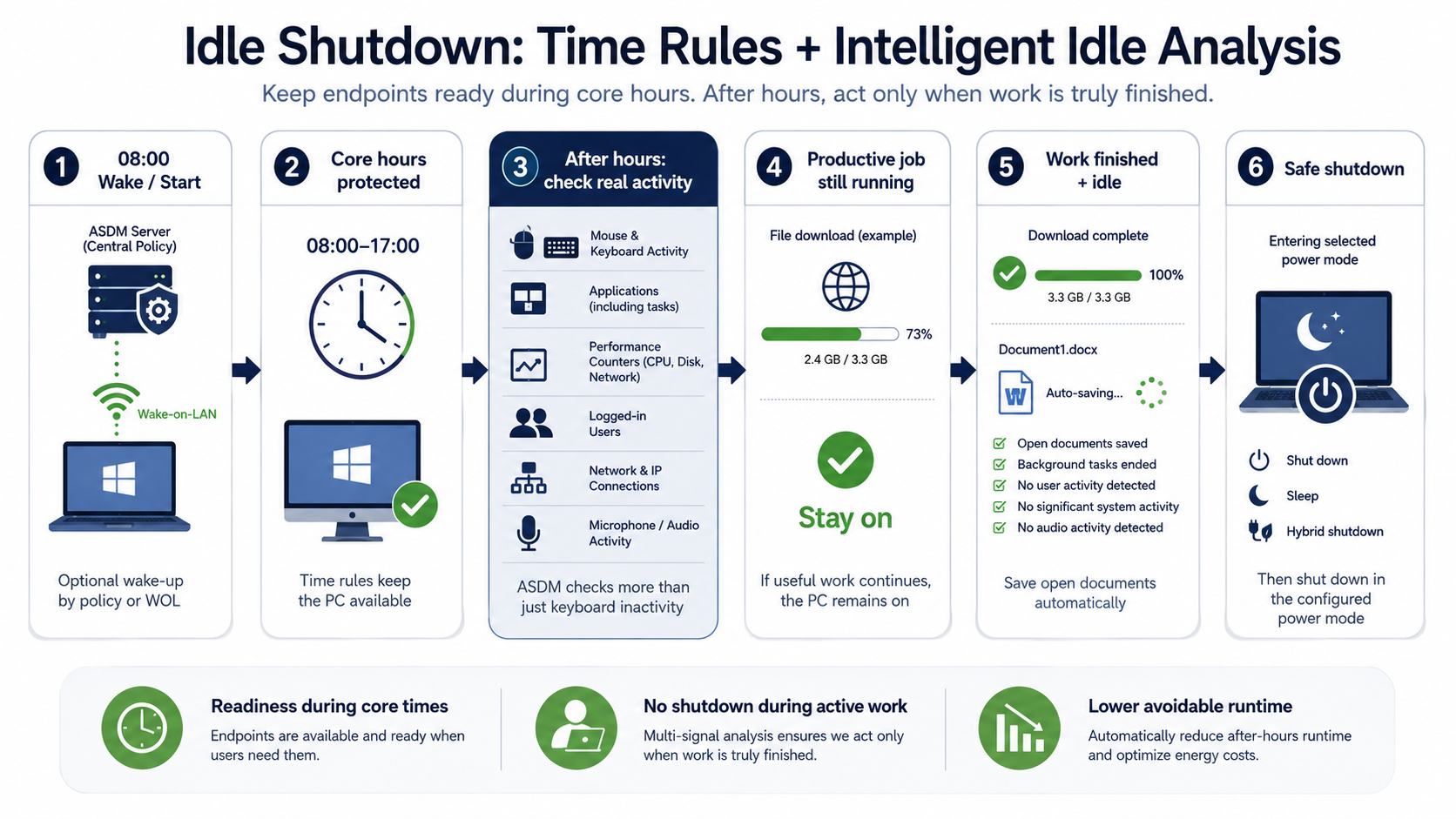
Why ASDM instead of a simple timer?
Fixed timers, operating-system defaults and scripts can help with parts of endpoint power management. Auto Shutdown Manager complements them with dedicated policies for context-aware shutdown decisions.
Shut down PCs that are no longer doing useful work.
Do not interrupt active work, late meetings, remote activity or leave open documents unprotected.
Backups, scans, queues and long-running tasks need protection.
Power savings should not break patching or planned IT work.
IT leaders need measurable savings, not guesswork.
Safe rollout path
Idle shutdown works best when IT begins with visible, controlled rules, validates user impact and expands only after the exceptions are understood.
Start with a department, site or endpoint group where work patterns and maintenance needs are well understood.
Check that productive tasks, scheduled work, remote access and user expectations are protected before scaling.
Roll out by group, site or organizational unit when runtime reduction is predictable and support impact is acceptable.
FAQ
Yes. Windows power management is useful for basic idle behavior, but ASDM can include a wider idle analysis: applications, services, performance counters, network activity, terminal sessions, printer queues, TCP/IP-enabled devices, time rules and optional volume-level detection. The exact policy should be configured and validated for the environment.
No. Fixed schedules can be useful, but the stronger approach is to combine schedules with idle detection and centrally defined exceptions. That is how power savings can coexist with real work patterns.
Auto Shutdown Manager can use signals such as processes, services, system load, network activity, sessions, printer queues and backup or scan activity as part of the idle decision. The exact policy should be validated in your environment.
No. Those tools can remain part of endpoint operations. ASDM adds idle shutdown, wake, maintenance and reporting controls.
Idle policies should reflect real work patterns. Productive time windows, endpoint groups, document-saving behavior and centrally managed rules can be used to avoid one-size-fits-all shutdown behavior.
Auto Shutdown Manager can save open documents automatically before shutdown. This should be part of a cautious rollout: define the policy, validate the behavior with real applications and make sure users understand what happens before broad deployment.
Start with a controlled pilot, choose conservative rules, validate user impact and only then expand by group, site or organizational unit.
Shut down safely. Wake reliably. Prove the savings.
Use Auto Shutdown Manager to reduce avoidable runtime without turning shutdown into a user disruption or a maintenance risk.
Auto Shutdown Manager · Remote Operations
Give administrators one central way to shut down, restart, log off, hibernate, sleep or wake managed PCs — from planned fleet operations to direct support intervention and controlled remote availability.
Operational fit
Enterprise power management fails when it is treated as a single Windows setting, a one-off Wake-on-LAN packet or a fragile script. IT needs an operating process that decides when a PC may safely power down, when it must be available again, and how this fits support, maintenance, remote access and savings goals.
These tools remain important for endpoint policy, deployment, compliance and administration. But they usually solve only parts of the power-state process: baseline settings, task execution, deployment timing or individual scripted actions.
ASDM adds the dedicated operating layer: safe shutdown rules, central remote actions, scheduled wake-up, Wake-on-LAN infrastructure, user self-service paths and reporting for energy, cost and CO₂ validation.
Central control
The main value is not managing one PC. The value is giving IT a simple central control point for endpoint availability across groups, sites, rooms, OUs, maintenance windows and support cases — without desk-by-desk work or undocumented one-off scripts.
Wake managed PCs before patching, inventory, backups or administrative checks so endpoint management tools can do their work.
Apply shutdown, restart, wake-up or logoff actions to selected groups, locations, departments, OUs or test sets from one managed workflow.
Use direct administrative actions when a specific endpoint must be restarted, logged off, powered down or woken for support or troubleshooting.
Keep machines available when required, but avoid the default habit of leaving entire fleets powered on overnight.
Wake selected office PCs for valid remote-access or maintenance scenarios without keeping entire fleets powered on permanently.
Connect power actions to central management, reporting and ROI validation instead of undocumented manual work.
Operations workflow
The goal is not to send more commands. The goal is to make endpoint power state predictable for users, IT operations, maintenance windows and energy-saving policies.

Wake-on-WAN Tool
The Wake-on-WAN Tool is the special path for cases where a remote source PC needs to ask the Auto Shutdown Manager Server to wake a registered client and keep it running as long as necessary.
The WoW request is sent to the ASDM Server. The final WOL-based wake command is sent from the server, not directly from the WoW client. The source PC and the target PC must both be valid ASDM clients of the server.
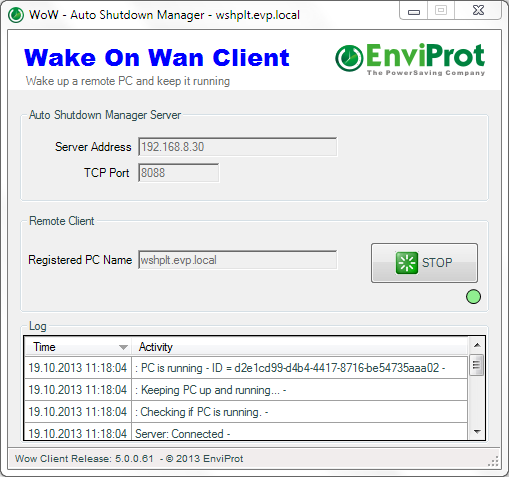
Choose by operational goal
Start from the operational goal and choose the ASDM capability that fits the situation: central admin control, routed wake-up, delegated self-service, special remote-client wake-up or savings validation.
Use remote operations for shutdown, restart, logoff, sleep, hibernate, wake-up, scheduled actions and support intervention.
Use the Wake-on-LAN infrastructure when the question is network delivery, WOL proxies, routed wake-up across VLANs, subnets or sites.
Use WOL Portals for regular user self-service when authorized users should wake assigned office PCs under policy.
Use the WoW Tool for specific remote-client scenarios such as home-office access to an office PC or temporary access to a rarely turned-on remote client.
Use the ROI Calculator when the question is business case, energy savings, cost savings and CO₂ estimate.
Validate shutdown behavior, wake reliability, maintenance windows and user exceptions in your own environment.
Availability first
Most organizations can imagine saving energy by turning PCs off. The harder part is doing it without disrupting users, maintenance, remote access or endpoint management. That is why ASDM combines shutdown rules, wake-up, portals, central management and reporting.
Use operating rules, schedules and exceptions so power-down is not just a blind command.
Wake systems for users, maintenance or IT operations where hardware and network conditions allow it.
Estimate and validate potential energy, cost and CO₂ savings instead of relying on assumptions.
Frequently asked questions
Short answers for IT teams evaluating ASDM as an operational complement to existing endpoint management.
No. Single-PC actions are useful for helpdesk and troubleshooting, but the main value is central control over groups, schedules, sites, OUs, maintenance preparation and operational policies.
Those tools remain important for endpoint management, deployment and baseline policy. ASDM adds the dedicated power-management layer: safe shutdown rules, scheduled wake-up, Wake-on-LAN infrastructure, portals and savings reporting.
ASDM should be configured with the organization’s operating rules: idle detection, user sessions, time rules, maintenance windows and exceptions. The objective is controlled shutdown, not blind power-off commands.
When a remote shutdown is executed, running applications are closed. ASDM can be configured to save open documents before shutdown as part of the shutdown workflow, subject to the application behavior and the configured policy.
Yes, where the organization deploys that workflow. For regular user self-service, ASDM WOL Portals are the preferred approach because access can be tied to assigned PCs and policy-controlled wake-up.
Use the WoW Tool for specific remote-client scenarios, such as home-office access to an assigned office PC, overnight maintenance of a display PC or another rarely turned-on client that must be available temporarily. The request goes through the ASDM Server.
Start with a limited pilot: one department, one room, one site or a defined test group. Validate shutdown behavior, wake reliability, maintenance windows, user exceptions and savings assumptions in your own environment.
Use the Enterprise trial to validate central remote operations, scheduled wake-up, WoW/WOL Portal scenarios and savings estimates with your own endpoint policies and network design.
Wake PCs and endpoints across local subnets, VLANs and remote locations without turning every router into a special-case configuration project. Auto Shutdown Manager combines scheduled wake-up, manual remote wake, WOL proxies and client-side reliability settings in one central power-management workflow.
Operational fit
For Wake-on-LAN to work reliably across larger routed networks, schedules, network topology, firewalls, and client configurations must be coordinated. Auto Shutdown Manager provides a central framework for these areas and supports controlled operations.
Architecture
Auto Shutdown Manager can wake endpoints from the central console while routing WOL traffic through the approach that fits the site: local broadcast, directed broadcast or a WOL proxy in the target network.
The proxy approach is especially useful where broadcast forwarding is restricted, undesirable or too expensive to maintain per router and per subnet.
Routing options
Different organizations handle broadcast traffic differently. Auto Shutdown Manager supports multiple WOL routing approaches so administrators can choose the method that matches their network and security policy.
Method A
Place an existing endpoint, server, virtual machine or small Linux relay device — for example a Raspberry Pi in a branch office or remote VLAN — in the target subnet and use it as the local WOL sender. The server communicates with the proxy, and the proxy sends the wake packet inside the local network segment. This avoids broadcast forwarding changes in many deployments.
Method B
For remote networks without an assigned WOL Proxy, Auto Shutdown Manager can use directed broadcasts automatically where the network and security policy allow routed broadcast forwarding. This normal directed-broadcast path does not require a manual Remote WOL Address / Port entry.
Where the network and security policy allow it, routers can be configured to forward controlled WOL traffic to a target broadcast address. Static ARP is only needed in special router topologies where a broadcast target must be mapped deliberately.
configure
set protocols static arp 192.168.20.254 hwaddr FF:FF:FF:FF:FF:FF
commit
saveSpecial-case override
Use a manual Remote WOL Address / Port entry only for special cases, for example when a router cannot forward remote broadcasts directly and the wake packet must be sent to a configured static-ARP or broadcast target.
For normal directed-broadcast routing, this manual override is not required. For multiple clients, apply remote WOL address and port settings in bulk only where the same special topology is shared.
Reliability
Wake-on-LAN depends on more than the server. Endpoint firmware, NIC driver settings, Windows Fast Startup, sleep or shutdown state and network policy can all affect whether a client wakes successfully.
Auto Shutdown Manager helps reduce these failures by managing supported client-side WOL settings centrally, including Wake on Magic Packet related settings and Windows Fast Startup handling where supported.
Use cases
Wake endpoints before planned maintenance, updates or software distribution windows.
Reach endpoints in distributed network segments using proxy or routed WOL approaches.
Prepare PCs before users arrive, then return them to power-saving policies afterwards.
Allow support workflows to bring managed devices online when intervention is needed.
Combine scheduled startup with shutdown policies to support predictable endpoint availability.
Provide controlled wake-up options through portal workflows where this is part of the deployment.
Frequently asked questions
Practical answers for IT teams planning Wake-on-LAN across VLANs, branch locations and managed endpoint environments.
No. A physical device is not required in every VLAN. Depending on your topology, you can use an existing endpoint, server, virtual machine or small Linux relay device in the target network segment. The important point is that the proxy can send the wake packet locally inside the subnet where the target PCs are located.
Directed broadcasts depend on network devices forwarding wake traffic toward a target subnet or broadcast address. A WOL proxy avoids that router-side broadcast dependency by placing a relay inside the target network segment. The better option depends on your routing design, security policy and operational preference.
Yes. Auto Shutdown Manager can use both approaches in the same environment. If a WOL proxy is configured for a remote network, wake requests can be routed through that proxy. For remote networks without a configured WOL proxy, ASDM can fall back to directed-broadcast or remote-WOL-address based wake-up routing according to the configured network settings and security policy.
Yes. A Raspberry Pi or another small Linux-based relay can be a practical option for branch offices, remote VLANs or locations where running a full server or virtual machine is not necessary. It should still be managed like any other infrastructure component: documented, monitored and placed in the correct target network segment.
Auto Shutdown Manager can support managed wake-up workflows around software deployment and maintenance windows. In environments using SCCM or Microsoft Configuration Manager, this helps align endpoint availability with scheduled updates, deployments and administrative tasks.
Managed endpoint availability
Use Auto Shutdown Manager to schedule, route and troubleshoot Wake-on-LAN from the same management environment used for endpoint power policies.