
 DE
DE  EN
EN Solutions · Public sector & education
Endpoint power management for schools, campuses and public-sector IT
Auto Shutdown Manager (ASDM) by EnviProt helps education and public-sector IT teams reduce avoidable PC runtime, keep classrooms and offices ready, wake devices for maintenance, and prove savings without building another script project.
Shut down safely. Wake reliably. Prove the savings.
The public-sector IT conflict
Devices should be off to save energy — but awake when students, staff and updates need them
In schools, universities, municipalities and public agencies, endpoint power management fails when shutdown, wake-up, maintenance and reporting are handled as separate tasks.
Classrooms and labs must be ready
Students and staff expect PCs to work at the start of the day. A pure “shut everything down” approach creates friction unless wake-up is managed reliably.
Patch nights collide with energy goals
Leaving PCs on just in case wastes energy. Turning them off without a wake strategy can break maintenance windows and increase manual IT work.
Campuses and sites are routed
VLANs, subnets, branch buildings and distributed campuses make basic Wake-on-LAN unreliable unless the wake path is designed for real networks.
Fast scan
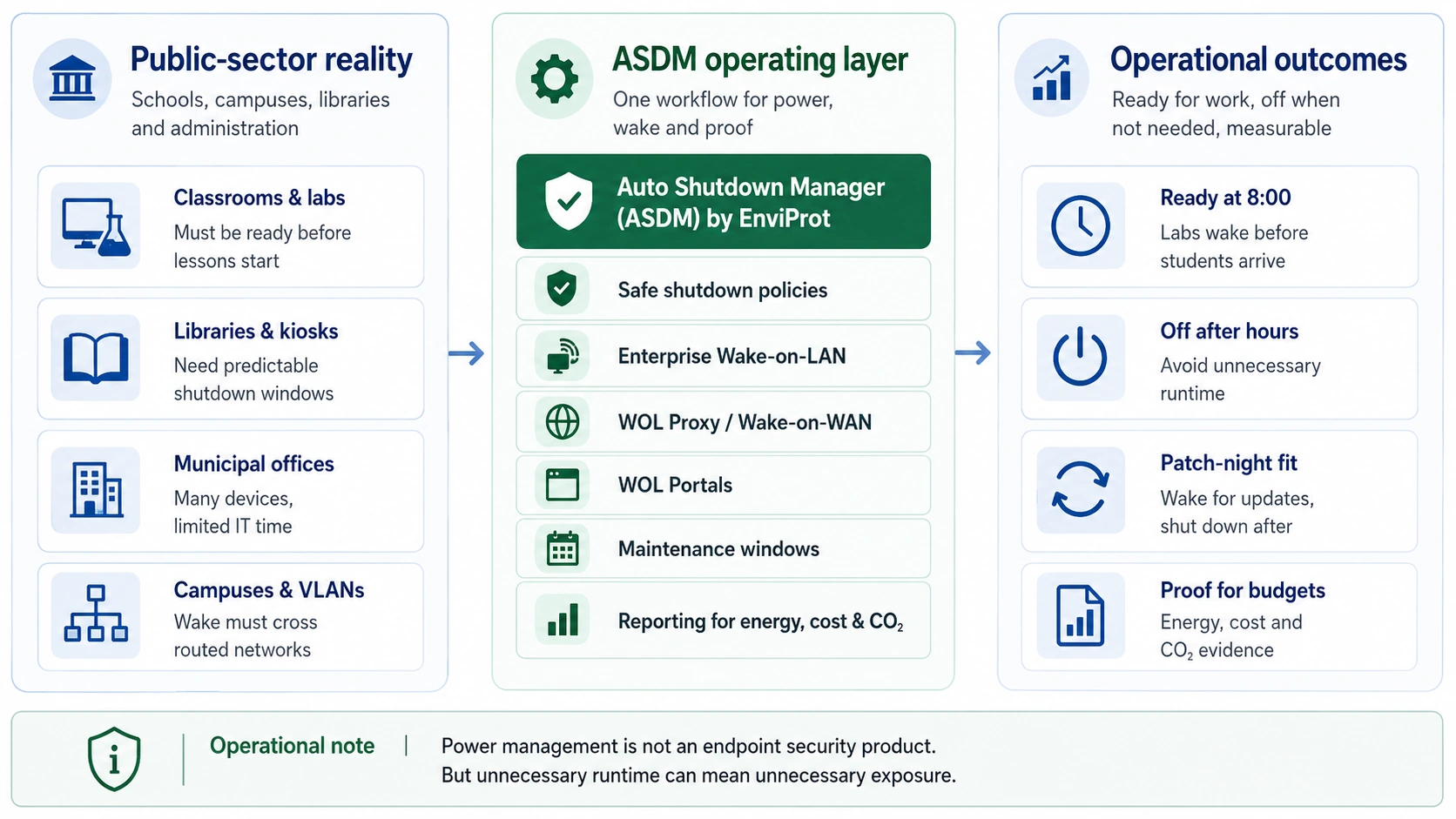
One operating layer for shutdown, wake, maintenance and proof
ASDM connects the daily power workflow around existing endpoint-management tools: Shut down safely. Wake reliably. Prove the savings.
ASDM answer
What ASDM adds to public-sector and education IT operations
Microsoft tools remain valuable. ASDM adds the dedicated endpoint power-and-wake layer that many environments otherwise try to build with scripts, scheduled tasks or manual procedures.
Safe shutdown policies
Shut down unused PCs with rules designed around real users, labs, libraries, shared devices and administrative workstations.
Enterprise Wake-on-LAN
Wake PCs before classes, office hours, patch windows or support sessions so systems are ready when needed.
WOL Proxy / Wake-on-WAN
Support wake-up across routed networks, VLANs and distributed sites where basic broadcast-based Wake-on-LAN is not enough.
WOL Portals and helpdesk wake
Give authorized users or support teams controlled ways to wake assigned PCs without opening broad admin access.
Maintenance-window readiness
Keep devices available for updates and other maintenance work, then return them to the intended power state afterwards.
Reporting, ROI and CO₂ proof
Provide evidence for IT leadership, budget discussions and sustainability reporting instead of relying on assumptions.
Microsoft fit
Complements SCCM/MECM, Intune and Group Policy — it does not replace them
Public-sector IT teams often already have mature Microsoft tooling. ASDM should sit next to that stack as the operational power-and-wake layer, not compete with it.
For SCCM / MECM maintenance
Use Configuration Manager for software deployment and updates. Use ASDM to help devices be awake for the operational window and powered down when the work is done.
For Intune, Group Policy and scripts
Keep policy and configuration management where it belongs. Use ASDM for the recurring power workflow: safe shutdown, reliable wake, portals and proof.
Where it fits
Built for shared devices, distributed sites and accountable IT budgets
The strongest public-sector case is not “turn PCs off.” It is controlled endpoint availability with measurable energy, cost and CO₂ evidence.
Schools and classrooms
Wake labs before lessons and shut down shared PCs after use, while keeping exceptions possible for exams, open days or after-hours work.
Universities and campuses
Coordinate labs, libraries, offices and distributed buildings across routed networks without relying on one-off local scripts.
Municipal and public administration
Reduce avoidable runtime across large PC fleets while preserving supportability, maintenance access and operational oversight.
Proof points
Historical education references — useful proof, not current guarantees
These references are intentionally framed as older proof points. They show that ASDM has been used in education and campus-like environments, but savings, licensing and rollout assumptions still need to be validated in the customer’s current environment.
Mesquite Independent School District
The MISD case study describes a school-district environment with 8,500 PCs across 47 campuses, including coordination with Microsoft SCCM for updates and central power control.
Open school district case studyUC Berkeley / LoCal project
An ENERGY STAR-published historical case reference describes ASDM in the UC Berkeley LoCal power monitoring and conservation project. Treat it as a campus research proof point, not as a current savings guarantee.
Open ENERGY STAR case referenceHerricks Union Free School District
The ASDM brochure describes a school-district classroom scenario where teacher workstations needed controlled logoff and shutdown behavior between classes.
Open ASDM brochureOsnabrück University of Applied Sciences
The ASDM brochure describes a higher-education deployment focused on saving energy, conserving resources and reducing cost without disrupting daily work.
Open ASDM brochureProcurement and proof
Pilot first, validate savings, then scale with evidence
Public-sector adoption needs a cautious path: evaluate in a representative environment, validate wake and shutdown behavior, and use reporting for budget and sustainability conversations.
Representative pilot
Start with a mix of labs, offices and distributed sites. Validate shutdown rules, wake reliability and maintenance-window behavior before broad rollout.
Download 45-Day Enterprise TrialDocumented education references
Use existing education references as proof material, then validate the operational and savings assumptions in your own environment.
Open school district case studyProcurement-ready evidence
Bring measured runtime, energy, cost and CO₂ evidence into budget discussions instead of selling a technical feature list alone.
Calculate ROISecurity guardrail
Unnecessary runtime can mean unnecessary exposure
ASDM is not an endpoint security product and does not replace patching, endpoint protection or hardening. But unnecessary runtime can mean unnecessary exposure. Public-sector PCs that do not need to run overnight or over weekends do not need to stay unnecessarily exposed either.
FAQ
Questions public-sector and education IT teams usually ask
Does ASDM replace SCCM/MECM, Intune or Group Policy?
No. ASDM complements those tools. SCCM/MECM, Intune and Group Policy remain responsible for configuration, policy and deployment. ASDM adds the dedicated workflow for safe shutdown, reliable wake, maintenance availability, WOL Portals and savings proof.
Can PCs still wake for patching and maintenance?
Yes. Devices can be planned around maintenance windows and then returned to the intended power state after the work is complete, where hardware and network conditions allow.
Can this work across campuses, VLANs and routed networks?
ASDM can use WOL Proxy and Wake-on-WAN concepts for environments where basic local broadcast wake-up is not enough. The exact design should be validated against your network topology.
Can helpdesk or remote users wake PCs?
WOL Portals can provide controlled wake options for authorized users or support staff, depending on how the environment is configured.
Will shutdown policies interrupt students or staff?
The goal is controlled shutdown, not blind shutdown. Rules should be piloted with representative users, device types and schedules so labs, libraries and offices remain usable.
Is this a security product?
No. Power management is not endpoint security. But reducing unnecessary runtime can reduce unnecessary exposure. Patch management, endpoint protection and hardening remain separate responsibilities.
How should a public-sector organization start?
Start with a 45-day trial in a representative pilot group. Validate wake reliability, user impact, reporting, ROI assumptions and maintenance-window behavior before scaling.
Are public-sector, education or non-profit terms available?
Current licensing and procurement terms should be confirmed directly with EnviProt. The page should not rely on old pricing assumptions without current proof.
Start controlled
Validate the power and wake workflow before scaling it across your institution
Run a focused trial, calculate the savings potential, and discuss licensing or rollout questions with Sales.